


Key Takeaways
- Audiense is worth paying for if you are a consumer brand, agency, or insight team running campaigns often enough to use audience data monthly, but hard to justify for small teams with only occasional questions.
- Audiense Online, the e-commerce tracking tool, starts at $225 a month and climbs to an Elite tier from $3,000, while the audience research products under Audiense Discover are quoted only after a sales call.
- Ratings back the platform’s core strength at 4.2 out of 5 on Capterra and 4.5 on G2, with reviewers praising segmentation depth but flagging a steep learning curve and data that leans heavily on public X activity.
- Audiense explains an audience in detail but does not create content for those people or place your brand where they will see it, so acting on the research is separate work with a separate cost.
- AmpiFire’s AmpCast AI complements audience research by creating 8 types of unique content around the topics your buyers search and automatically publishing it on 300+ sites where they already spend time.
Is Audiense Worth It?
Audiense earns its cost when audience research changes what you actually do. A brand that reallocates media budget, drops a sponsorship, or rewrites creative based on segment data recovers the fee quickly, because those decisions carry far more money than the subscription does. The same is true for agencies that bill research into client retainers, where one strategy deck can cover several months of platform access.
It stops being worth it in three situations. The first is low usage, since a tool priced for continuous work is poor value if you log in twice a year. The second is a small team without the time to learn it, given that reviewers consistently describe a demanding first few weeks. The third is a business with too little traffic or budget to act on what the data says.
There is also a ceiling on what any research platform can deliver. Audiense will tell you that your buyers listen to certain podcasts, follow certain creators, and read certain publications. Acting on that means producing content for those channels and getting it published there, which is separate work with a separate cost. Teams that buy the research without budgeting for the output tend to end up with excellent slides but flat traffic.
Instead of leaving audience insights in a strategy deck, AmpCast AI turns them into multi-format content based on what your target audience is already interested in and distributes it across hundreds of sites to generate long-term organic traffic.

How AmpiFire Works:
- Research & Target: Find high-demand topics your buyers search for.
- Create & Repurpose: AmpiFire’s AmpCast AI generates news articles, blog posts, interview podcasts, longer informational videos, reels/shorts, infographics, flipbooks/slideshows, and social posts.
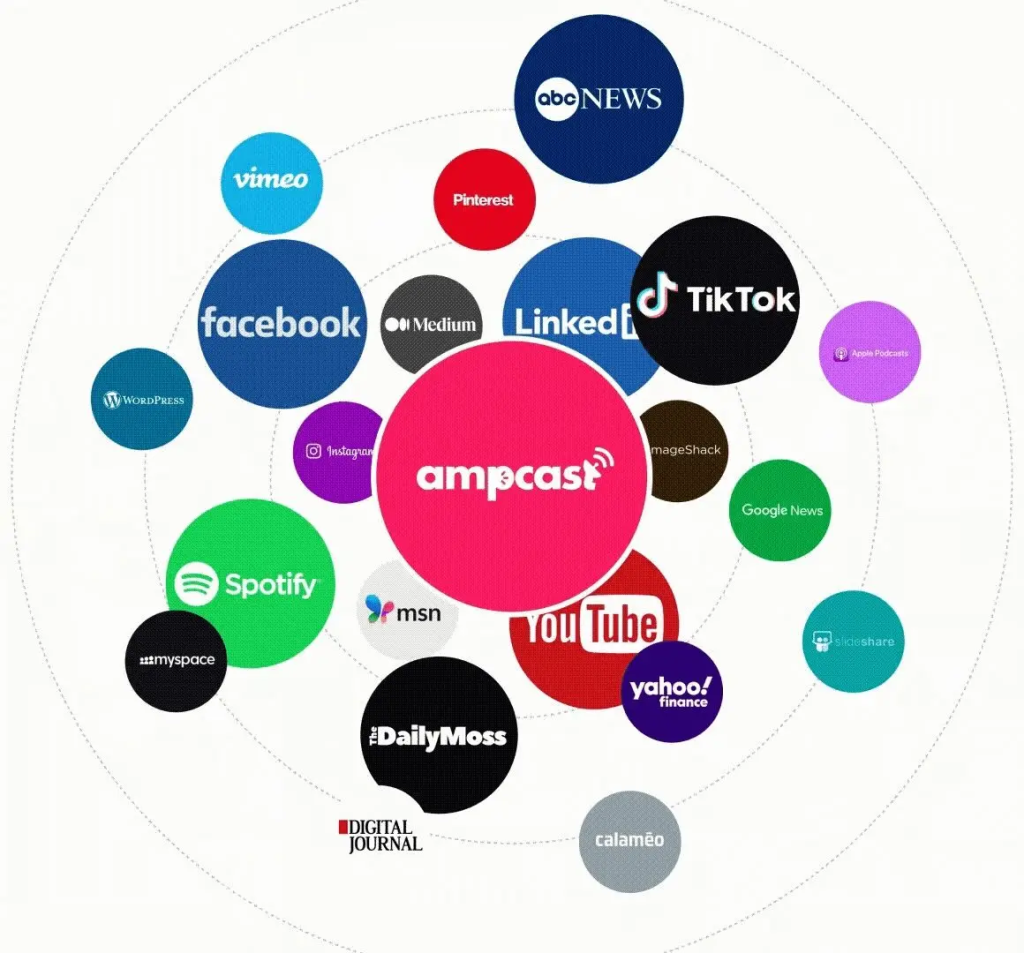
- Distribute & Amplify: Auto-publish to 300+ sites, including Google News, YouTube, Spotify, and major news networks.
Get more traffic from people who want to buy your stuff, and powerful “As Seen On” trust badges for your site.
Do It Yourself (with AI), Done For You Content, & 100% Managed Organic Growth options available.
Grow Your Free Traffic From Everywhere
What Does Audiense Do?
Audiense is an audience research company that launched in Spain in 2011 as SocialBro and later bought several other data companies, including Affinio, Soprism, and Tweet Binder. The business is now part of Buxton, a location analytics firm founded in 1994, which acquired Audiense in March 2025 and later adopted the Audiense name across the whole group. The platform reads public activity across networks including Instagram, X, Facebook, LinkedIn, and TikTok, then sorts people into groups based on shared interests, personality traits, media habits, and brand affinities.
Marketers use it to answer questions that surveys are too slow to handle. Which sub-groups exist inside our customer base? What podcasts do they listen to? Which creators do they already follow? Which competitor audiences overlap with ours?
Agencies, strategists, and insight teams turn those answers into campaign plans, influencer shortlists, and personas backed by data rather than guesswork.
Audiense Features by Product
Audiense reorganized its catalog into five products in 2026. The older names buyers may recognize, such as Insights, Connect, Demand, Affinio, and Soprism, now sit inside one product.
Audiense Discover: Audience Research
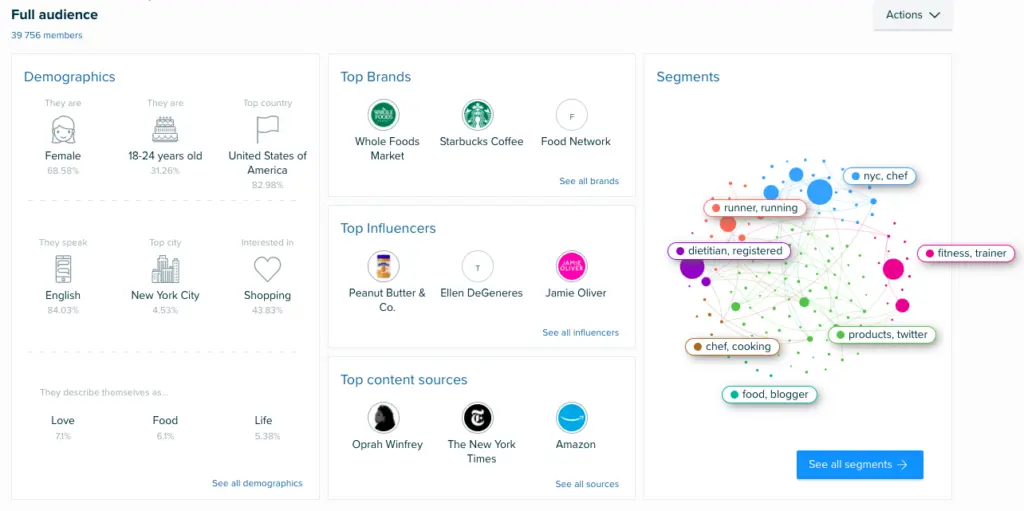
Discover is the main audience research product and the new home for the legacy Insights, Connect, Demand, Affinio, and Soprism tools. It builds audience segments using demographics, social activity, follower connections, shopping signals, psychographics, conversation topics, and brand affinities.
You can upload your own lists, including web traffic, newsletter subscribers, and CRM records, and Audiense will profile those specific people rather than a generic market sample. Outputs include segment breakdowns, persona ID cards, and targeting packs ready to hand to a media buyer. Audiense says the product draws on data patterns from 5.5 billion social accounts and 145 proprietary consumer segments.
Audiense Action: Campaign Planning
Action is an AI assistant for campaign planning. You describe a campaign idea and test it against audience data before spending money, checking which channels and creative directions match the people you want to reach.
Audiense Online: Conversion Tracking
Online is server-side conversion tracking for e-commerce stores, built on Elevar, which Buxton acquired in January 2024 before the combined group rebranded as Audiense. It captures purchase and behavior data that browser-based tracking misses, then pushes clean event data to advertising and analytics tools such as Meta, Google Ads, TikTok, GA4, and Klaviyo.
Audiense In-Person & Data Services
In-Person applies Buxton location intelligence to physical store planning and event strategy. Data Services pipes Audiense consumer data straight into your own systems so analytics teams can enrich existing customer records.
Audiense Pricing in 2026
Pricing splits into two very different buckets, and the gap between them explains most of the confusion buyers run into. One product has a published rate card while the rest sit behind a sales conversation.
Audiense Online Pricing: Published Monthly Rates
Audiense Online is the only product with prices listed on the website. Core, Advanced, and Premium include a 15-day free trial. Elite is arranged directly with the sales team.
- Core costs $225 per month and includes server-side tracking for Shopify stores, up to 2,000 orders per month, and up to two destinations.
- Advanced costs $650 per month and supports up to 10,000 orders per month, up to four destinations, and profit signals sent to ad platforms.
- Premium costs $1,250 per month and supports up to 30,000 orders per month, up to ten destinations, multi-storefront tracking, and API access for platforms beyond Shopify.
- Elite starts at $3,000 per month and supports up to 75,000 orders per month and up to 25 destinations, with pricing and setup arranged through the sales team.
Extra destinations cost $125 per month each. Order overages range from $0.50 per order on Core to $0.04 per order on Elite. Guided setup starts at a $1,000 one-time fee and increases to $4,500 for headless stores.
Audiense Discover Pricing: Quote Only
Audiense Discover, Action, In-Person, and Data Services all route through a free trial request followed by a sales call. Audiense does not publish a rate card for any of them, and the price you are given depends on seats, report volume, markets covered, and which data sources you need.
That makes budgeting harder than it should be. Ask the sales team three things before you commit: how many audience reports your plan covers per year, how many seats are included, and what an extra report or seat costs once you pass the limit.
Audiense Customer Reviews
Audiense sits at 4.5 out of 5 on G2 and 4.2 out of 5 on Capterra. Capterra breaks its score down further, rating features highest at 4.6, ease of use at 4.3, value for money at 4.0, and customer service lowest at 3.9.
Positive Feedback
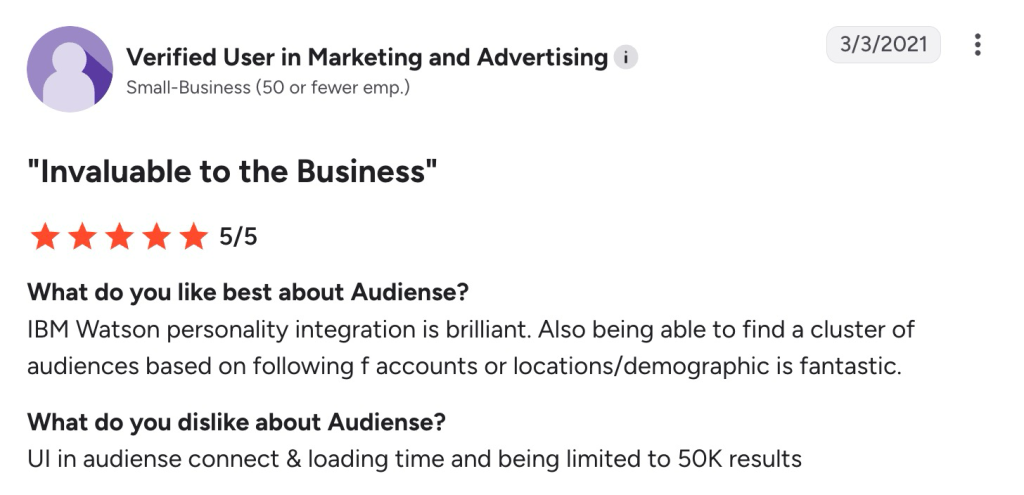
G2 reviewers most often praise the depth of audience insight and the sharper targeting it produces.
Several describe building segments around people who engage with a brand online rather than only past purchasers, then learning which shows, podcasts, and influencers those groups follow. Others highlight how quickly the data comes back and how personality profiling helps shape tone of voice.
Negative Feedback
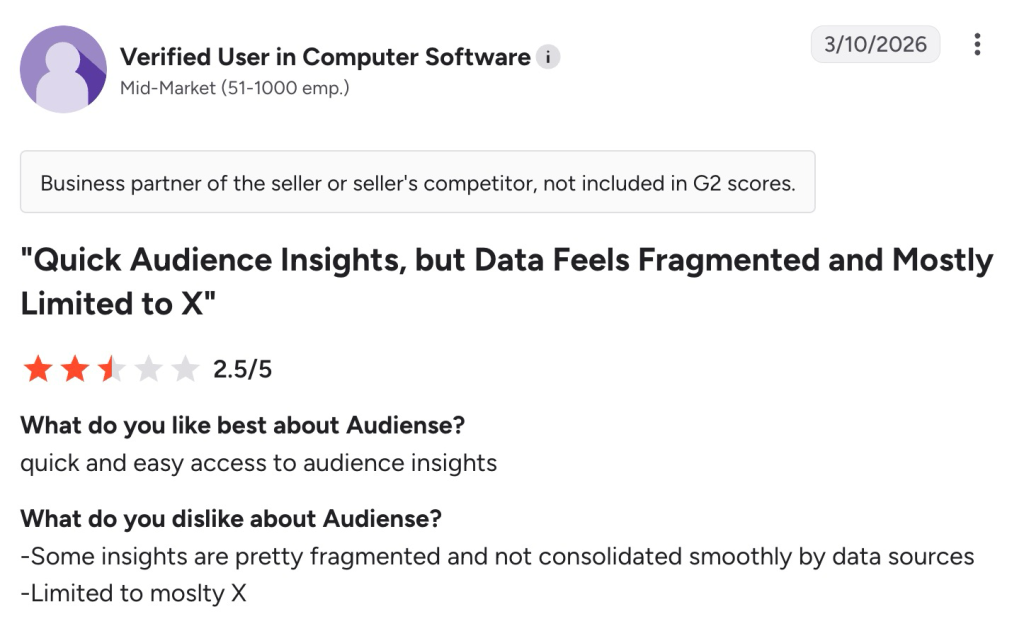
Data consistency draws the most repeated criticism on G2. Coverage varies by channel and reports lean heavily on public X activity, which reviewers say makes some profiles less representative than they need.
Requests for better data integration and more flexible audience search come up repeatedly, alongside a steep learning curve caused by feature density and slow audience building for ad targeting.
Both platforms tell the same story. Teams using Audiense regularly rate it highly, while occasional users on tighter budgets find the learning time and the data gaps harder to accept.
AmpiFire Puts Audiense’s Audience Insights to Work
Audience intelligence gives you a map. It shows the podcasts your buyers listen to, the videos they watch, the publications they trust, and the topics they search before spending money. What the map cannot do is put your brand in any of those places, and that gap is where most audience research quietly stops paying off.
At AmpiFire, we do the publishing side of that work. We research the topics your buyers search for before they purchase, then our AmpCast AI turns each topic into 8 content formats: news articles, blog posts, interview podcasts, longer informational videos, reels/shorts, infographics, flipbooks/slideshows, and social posts. Our platform publishes all of it automatically across 300+ sites, including LinkedIn, YouTube, Spotify, Pinterest, Google News, and FOX affiliate sites, so the audience Audiense describes has something of yours to find on the channels they already use. If you want research turned into traffic, try AmpiFire today.
Frequently Asked Questions (FAQs)
Does Audiense have a free plan?
Audiense provides a free trial across its products, requested through the website, though the standalone X Marketing tool no longer appears in Audiense’s product line-up, and its former pricing page now redirects to Audiense Discover. Full access to the audience research products requires a paid subscription arranged with the sales team.
What data sources does Audiense use?
Audiense analyses public social data patterns from platforms including Instagram, X, Facebook, LinkedIn, TikTok, Google, and YouTube. Customers can also upload first-party data such as web traffic, newsletter lists, and CRM records to profile their own contacts instead of a general market sample.
Can Audiense analyze my own customer list?
Yes. Customers can upload owned data such as website traffic, newsletter subscribers, and CRM records, and Audiense will build segments from those specific people rather than a general market sample. That makes the findings far more relevant to an existing customer base.
Is Audiense the same as a social listening tool?
No. Social listening tracks what people say about a brand. Audiense profiles who those people are, covering their interests, personalities, media habits, and connections. Many teams run both, using listening for conversation monitoring and Audiense for audience structure.
How does AmpiFire differ from an audience intelligence platform?
Audiense researches audiences and hands you the findings. AmpiFire acts on findings like those. We research the topics your buyers search for before purchase, produce multi-format content around them, and publish it on the search, social, video, and podcast channels those buyers already use.
*Disclaimer: Results may vary based on individual circumstances, business type, and content strategy. The time savings and outcomes mentioned are based on typical user experiences and are not guaranteed. For specific pricing and service details, please visit AmpiFire.
Author
Related Posts


Brandwatch Features, Pricing & Reviews: Is This Social Media Management & Consumer Intelligence Platform Worth It?
Learn about Brandwatch's features, pricing tiers, and G2 reviews, plus how AmpiFire builds the brand mentions and content presence that…


Similarweb Pricing, Reviews & Features: Is This Digital Intelligence Platform Worth It?
Similarweb pricing starts at $129/month, or $99/month billed annually. Compare self-serve tiers, enterprise packages, user ratings, and hidden costs in…


Social Champ Reviews, Pricing & Features: Is This Social Media Management Tool Worth It?
Get honest Social Champ reviews. Learn pricing, features, and if this social media management tool is worth your investment for…

Taggbox Pricing, Features & Reviews: Is This Social Media Widget Worth It?
Discover Taggbox pricing, features, and reviews to determine if this social media widget is worth your investment. Find the right…

VideoCreator Reviews, Features & Price: Is This Social Media Video Software Worth It?
Discover if VideoCreator social media video software is worth it with our review covering features, pricing, templates, and motion tracking…


Woorise Pricing & Reviews: Is This Interactive Lead Generation Platform Worth It?
Find out whether Woorise is worth it in our review of its pricing, giveaway builder, and real user feedback, and…