
Key Takeaways
- A content marketing funnel is a step-by-step system that guides people from first discovering a problem to making a final purchase decision, using content matched to their level of intent at every step of the way.
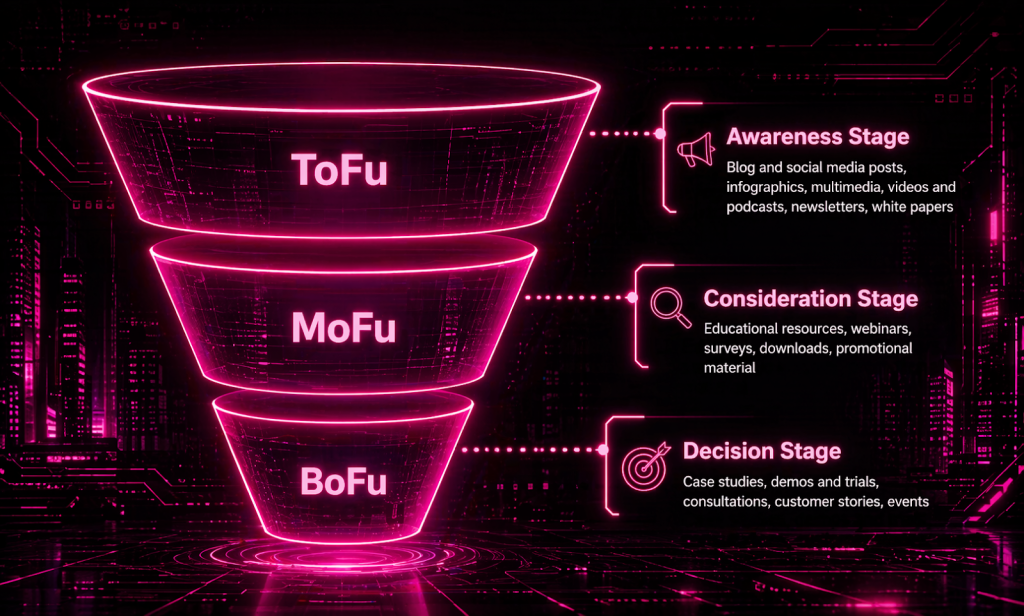
- The funnel has three stages: Top of Funnel (ToFu) creates awareness through educational content, Middle of Funnel (MoFu) builds trust as people compare options, and Bottom of Funnel (BoFu) drives conversions by removing final doubts.
- Each stage uses different content types and metrics: ToFu uses blog posts, short-form videos, and infographics to grow reach, MoFu uses webinars, case studies, and comparison guides to grow engagement, and BoFu uses demos, testimonials, and pricing pages to grow conversions.
- Real examples include skincare brands teaching “what does retinol do” at ToFu, SaaS companies running nurture webinars at MoFu, and digital agencies closing deals with free audits and case studies at BoFu.
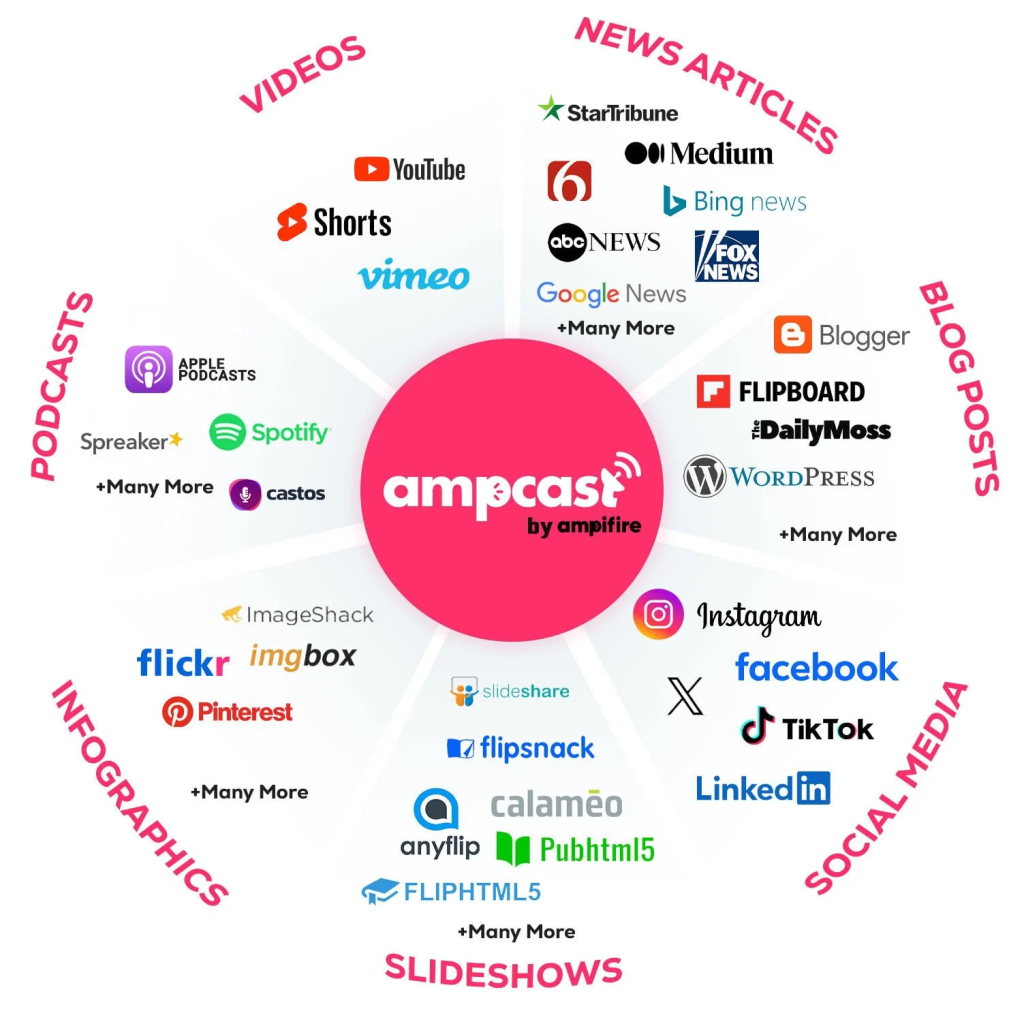
- AmpiFire’s AmpCast AI turns one topic into 8 content formats (blog posts, videos, reels/shorts, podcasts, infographics, slideshows, news articles, and social posts) and publishes them across 300+ platforms like YouTube, Spotify, Pinterest, and Google News, so your content covers every funnel stage at once.
What is a Content Marketing Funnel?
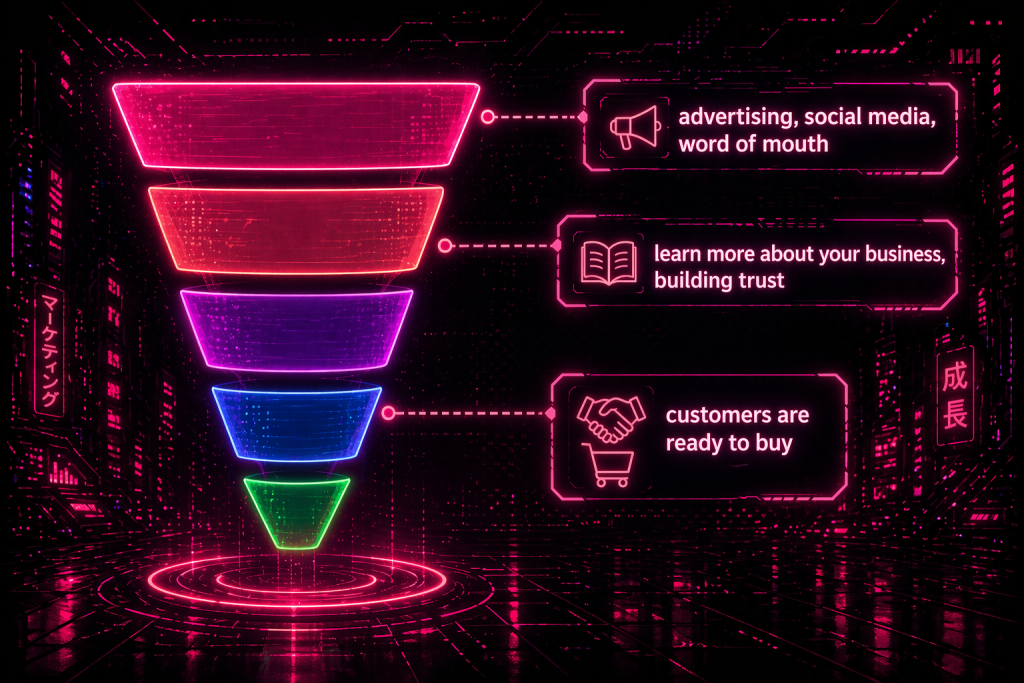
Before anyone buys, they move through three mental stages: realizing they have a problem, looking at their options, and choosing a solution. These stages line up directly with the three parts of a content marketing funnel, known as ToFu (Top of Funnel), MoFu (Middle of Funnel), and BoFu (Bottom of Funnel).
At ToFu, a skincare brand might publish a blog post like “what does retinol do?” to attract strangers. At MoFu, a SaaS company might run webinars and send nurture emails to help people compare solutions. At BoFu, a digital agency might offer free audits and share client case studies to close the sale.
Getting the right content in front of the right person at the right stage is what separates funnels that grow revenue from funnels that leak leads, and below, we break down exactly what belongs at each stage and how to make it work.

How AmpiFire Works:
- Research & Target: Find high-demand topics your buyers search for.
- Create & Repurpose: AmpiFire’s AmpCast AI generates news articles, blog posts, interview podcasts, longer informational videos, reels/shorts, infographics, flipbooks/slideshows, and social posts.
- Distribute & Amplify: Auto-publish to 300+ sites, including Google News, YouTube, Spotify, and major news networks.
Get more traffic from people who want to buy your stuff, and powerful “As Seen On” trust badges for your site.
Do It Yourself (with AI), Done For You Content, & 100% Managed Organic Growth options available.
Grow Your Free Traffic From Everywhere
Top of Funnel (ToFu): Awareness Stage
ToFu is the entry point of the funnel, where people first become aware of a problem or need. This is where broad, educational content attracts new audiences and introduces them to your brand.
At this stage, people are not ready to buy. They are still trying to understand their situation, searching for answers, and consuming general content that helps them make sense of their problem. Your role here is to educate and build trust, not to sell.
What You’re Trying to Do at ToFu
The main goal at ToFu is to attract the right audience and position your brand as a helpful, reliable source of information. You are simply trying to get noticed and start the relationship. Most people at this stage are not qualified leads yet, and that is completely normal.
Who’s in the ToFu Stage
Your audience is problem-aware but not solution-aware. They understand something is wrong or could be improved, but they don’t yet know what to do about it. They find content through search engines, social media, and video platforms while exploring general educational topics.
Content That Generates Awareness at ToFu
The most effective ToFu content focuses on education and awareness. Optimized blog posts targeting informational keywords work especially well because they capture long-term search traffic.
Short-form videos on platforms like TikTok, Instagram Reels, and YouTube Shorts also play a major role in modern awareness. Alongside these, infographics, podcast episodes, guest posts, YouTube explainers, and educational social posts all help expand reach and visibility.
Key ToFu Performance Metrics
Success here is not about conversions. It is about visibility and reach. Metrics like organic traffic, impressions, new visitors, time on page, bounce rate, and social shares tell you if your content is being found and consumed.
Real-World ToFu Example
For example, a skincare brand may publish content around “what does retinol do” instead of running ads. This type of educational content attracts thousands of visitors who are interested in skincare but unfamiliar with the brand. Over time, these visitors naturally move into email lists, retargeting campaigns, or deeper MoFu content.
Middle of Funnel (MoFu): Consideration Stage
MoFu is where awareness turns into evaluation. At this point, people already understand their problem and are actively comparing solutions. This is the stage where strong content can significantly increase trust, while weak content can cause leads to drop off.
What You’re Trying to Do at MoFu
The goal here is to educate deeper and clearly differentiate your brand. Prospects are no longer looking for general information; they want proof, clarity, and reasons to trust one solution over another.
Who’s in the MoFu Stage
These are engaged users who have already interacted with your ToFu content. They are now researching options, comparing providers, reading reviews, and trying to make informed decisions.
Content That Builds Trust at MoFu
MoFu content goes deeper and becomes more specific. Case studies, whitepapers, webinars, product demos, comparison guides, email nurture sequences, and gated resources all work well because they help prospects evaluate your solution more seriously. The key is consistency; one piece of content rarely converts alone, but a sequence of touchpoints builds trust over time.
Key MoFu Performance Metrics
At this stage, engagement matters more than reach. You measure success through email click-through rates, content downloads, webinar attendance, lead qualification rates, and overall engagement across your nurture flows.
Real-World MoFu Example
A SaaS company might start with free MoFu templates and then guide users through structured emails, webinars, and comparison content. Each step builds more trust, helping the prospect gradually move closer to a buying decision.
Bottom of Funnel (BoFu): Decision Stage
BoFu is the final stage of the funnel where prospects are ready to make a decision. They already understand their problem and have compared solutions, so now they are looking for confirmation that they are making the right choice.
At this point, content must remove friction, reduce doubt, and reinforce confidence in the decision.
What You’re Trying to Do at BoFu
The goal is conversion. You are turning high-intent leads into paying customers by addressing final objections and making the choice as clear and easy as possible.
Who’s in the BoFu Stage
These are decision-ready leads who are comparing pricing, features, reviews, and competitors. They are very close to taking action, but may still have small concerns or hesitations.
Content That Drives Conversions at BoFu
BoFu content is highly specific and action-oriented. Case studies with real results, product demos, pricing pages, testimonials, ROI calculators, competitor comparisons, free trials, and consultations all help remove uncertainty. At this stage, clarity, proof, and confidence replace education as the priority.
Key BoFu Performance Metrics
Success at BoFu is measured by conversions and revenue impact. Key metrics include conversion rate, sales-qualified leads, deal close rate, average deal size, sales cycle length, and customer acquisition cost.
Real-World BoFu Example
A digital agency might use detailed case studies, free audits, and consultation calls to close deals. Prospects see real, relevant results, experience the agency’s thinking firsthand, and convert faster because most of their doubts have already been addressed.
How AmpiFire Helps You Build a Complete Content Marketing Funnel
The most effective way to build a content marketing funnel is to consistently create the right content for each stage. ToFu earns attention, MoFu earns trust, and BoFu earns the sale, and skipping any one of them is where most leads quietly slip away.
With AmpiFire’s AmpCast AI platform, we turn one topic into 8 different content formats (e.g., news articles, blog posts, social posts, reels/shorts, longer informational videos, infographics, flipbooks/slideshows, and interview podcasts) and distribute them across 300+ platforms like YouTube, Spotify, Pinterest, Google News, and more. Learn how to use AmpCast AI to ensure your content reaches people at every stage of their journey, across all the places they spend time.
Frequently Asked Questions (FAQs)
What is the difference between ToFu, MoFu, and BoFu content?
ToFu, MoFu, and BoFu are the three funnel stages, each based on how ready a user is to take action. ToFu focuses on attracting and educating new audiences who are just realizing a problem. MoFu helps users compare and evaluate solutions in more detail. BoFu supports final decision-making and encourages conversion.
How many pieces of content do I need for each funnel stage?
There’s no fixed number, but most funnels include more content at ToFu, a moderate set at MoFu, and fewer but stronger assets at BoFu. The goal is to ensure each stage answers user questions and guides them forward. Focus on balance and quality rather than hitting a strict content count.
Can small businesses use a content marketing funnel effectively?
Yes, small businesses can use funnels very effectively because they help organize content and focus efforts. Even a simple setup with awareness, nurturing, and conversion content can guide users from awareness to purchase. It’s a practical way to grow without needing large budgets.
What metrics should I track at each stage of the content funnel?
At ToFu, focus on visibility and reach, at MoFu on engagement and lead quality, and at BoFu on conversions and sales performance. Together, these metrics show how smoothly users move through the funnel. Tracking all stages helps you understand where improvements are needed.
How long before a content funnel drives traffic?
Results depend on the stage, so some BoFu content can convert quickly, while ToFu content takes longer to build momentum. Over time, consistent content across all stages creates stronger results as everything compounds. That’s why AmpiFire’s AmpCast AI helps by creating content for every funnel stage at once and distributing it across 300+ platforms, so your funnel builds momentum faster and keeps working long-term.
*Disclaimer: Results may vary based on individual circumstances, business type, and content strategy. The time savings and outcomes mentioned are based on typical user experiences and are not guaranteed. For specific pricing and service details, please visit AmpiFire.
Author
Related Posts


Use The Buyer’s Journey 4 Stages to Get More Traffic & Sales
The Purchase Funnel is a useful way to conceptualize the transition from people who aren’t interested in your product or…

OfferLab by Russell Brunson: Is This Collaborative Funnel Building Platform Legit?
Is OfferLab legit? Read the complete review of Russell Brunson's collaborative marketplace for creators and affiliates to build profitable joint…

The Best B.S. Ad Funnel I Ever Saw [Deconstructed]
I’ve been marketing online for 15+ years. Thought I’d seen every sneaky tactic. Every dirty trick. But even I still…
Convertri Features & Price: Is It The Fastest Funnel Building Tool In 2026?
Explore Convertri's features and pricing to see if it's the fastest funnel-building tool in 2024 for boosting your online business…

Inbound vs Outbound Marketing for B2B Companies: Differences & Examples
Compare inbound vs outbound B2B marketing, learn key differences, and see how AmpiFire amplifies results with multi-platform content and organic…

Organic vs Paid Social Media Marketing for Reach: Differences & Examples
Organic vs paid social media marketing differ in cost, speed, and control. Learn how to use both together and how…