


Key Takeaways
- HubSpot targets small to mid-sized businesses with intuitive tools, while Marketo serves enterprises needing deep customization and complex automation.
- HubSpot offers rapid setup within days, whereas Marketo requires months of technical implementation and dedicated marketing operations expertise to manage.
- HubSpot includes a fully integrated CRM, while Marketo excels when paired with external enterprise-level systems like Salesforce for advanced lead management.
- Successful marketing requires pairing automation with broad content distribution to ensure a steady stream of organic leads enters the sales funnel.
- AmpiFire’s AmpCast AI complements either tool by handling content creation and distribution, turning a single topic into 8 formats and automatically publishing across 300+ sites to drive organic traffic.
HubSpot vs Marketo: The Critical Differences That Matter
HubSpot and Marketo Engage lead the industry in marketing automation, but they serve distinct business needs. HubSpot is an all-in-one CRM and marketing suite designed for ease of use, making it the primary choice for small to mid-market companies that need to launch campaigns quickly. In contrast, Marketo (now part of the Adobe Experience Cloud) is a highly specialized enterprise solution built for complex lead scoring, deep customization, and integration with external CRMs like Salesforce.
The choice between the two often depends on technical resources and existing infrastructure. HubSpot offers a user-friendly interface and tiered pricing that starts around $15–$20 per month for basic tools, allowing for implementation in just a few days. Marketo requires dedicated marketing operations expertise and months of setup time, but it provides superior multi-touch attribution and global governance for large-scale organizations with established technology ecosystems.

How AmpiFire Works:
- Research & Target: Find high-demand topics your buyers search for.
- Create & Repurpose: AmpiFire’s AmpCast AI generates news articles, blog posts, interview podcasts, longer informational videos, reels/shorts, infographics, flipbooks/slideshows, and social posts.
- Distribute & Amplify: Auto-publish to 300+ sites, including Google News, YouTube, Spotify, and major news networks.
Get more traffic from people who want to buy your stuff, and powerful “As Seen On” trust badges for your site.
Do It Yourself (with AI), Done For You Content, & 100% Managed Organic Growth options available.
Grow Your Free Traffic From Everywhere
HubSpot: The All-in-One Marketing Platform
Core Features & Capabilities
HubSpot’s Marketing Hub includes a comprehensive set of tools designed to support the full marketing funnel. Email marketing capabilities allow for personalized communication at scale, with drag-and-drop editors and smart sending features that optimize delivery timing.
Landing page and form builders let you create conversion-focused assets quickly, without needing design or development resources. The platform’s SEO tools offer actionable recommendations to improve content visibility, while social media management features enable teams to schedule, publish, and monitor engagement across channels.
HubSpot’s automation tools have become increasingly sophisticated, enabling the creation of complex workflows based on triggers, conditions, and actions. The platform’s recent AI enhancements include content generation assistance, predictive lead scoring, and conversation intelligence—making advanced capabilities accessible to marketing teams of all sizes.
Pricing Structure
HubSpot employs a tiered pricing model that scales with business needs, offering Starter, Professional, and Enterprise levels for its Marketing Hub. The Starter package provides basic email marketing and ad management features ideal for small businesses just beginning their marketing automation journey.
The professional tier unlocks advanced capabilities, including A/B testing, custom reporting, and sophisticated automation workflows. The Enterprise level delivers the full suite of features, including advanced permissions, adaptive testing, and predictive lead scoring.
User Experience & Interface
HubSpot’s interface is widely recognized as one of the most intuitive in the marketing automation space, featuring a clean, modern design, logical navigation, and contextual help. The platform emphasizes visual builders for workflows, emails, and landing pages, reducing the learning curve for new users and enabling marketers without technical backgrounds to create sophisticated campaigns.
HubSpot’s mobile app extends this user-friendly approach, allowing marketers to monitor performance metrics, receive notifications, and manage basic tasks on the go.
Marketo: Advanced Automation for Enterprise
Core Features & Capabilities
Marketo’s feature set encompasses advanced lead management, email marketing, account-based marketing, and revenue attribution capabilities designed for enterprise complexity. Its lead scoring system supports intricate behavioral and demographic scoring models that can adapt by product line, business unit, or market segment.
Marketo truly differentiates itself by supporting complex organizational structures. Features like Workspaces and Partitions allow global enterprises to manage distinct marketing operations across regions or business units while maintaining centralized control and governance.
The platform’s Revenue Cycle Analytics provides sophisticated multi-touch attribution and pipeline analysis, connecting marketing activities directly to revenue outcomes with modeling capabilities that surpass what’s available in HubSpot without third-party additions.
Pricing Structure
Marketo’s pricing structure is less transparent than HubSpot’s, with costs typically starting in the thousands of dollars for the Growth or Select editions and increasing substantially for the Prime, Ultimate, and Ultimate editions.
The platform uses a combination of database size and feature accessibility to determine pricing, with significant jumps between tiers to access advanced capabilities such as revenue attribution, predictive content, and account-based marketing.
Additional costs often include implementation services and potentially required add-ons such as Marketo Sales Connect or advanced analytics packages.
Learning Curve & Implementation
Marketo has a steeper learning curve than HubSpot, requiring dedicated resources and specialized expertise to implement and maintain effectively. Implementation timelines typically range from 1–3 months for standard deployments to 6+ months for complex enterprise integrations with extensive customization and data migration needs.
The platform’s power comes with complexity, as users must navigate a more technical interface with concepts such as tokens, snippets, and program statuses that require training to master.
HubSpot vs Marketo: Side-by-Side Comparison
| Feature | HubSpot | Marketo |
| Best For | Small to mid-sized businesses | Enterprise organizations |
| Built-in CRM | Yes, fully integrated | No — pairs with external CRMs like Salesforce |
| Ease of Use | Intuitive, drag-and-drop interface | Steeper learning curve, more technical |
| Implementation Time | Days | 1–3 months (up to 6+ for complex setups) |
| Pricing Tiers | Starter, Professional, Enterprise | Select, Prime, Ultimate, Enterprise |
| Lead Scoring | Predictive lead scoring (Enterprise tier) | Advanced behavioral and demographic scoring across segments |
| Multi-Touch Attribution | Limited without third-party tools | Built-in Revenue Cycle Analytics |
| Account-Based Marketing | Available | Advanced, enterprise-grade |
| AI Capabilities | Content generation, predictive scoring, and conversation intelligence | Sophisticated data analytics, predictive content |
| Multi-Region/Business Unit Support | Basic | Workspaces and Partitions for centralized governance |
| Mobile App | Yes | Limited |
| Technical Expertise Required | Low | Highly dedicated marketing ops team recommended |
| Ideal User | Marketers without technical backgrounds | Marketing operations specialists |
Why Marketing Automation Alone Won’t Fill Your Pipeline
Automation Without Traffic Is an Empty Engine
The most sophisticated workflows in HubSpot or Marketo are only as effective as the volume and quality of leads entering them. Both platforms excel at managing contacts once they arrive, but neither creates the content or distribution needed to attract them organically.
Without a steady flow of new visitors discovering your brand, even the best automation setup sits underutilized, nurturing a shallow pipeline rather than a full one.
Multi-Channel Content Distribution: The Solution
The solution? Publish your brand across the channels your buyers already use, consistently and at scale. Content distributed to high-authority sites across search, video, audio, and social platforms feeds your HubSpot or Marketo workflows with a steady stream of organic leads that already trust your brand.
Each piece continues to attract visitors month after month, creating a compounding effect that grows your pipeline without increasing your workload. Platforms like AmpiFire’s AmpCast do this by turning one topic into 8 content formats and publishing them across 300+ sites — delivering broader reach at a fraction of the cost of an in-house team or a traditional agency.
Amplify Your Marketing Automation With AmpiFire
AmpiFire’s AmpCast AI transforms a single topic into 8 content formats: news articles, social posts, reels/shorts, infographics, interview podcasts, flipbooks/slideshows, blog posts, and longer informational videos. It then publishes them across 300+ high-authority sites, including Google News, YouTube, Spotify, and FOX affiliates.
This matters because buyers who encounter your brand across multiple trusted platforms before entering your email sequence convert at higher rates, since credibility is already established.
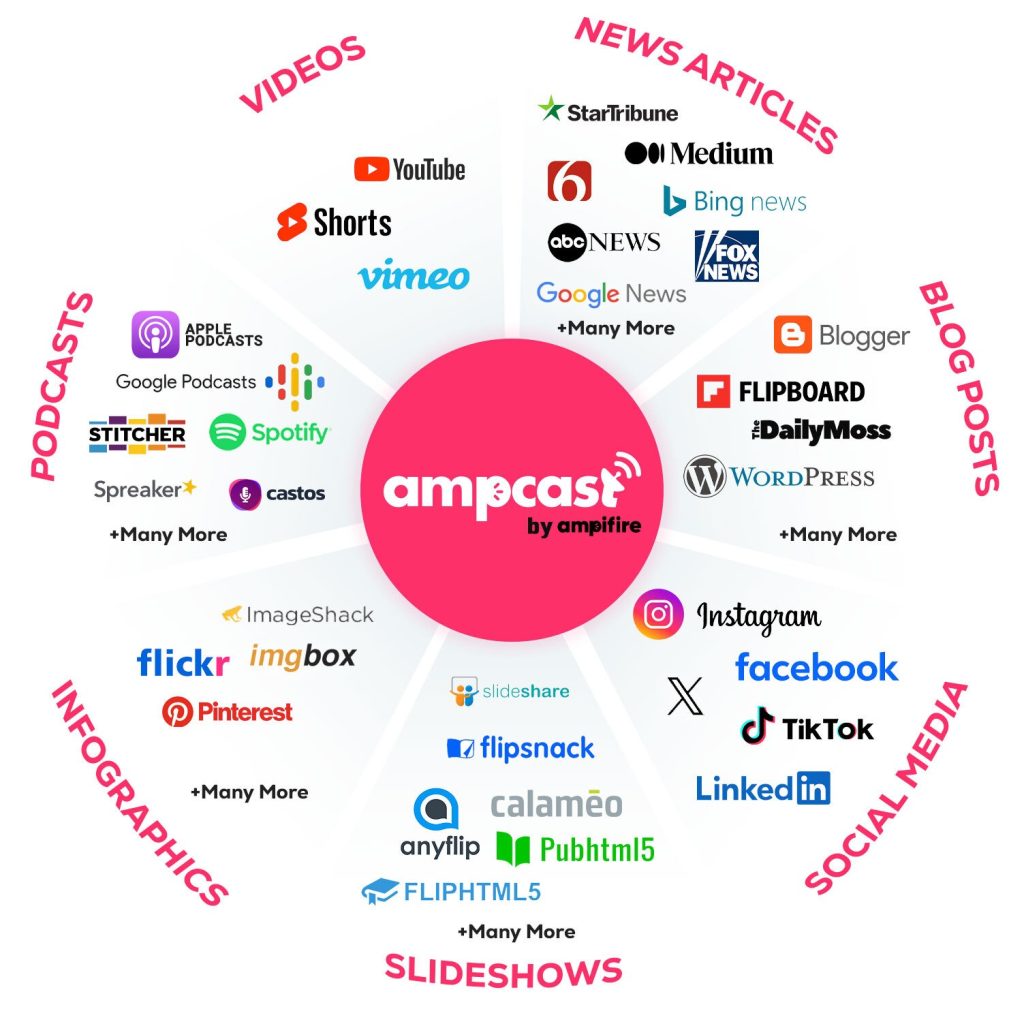
The practical advantage is just as strong. Instead of hiring separate writers, video producers, podcast editors, and social media managers, or paying a traditional agency to handle one format at a time, AmpCast consolidates everything into a single platform, placing your business everywhere your audience is.
The businesses that get the most from their marketing stack are the ones that pair strong automation with consistent, multi-channel brand visibility.
Frequently Asked Questions (FAQs)
Do I need marketing automation software if I already use AmpiFire?
They serve different purposes. AmpiFire creates and distributes content to bring organic visitors to your site. Marketing automation tools like HubSpot or Marketo then nurture those visitors through email sequences and lead scoring. Using both together means you attract more prospects and convert them more efficiently than relying on either one separately.
Which is more affordable for a small business — HubSpot or Marketo?
HubSpot is the more budget-friendly option for smaller teams. Its Starter plan begins around $15–20 per month and includes basic automation features. Marketo typically starts in the thousands per month and often requires additional spending on implementation and technical support, making it a better fit for larger organizations with dedicated marketing operations staff.
Can marketing automation replace content marketing entirely?
No. Automation tools manage and optimize your communication with existing leads, but they do not generate the content that attracts new visitors in the first place. Without fresh, distributed content bringing people to your website from search, social, and video channels, your automation workflows will have fewer leads to work with over time.
What should I prioritize — better automation or wider content reach?
If you already have steady traffic but struggle to convert it, focus on automation first. If your traffic is low or relies heavily on paid ads, prioritize content distribution to build organic reach. The strongest marketing strategies address both sides — bringing in new audiences through content while using automation to turn those visitors into customers.
How does AmpiFire AmpCast AI work alongside tools like HubSpot or Marketo?
AmpiFire AmpCast AI handles the top of your funnel by turning topics into 8 formats: news articles, social posts, reels/shorts, infographics, interview podcasts, flipbooks/slideshows, blog posts, and longer informational videos, and publishing them on 300+ sites. The organic traffic it generates feeds directly into your HubSpot or Marketo workflows, giving your automation more leads to nurture and convert.
*Disclaimer: Results may vary based on individual circumstances, business type, and content strategy. The time savings and outcomes mentioned are based on typical user experiences and are not guaranteed. For specific pricing and service details, please visit AmpiFire.
Author
Related Posts


Moosend Features, Reviews & Pricing: Is This Email Marketing & Automation Platform Worth It?
Get honest Moosend reviews. Learn features, pricing, and whether this email marketing and automation platform is worth it for your…

ConvertKit vs ActiveCampaign for Email Automation: Differences & Pricing
Learn the key differences between ConvertKit and ActiveCampaign, including pricing and automation, and how AmpiFire helps expand your audience organically.


Content Marketing vs Traditional Marketing: What’s the Difference?
Learn about the key differences between content marketing and traditional marketing, including their pros and cons, and how each can…

SendX Pricing, Features & Reviews: Is This AI-Powered Email Marketing Software Worth the Cost?
See real SendX reviews covering pricing, AI-powered features, and deliverability tools. Learn if this email marketing software is worth it.

Black Friday 2025: Best Marketing & Sales Software and Course Deals
Check out the best Black Friday 2025 deals on marketing and sales SaaS and courses to save big while leveling…


iContact Reviews, Cost & Features: Is This Email Marketing Software Worth It?
Discover if iContact is right for your business. Learn about pricing from $9/month, key features, and user reviews for this…