

Key Takeaways
- SEO (search engine optimization) delivers sustainable, long-term traffic growth with higher trust signals, while PPC (Pay-Per-Click) generates immediate visibility and targeted results.
- The average ROI timeline for SEO is 6–12 months, compared to PPC’s immediate returns that stop when ad spend ends.
- Organic search results receive 70–80% of clicks compared to 20–30% for paid ads, despite PPC’s prominent placement.
- The MultiCasting approach that reaches further than SEO and PPC offers a powerful traffic ecosystem that supports different business objectives.
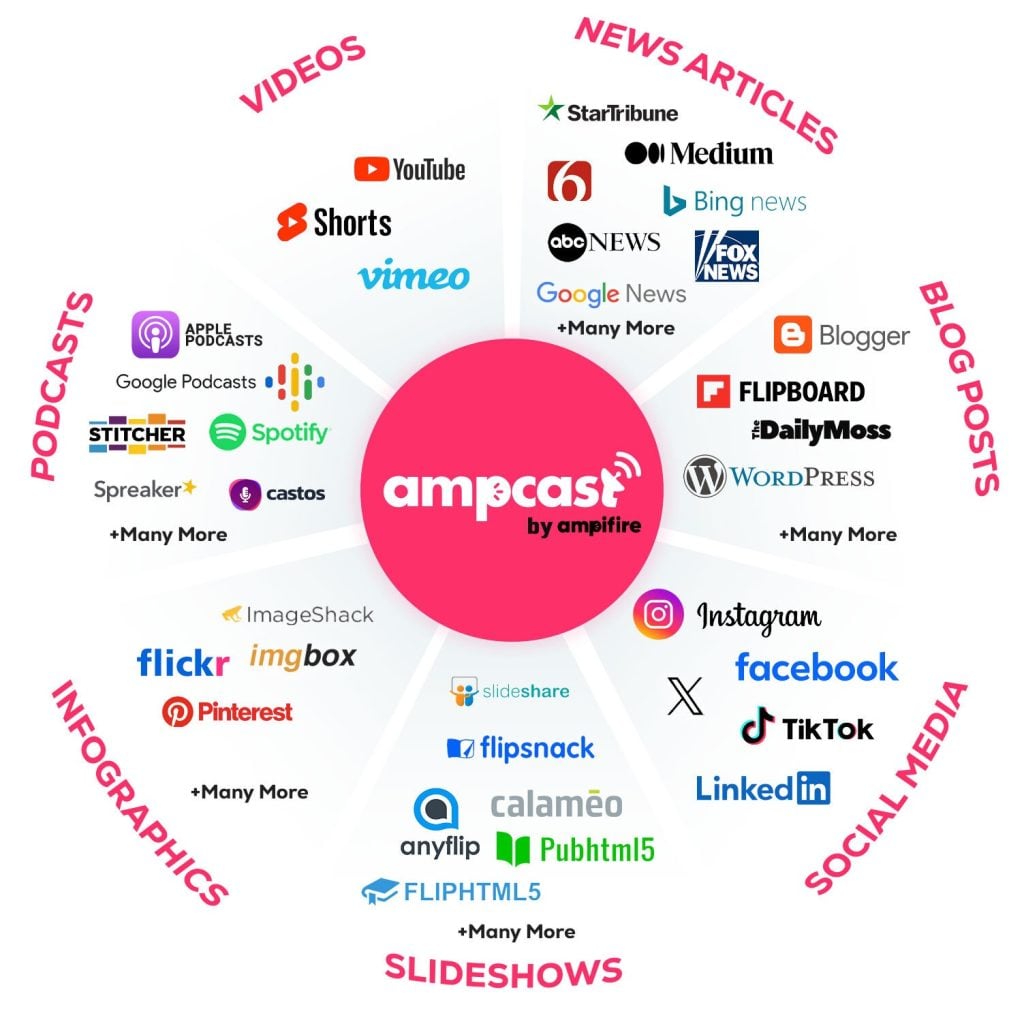
- AmpiFire’s AmpCast AI platform’s MultiCasting approach surpasses traditional SEO and PPC by turning one topic into 8 formats and publishing across 300+ sites, building organic traffic from search, video, podcasts, and social media.
What Makes SEO Different From PPC
SEO and PPC are the two dominant strategies for driving traffic from search engines, but they work in fundamentally different ways. SEO earns visibility by optimizing your website’s content, structure, and authority so search engines rank it higher in organic results, a process that builds momentum over months and compounds over time. Many businesses also work with seo companies to strengthen their long-term organic search performance and improve technical optimization.”
PPC purchases visibility through auction-based keyword bidding, placing your ad at the top of search results the moment your campaign goes live, but that placement disappears the instant you stop paying. Both target the same search results page, but the cost structures, timelines, and long-term returns couldn’t be more different.
This guide breaks down exactly how SEO and PPC compare across control, trust, click-through rates, and scalability, with real-world examples from companies like Canva and Away Travel that show how each strategy performs in practice.

How AmpiFire Works:
- Research & Target: Find high-demand topics your buyers search for.
- Create & Repurpose: AmpiFire’s AmpCast AI generates news articles, blog posts, interview podcasts, longer informational videos, reels/shorts, infographics, flipbooks/slideshows, and social posts.
- Distribute & Amplify: Auto-publish to 300+ sites, including Google News, YouTube, Spotify, and major news networks.
Get more traffic from people who want to buy your stuff, and powerful “As Seen On” trust badges for your site.
Do It Yourself (with AI), Done For You Content, & 100% Managed Organic Growth options available.
Grow Your Free Traffic From Everywhere
Real-World Examples: SEO & PPC
Real-World SEO Success Story: Canva
When Canva launched in 2013, it faced the challenge of competing against established design tools like Adobe. Rather than relying on traditional content marketing, the company built a programmatic SEO strategy around its own product.
Canva created over 24,000 templated landing pages in English across three categories: template pages (targeting searches like “resume templates”), create pages (targeting “create a poster”), and feature pages (targeting “background remover”). Each page was designed to match specific search intent while funneling visitors directly into Canva’s free design editor.
The company then translated these pages into dozens of languages to reach non-English-speaking users, who make up over 65% of its audience. This strategy now drives over 100 million organic visits per month, making SEO one of Canva’s most powerful acquisition channels.
Proven PPC Campaign Example: Away Travel
Away Travel, the direct-to-consumer luggage brand founded in 2015 by two former Warby Parker executives, used Google Ads strategically to capture market share in a category dominated by legacy brands like Samsonite and Tumi. What made Away’s approach distinctive was its heavy investment in unbranded paid search.
In their early growth phase, about 70% of Away’s Search Ads clicks (worth roughly $35,000 per month), came from non-branded keywords. Most ecommerce brands struggle to convert profitably on unbranded terms, but Away’s strong brand recognition (built through PR, social media, and influencer marketing) enabled it to achieve high enough conversion rates to run these campaigns at scale.
Away also paired Search Ads with Shopping Ads across the U.S., UK, and Canada, using each campaign type to capture customers at different stages of the buying journey.
The 3 Advantages of SEO
1. Long-Term ROI & Compound Growth
SEO’s most compelling advantage is its cumulative return on investment that increases over time. Unlike PPC, where each click represents a new cost, SEO investments continue delivering traffic long after the initial work is completed. Foundational activities like on-page optimization, content development, and link building in SEO accumulate as long-term assets that keep generating organic visits without further ad spend.
This creates a snowball effect where ranking improvements for one keyword often positively impact related terms, expanding your visibility across your industry’s search results.
2. Higher Click-Through Rates Than PPC
Organic search results consistently outperform paid ads in terms of click-through rates. Multiple studies show that organic listings receive a higher click-through rate, with 70–80% of users ignoring paid ads. This stark difference stems from users’ inherent trust in organic results over advertisements, perceiving them as more relevant and credible.
This click distribution becomes even more pronounced for informational queries where users are researching rather than actively shopping. In these searches, organic results on the first page of Google capture up to 91.5% of clicks, while paid ads receive minimal engagement.
3. Enhanced Brand Credibility & Trust
High organic rankings serve as powerful trust signals to potential customers. When your website consistently appears at the top of organic search results for relevant industry terms, users perceive your brand as an authority in your field.
This perceived expertise translates directly into higher conversion rates, as visitors are more inclined to trust your products, services, and information than those of competitors ranking lower or appearing only in paid ads — a dynamic that makes SEO for enterprises particularly powerful when building authority at scale.
The Challenges of SEO You Must Know
Time to Results: The 6–12 Month Reality
The most significant SEO challenge is the extended timeline required to see meaningful results. Unlike PPC’s immediate impact, organic strategies typically take 6–12 months before delivering substantial yield, particularly in competitive industries.
This delayed gratification creates organizational challenges, especially when executives or stakeholders expect quick returns on marketing investments.
Content Creation Requirements
Effective SEO demands substantial content development resources. Search engines reward websites that consistently publish high-quality, relevant content that comprehensively addresses user needs.
This requirement necessitates ongoing investment in content creation, including research, writing, editing, and multimedia production, which many organizations struggle to sustain. Staying informed through a newsletter on SEO can help teams keep up with content best practices and algorithm changes without falling behind.
The 3 Key Benefits of PPC Advertising
1. Instant Traffic & Visibility
PPC’s most significant advantage is the immediate visibility it provides. Within hours of launching a campaign, your business can appear at the top of search results for your target keywords, generating immediate traffic and leads.
This immediacy makes PPC invaluable for time-sensitive initiatives such as product launches, seasonal promotions, or limited-time offers, where waiting for organic rankings isn’t viable.
2. Precise Audience Targeting Options
Modern PPC platforms offer targeting capabilities that far exceed what’s possible through organic search. Advertisers can precisely define their audience based on demographics, interests, behaviors, and intent signals, ensuring ads reach the most valuable prospects.
This granular targeting extends to remarketing opportunities that re-engage previous visitors based on their specific interactions with your website.
3. Measurable ROI & Performance Data
PPC provides unmatched visibility into campaign performance and return on investment. The direct connection between ad spend and results creates clear accountability, with platforms tracking impressions, clicks, conversions, and revenue, and attributing them to each campaign, ad group, and keyword.
This transparency enables precise calculation of key metrics such as cost per acquisition, return on ad spend, and lifetime value-to-cost ratios.
The Drawbacks of PPC Campaigns
Rising Cost-Per-Click in Competitive Industries
PPC costs have risen dramatically across most industries over the past decade. This inflation stems from growing competition as more businesses shift budgets toward digital channels, combined with limited ad inventory and auction-based pricing models.
Keywords in high-value industries like legal services, insurance, or financial products routinely exceed $100 per click, making unit economics challenging even with strong conversion rates.
Ad Blockers & Visibility Issues
The growing adoption of ad-blocking technology represents another significant challenge for PPC campaigns. With approximately 37.5% of internet users now employing ad-blocking tools, a substantial portion of potential customers never see paid advertisements regardless of targeting quality or bid amount.
This technological barrier particularly affects younger, tech-savvy demographics who tend to be early adopters of ad-blocking tools, potentially limiting reach among valuable audience segments.
SEO vs PPC: Head-to-Head Comparison
| Factor | SEO | PPC |
| Cost Model | Upfront investment that appreciates over time | Pay per click; ongoing spend required |
| Time to Results | 6–12 months for meaningful results | Immediate (within hours of launch) |
| Traffic When You Stop | Continues generating visits | Stops completely |
| Click-Through Rate | 70–80% of clicks go to organic results | 20–30% of clicks |
| Trust & Credibility | High — users perceive organic results as more credible | Lower — users often skip ads |
| Targeting Control | Limited to keyword/content optimization | Precise demographic, behavioral, and remarketing targeting |
| Flexibility | Slower to adjust; algorithm-dependent | Real-time adjustments to messaging, budget, and audience |
| Best For | Long-term brand authority and sustained traffic | Product launches, seasonal promos, and fast lead generation |
The MultiCasting approach: Scaling Above SEO & PPC
Why Being Everywhere Beats Being on Page One
Today’s buyers don’t make decisions from a single Google search. They research across YouTube, listen to podcasts, scroll social media feeds, read industry blogs, and scan news sites before they ever commit to a purchase. If your brand only shows up on a search results page, you’re invisible during most of that journey.
The MultiCasting approach solves this by placing your brand across every channel your audience uses — not just search, but video platforms, podcast directories, news outlets, blogs, slide-sharing sites, and social media. This level of repeated, multi-channel exposure builds a depth of trust that no single Google ranking or paid ad placement can replicate.
The Cost of Going Omnipresent
The main barrier to the MultiCasting approach is the cost. Doing it manually means hiring writers, video producers, podcast editors, and distribution managers — each handling a single channel at a time. That overhead adds up fast, and the output is slow relative to the number of platforms you need to cover.
Automated content distribution flips that model on its head. Instead of coordinating multiple teams across multiple formats and platforms, platforms like AmpiFire’s AmpCast AI turn a single topic into multiple content types and publish them across 300+ platforms simultaneously. The result is far greater reach, faster brand building, and a diversified traffic portfolio at a fraction of the cost of manual work.
Scale Your Traffic Beyond SEO & PPC With AmpiFire
Neither SEO nor PPC alone can place your brand everywhere buyers look. AmpiFire’s AmpCast platform goes beyond both by transforming one topic into 8 content formats: news articles, blog posts, podcasts, videos, video shorts, infographics, slideshows, and social posts, and publishing them across 300+ high-authority sites like Google News, YouTube, Spotify, and FOX affiliates.
When potential customers see your brand across multiple platforms, it builds the kind of credibility that a single search ranking or ad placement simply cannot match.
Directbed.ca, a Canadian furniture e-commerce store, ran just 35 Amp campaigns with us and saw a 417.8% increase in organic traffic in 14 months — results that compound over time as each piece of content continues driving visitors.
Compared to hiring in-house content teams or working with traditional agencies, AmpiFire AmpCast AI delivers broader reach at a fraction of the cost.
Frequently Asked Questions (FAQs)
Is it better to start with SEO or PPC for a new business?
It depends on how quickly you need results. PPC brings immediate traffic, which helps when you need leads right away. But investing in organic content early builds a foundation that keeps paying off long term. Many new businesses run PPC for quick wins while building their organic presence through consistent content creation and distribution.
Why do organic search results get more clicks than paid ads?
People generally trust results that earned their ranking over those that paid for placement. Studies show that users ignore 70–80% of all paid search ads. Users see top organic results as more credible and relevant, which is why building a strong organic presence across multiple channels matters for long-term traffic growth.
What happens to my traffic if I pause my PPC campaigns?
Your paid traffic stops immediately. Unlike organic content, which continues attracting visitors long after it is published, PPC delivers zero traffic the moment your budget runs out. That is why relying only on ads is risky — diversifying into organic channels creates a safety net that keeps your business visible even without active ad spend.
How does AmpiFire’s AmpCast AI compare to traditional SEO or PPC?
AmpCast AI surpasses both by turning one topic into 8 formats — articles, blogs, podcasts, videos, shorts, infographics, slideshows, and social posts — and publishing them across 300+ sites, including YouTube, Spotify, and Google News. This builds organic traffic from multiple channels, not just search engines, without paying per click.
*Disclaimer: Results may vary based on individual circumstances, business type, and content strategy. The time savings and outcomes mentioned are based on typical user experiences and are not guaranteed. For specific pricing and service details, please visit AmpiFire.
Author
Related Posts

Brandwatch vs Sprout Social: Features, Pros & Cons
Compare Brandwatch vs Sprout Social features, pros, and cons, and see how AmpiFire's multi-platform distribution extends reach beyond social media.
ContentStudio vs Hootsuite for Social Media Management: Features, Pros & Cons
Compare ContentStudio vs Hootsuite, their features, pros, cons, and find a smarter way to grow reach beyond social media with…
Brandwatch vs Hootsuite for Social Media Management: Pricing, Pros & Cons
Brandwatch vs Hootsuite compared by pricing, features, pros, and cons. See which fits your team and where AmpiFire fills the…

Mailchimp vs Constant Contact for Email Marketing Campaigns: Cost, Pros & Cons
Compare Mailchimp vs Constant Contact to find the best email marketing platform for your business. Learn the pricing, features, pros,…

ClickDesigns Features, Pricing, Pros & Cons: Can This AI-Powered Graphic Designer Beat Canva?
Discover ClickDesigns' features, pricing, pros, and cons to see if this AI-powered tool can truly compete with Canva for your…


3 Main Types of Business Models: Pros and Cons of Ecommerce, Affiliate & Local Marketing
Are you interested in learning about different types of business models? Consider this breakdown on using ecommerce, affiliate, and local…