

Key Takeaways
- Blaze AI excels at marketing-focused content creation with specialized features for brand voice consistency, while ChatGPT offers more versatility across different content types.
- For small business owners and solo marketers, Blaze AI provides a more streamlined workflow with direct publishing integrations that can save significant time.
- ChatGPT is stronger for technical content and long-form writing, but neither it nor Blaze AI matches AmpiFire’s AmpCast AI for automatically publishing your content to 300+ platforms.
- The right choice depends on your goal, but if you need content created and distributed everywhere automatically, neither Blaze AI nor ChatGPT comes close to what AmpiFire delivers.
- Try AmpiFire’s AmpCast AI to get the best of both worlds: transforming one topic into 8 content formats (news articles, blog posts, interview podcasts, longer informational videos, reels/shorts, infographics, flipbooks/slideshows, and social posts) and publishing to 300+ platforms, so you focus on running your business.
Blaze AI vs ChatGPT: Which is the Better AI Content Generator
Blaze AI is purpose-built for marketing content creation, focusing on brand voice, multichannel content distribution, and streamlined publishing workflows, while ChatGPT functions as a general-purpose AI assistant built for flexibility across a wide range of content types.
The core difference between the two comes down to design philosophy. Blaze AI is a complete content marketing ecosystem, while ChatGPT is a powerful but more general text generation tool that requires additional steps to achieve the same end-to-end results.

How AmpiFire Works:
- Research & Target: Find high-demand topics your buyers search for.
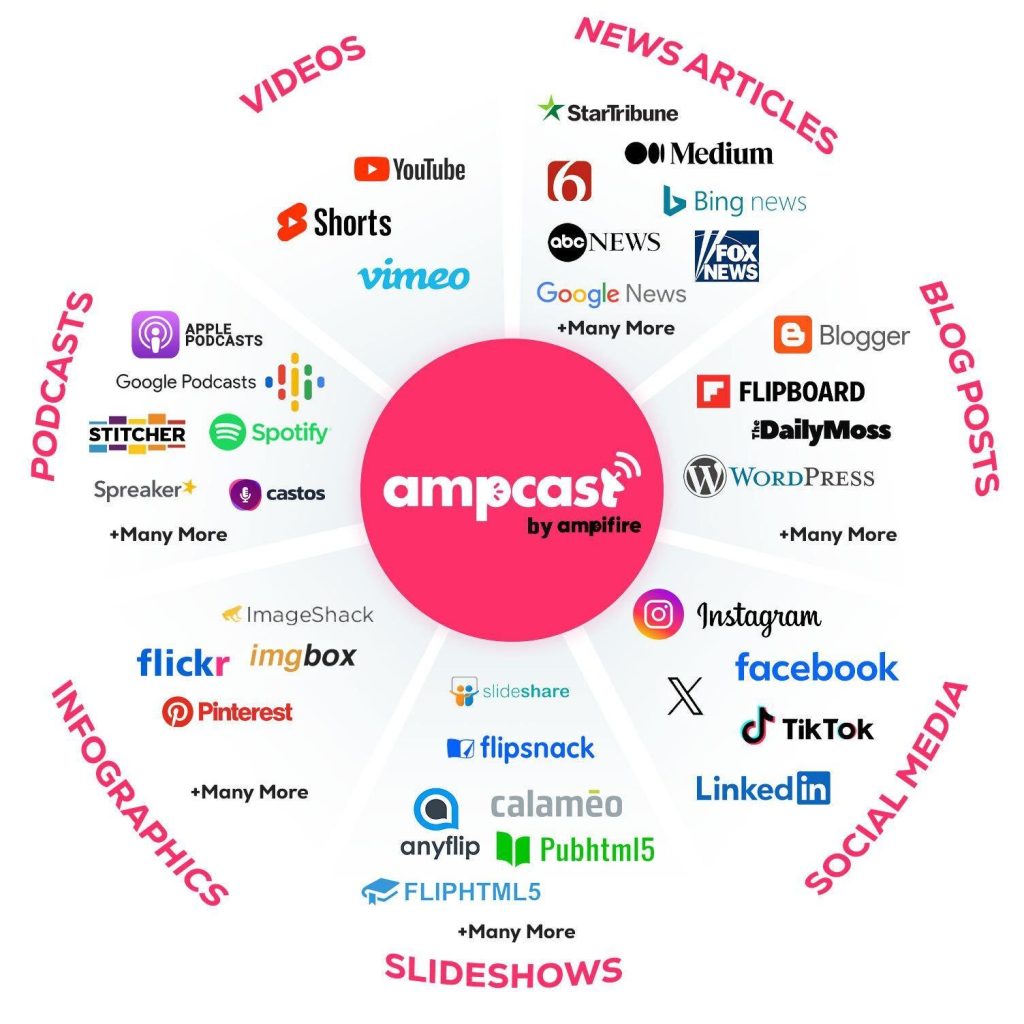
- Create & Repurpose: AmpiFire’s AmpCast AI generates news articles, blog posts, interview podcasts, longer informational videos, reels/shorts, infographics, flipbooks/slideshows, and social posts.
- Distribute & Amplify: Auto-publish to 300+ sites, including Google News, YouTube, Spotify, and major news networks.
Get more traffic from people who want to buy your stuff, and powerful “As Seen On” trust badges for your site.
Do It Yourself (with AI), Done For You Content, & 100% Managed Organic Growth options available.
Grow Your Free Traffic From Everywhere
Which AI Tool Is Better at Maintaining Your Brand Voice?
How Blaze AI Learns Your Unique Brand Voice

Blaze AI uses a brand voice training system that analyzes your existing content from website URLs, pasted text, uploaded documents, and connected Instagram accounts. This technology identifies patterns in vocabulary, sentence structure, tone, and messaging preferences to create a brand voice profile.
Once established, this profile guides all content generation, ensuring new material sounds authentically like your brand without requiring constant adjustments.
The platform allows for fine-tuning this voice model through simple feedback mechanisms, creating an increasingly accurate representation of your brand’s unique communication style over time. This automated approach to brand consistency represents one of Blaze’s most significant advantages for marketing-focused content creation.
ChatGPT’s Approach to Tone & Style Adaptation

ChatGPT approaches tone and style adaptation differently. While it doesn’t offer a dedicated brand voice training system like Blaze, its Memory feature can retain tone, voice, and format preferences across sessions, reducing the need to re-establish guidelines from scratch. Users can also provide explicit instructions within each conversation, and the model adapts to these quickly and with real precision.
The platform’s strength lies in its ability to quickly pivot between radically different writing styles, often within the same conversation. However, while Memory reduces repetition for general preferences, it doesn’t replace the structured brand profile that Blaze offers. This means that users managing detailed or evolving brand guidelines may still find voice consistency more labor-intensive across high-volume content production.
Best Option for Consistency Across Multiple Content Pieces
The standout advantage Blaze AI offers marketing teams is consistent brand messaging across dozens or even hundreds of content pieces without additional input.
This is especially useful for campaigns requiring cohesive messaging across multiple platforms or for businesses managing content calendars with high-volume publishing schedules.
With its Memory feature enabled, ChatGPT can carry forward brand voice preferences across sessions, but this memory is general-purpose, not marketing-specific.
It retains high-level preferences rather than a structured brand profile. Organizations seeking tighter control over brand-consistent content may still maintain prompt libraries and style guides to supplement ChatGPT’s memory capabilities.
Content Workflow Efficiency Comparison
Blaze AI’s Marketing-Focused Workflow
Blaze AI streamlines the marketing content process by combining ideation, drafting, editing, and publishing within a single platform. Its workflow begins with either selecting from pre-built content templates or entering a basic content brief. The AI then generates multiple variations that match your brand voice profile, allowing for quick selection and refinement.
What truly distinguishes Blaze’s workflow is its direct publishing integrations with popular marketing platforms like WordPress, social media channels, and email marketing services. This means content can move from concept to live publication without leaving the Blaze ecosystem.
ChatGPT’s General-Purpose Approach
ChatGPT employs a more conversational workflow that excels in flexible content creation but requires more manual intervention for finalization and publication. The typical ChatGPT content workflow begins with detailed prompt engineering to establish parameters, followed by iterative refinement through back-and-forth conversation with the AI. Users can request revisions, expansions, or stylistic changes through natural language instructions.
Unlike Blaze, ChatGPT’s native interface has limited built-in publishing integrations, though WordPress.com added direct AI agent publishing support via MCP in March 2026, and third-party plugins and the API continue to expand automation options. This separation creates additional steps between content creation and distribution, particularly for teams managing multiple publishing channels.
Which AI Generates Better Content: Blaze AI or ChatGPT?
Past the workflow, content quality is what actually determines which tool earns a permanent spot in your stack. Both Blaze AI and ChatGPT produce fluent, natural-sounding text, but their approaches to content quality optimization differ in important ways.
Blaze AI and ChatGPT Content Quality
ChatGPT, as a general-purpose AI trained on a broad knowledge base, may offer an advantage for factual recall on general knowledge and specialized topics, though no published benchmark directly compares the two platforms’ accuracy. Blaze AI compensates for potential factual limitations through its focused approach to content marketing, where brand messaging and persuasive writing often take precedence over encyclopedic knowledge.
However, both platforms can produce factual errors, especially regarding recent events or highly specialized topics, making human review essential for content requiring perfect accuracy.
AmpiFire’s AmpCast AI Content Quality
AmpiFire’s AmpCast AI approaches quality from a different angle. Rather than generating a single draft for one channel, AmpCast AI produces 8 purpose-built content formats (news articles, blog posts, interview podcasts, longer informational videos, reels/shorts, infographics, flipbooks/slideshows, and social posts), each optimized for the platform where it will be published. A blog post reads like a blog post, a podcast script sounds conversational, and a news article follows editorial structure. That format-specific approach means your content meets audience expectations on every platform, which directly affects how it performs.
AmpCast AI then distributes those formats across 300+ high-authority sites like Google News, YouTube, Spotify, and FOX affiliates automatically. For businesses that already have a content creation workflow in place, AmpCast AI fills both the quality-per-channel and distribution gaps that Blaze AI and ChatGPT leave open.
Blaze AI vs ChatGPT vs AmpCast AI: Comparison Table
| Feature | AmpCast AI | Blaze AI | ChatGPT |
| Primary Focus | Multi-format content creation + distribution | Marketing content creation | General-purpose AI assistance |
| Brand Voice Learning | AI-driven via AmpCast AI | Yes, automated | Semi-automated via Memory; manual prompting for specifics |
| Content Formats | 8 formats: news articles, blog posts, interview podcasts, longer informational videos, reels/shorts, infographics, flipbooks/slideshows, and social posts | Text and visual marketing content | Text and image content (video via standalone Sora app) |
| Publishing Integration | Auto-publish to 300+ sites | WordPress, social platforms | Limited native integrations; WordPress.com now supports AI agent publishing via MCP (March 2026) |
| Time to Publish | Automated after setup | Minutes for social posts; under 1 hour for blogs (estimated) | Varies by prompt complexity and editing workflow (estimated) |
| SEO & Backlinks | High-authority placements across 300+ sites | Limited | None |
| Best For | Businesses that need content created and distributed everywhere | Branded marketing content at scale | Versatile content ideation and drafting |
| Service Levels | DIY with AI, Done For You, and 100% Managed options | Single platform access | Free, Go, Plus, Pro, Business, and Enterprise tiers |
| ROI Focus | Organic reach + brand authority | Workflow efficiency | Content versatility |
| Multi-Channel Distribution | 300+ platforms, including Google News, YouTube, Spotify, FOX affiliates | Limited social platforms | None |
Stop Comparing, Start Distributing
Blaze AI and ChatGPT are both capable content creation tools, but they stop at the draft. Neither one handles distribution at scale. AmpiFire’s AmpCast AI takes one topic, transforms it into 8 content formats, and automatically distributes them to 300+ sites like Google News, YouTube, Spotify, and FOX affiliates. When potential customers see your brand across channels, that’s credibility you don’t have to manually build.
If you’re a solo entrepreneur or a growing team, our AmpCast AI handles the heavy lifting of formatting, repurposing, and publishing so you can put your time back into running your business.
Frequently Asked Questions (FAQs)
What is Blaze AI used for?
Blaze AI is a marketing content platform designed for small businesses and solo marketers who need to produce brand-consistent content quickly. It learns your brand voice from existing materials, generates content across multiple marketing formats, and connects directly to publishing channels like WordPress and social media so you can go from draft to live post without switching tools.
Do either Blaze AI or ChatGPT offer content templates?
Blaze AI provides an extensive library of marketing-specific templates including social media posts, email marketing, blog structures, and product descriptions with optimal format guidance. ChatGPT does not offer a traditional template library within its interface, but the GPT Store hosts millions of custom GPTs, many designed for specific content formats such as blog posts, email newsletters, and social media copy.
Can Blaze AI and ChatGPT help with multi-platform content distribution?
Blaze AI offers direct publishing to WordPress and social media, while ChatGPT has minimal built-in distribution, relying primarily on third-party integrations. For full multi-channel reach, AmpCast AI automatically publishes to 300+ high-authority platforms, including Google News, YouTube, Spotify, and FOX affiliates.
Which are the top 5 AI tools?
The top five AI content tools right now are AmpiFire’s AmpCast AI for multi-format content creation and distribution across 300+ platforms, ChatGPT for versatile general-purpose writing, Blaze AI for brand-consistent marketing content, Jasper for ad and marketing copy, and Claude for detailed long-form and analytical writing. Each serves a different purpose, so the best pick depends on whether you need broad reach, brand consistency, or flexible ideation.
What is AmpiFire used for?
AmpiFire’s AmpCast AI is a content amplification platform that transforms a single topic into 8 distinct content formats (news articles, blog posts, interview podcasts, longer informational videos, reels/shorts, infographics, flipbooks/slideshows, and social posts) then automatically distributes them across 300+ high-authority sites like Google News, YouTube, and Spotify. Businesses use AmpiFire to build organic visibility, earn trust through multi-platform presence, and drive free traffic without managing each channel manually.
Author
Related Posts


Blaze AI Features & Pricing: Can This App Generate High-Quality Content Quickly?
Blaze AI simplifies content marketing with automation, brand voice adaptation, and affordable pricing, perfect for solopreneurs and small businesses.
AmpCast vs. ChatGPT vs. Claude vs Canva: The Rapid Content Showdown
AmpCast AI • Benchmarks Content Creation Speed Revolution How AmpCast AI outpaces every content creation approach across video, audio, written…

Does Google Hate AI Content? ChatGPT’s Stance on Detection, SEO, Indexing, & Duplicate Penalties
Learn how Google views AI Chat GPT content through the lens of Chat GPT. Discover the impact of indexing, duplicate…

How to Get Cited by AI: Using Big Authority Sites to Infiltrate ChatGPT, Google AI & Perplexity
Learn how to get cited by AI tools like ChatGPT, Google AI, and Perplexity by publishing on high-authority sites to…

3 Best Podcast to Article Generator [2026 Edition]
Compare top podcast-to-article tools in 2026. Learn about AI platforms that convert audio to text, create multi-format content & boost…


Tagshop AI Reviews, Features & Pricing: Is This Video Ad Generator Worth It?
Learn honest Tagshop AI reviews, top features like URL-to-Video and 1,000+ AI avatars, plus pricing from free to $99/mo. See…