

Key Takeaways
- The fastest way to get cited by AI tools like ChatGPT, Google AI, and Perplexity is to publish clear, factual content on high-authority sites that those tools already trust. If your brand isn’t appearing in those answers, you are invisible to buyers who are ready to spend money.
- Big authority sites like USA Today, Business Insider, and the Associated Press have spent 20+ years building the domain trust that AI relies on. Publishing on these platforms lets your brand borrow that trust immediately, instead of spending years building it on your own website.
- ChatGPT, Google AI, and Perplexity each pull from different sources, but all three consistently favor the same thing: high-authority sites with clear, factual, recently updated “best of” content. A study of 485,000 citations found that 43.8% of all AI citations come from “best of” lists, with 79.1% updated within the current year.
- AI treats the same information repeated across multiple trusted sources as consensus truth. Publishing buyer guides, product comparisons, and “best of” lists across news sites, YouTube, podcasts, and blogs is the most direct path to consistent citations across all three platforms.
- AmpiFire’s AmpCast AI turns one topic into 8 content formats and publishes them across 300+ platforms (including Google News, YouTube, Spotify, USA Today, and Business Insider), giving your brand the multi-channel presence ChatGPT, Google AI, and Perplexity look for before recommending you.
How to Get Cited by AI?
To get cited by AI tools like ChatGPT, Google AI, and Perplexity, publish clear, factual content on high-authority sites that those tools already trust. If your brand doesn’t appear on those websites, AI will never recommend you. The fastest path to AI citations isn’t building your site’s authority from scratch. It is publishing on platforms like USA Today, Business Insider, and the Associated Press that already carry the trust AI relies on.
A Wellows study of 485,000 ChatGPT citations confirms this. Nearly 44% of all citations for product queries come from “best of” blog lists published on high-authority domains. SE Ranking’s analysis of 129,000 domains found that sites with Domain Trust scores above 90 earn nearly 4X as many citations as those with lower scores. The data is clear: authority drives citations, and publishing on big sites lets you borrow that authority immediately.
This guide breaks down exactly where AI gets its answers, which content types are most often cited, the five signals that determine whether your content appears in AI responses, and a step-by-step strategy for getting your brand recommended by ChatGPT, Google AI, and Perplexity.
But first, you need to understand what you’re up against.

How AmpiFire Works:
- Research & Target: Find high-demand topics your buyers search for.
- Create & Repurpose: AmpiFire’s AmpCast AI generates news articles, blog posts, interview podcasts, longer informational videos, reels/shorts, infographics, flipbooks/slideshows, and social posts.
- Distribute & Amplify: Auto-publish to 300+ sites, including Google News, YouTube, Spotify, and major news networks.
Get more traffic from people who want to buy your stuff, and powerful “As Seen On” trust badges for your site.
Do It Yourself (with AI), Done For You Content, & 100% Managed Organic Growth options available.
Grow Your Free Traffic From Everywhere
The Uncomfortable Truth About Who Controls What AI Says

A whistleblower story: a friend who worked SEO for one of the world’s biggest crypto companies, reporting directly to billionaires, revealed something disturbing. He was hired by a synthetic sweetener company to infiltrate Wikipedia. Plant information that becomes “the truth.”
This is standard practice. Governments do it. Major corporations do it. There are operatives who have infiltrated Wikipedia, Reddit, ChatGPT, and news sites to shape what people believe.
Meanwhile, ethical brands with real products that help people? Most haven’t even posted anything today about what they do. The good news is you don’t need a manipulation budget. You need the right strategy, and this guide lays it out, backed by data from hundreds of thousands of AI citations.
Why Your Brand Needs to Show Up in AI Answers
93% of buyers research across multiple platforms before purchasing. They’re checking Google, ChatGPT, YouTube, social media, podcasts, review sites, news sites, and forums, all before they buy.
This creates what we call the Invisible Chaos Funnel: multiple research touchpoints you can’t even see. If you’re missing from any of them, you leak sales to competitors who ARE there.
The Numbers Behind the Problem
The numbers paint a sharp picture.
- 97% of people search online for local businesses.
- 93% say online reviews impact their buying decisions.
- 91% trust online reviews as much as personal recommendations.
- 70% will avoid buying if they don’t like the company behind the product.
- 70% of potential customers are lost if negative press appears on page 1.
Overall, 10–80% of sales are lost if you’re not actively managing your brand on Google and in AI.
What This Means for Your Brand
If your brand is missing from any of these research channels, you are invisible to buyers who are ready to spend money. AI tools like ChatGPT, Google AI Overviews, and Perplexity now sit between your customers and your business.
They answer buying questions, suggest products, and point people toward brands they consider trustworthy. To get cited by these tools, you need to publish clear, factual content on high-authority sites that they already trust.
Where Do ChatGPT, Google AI, and Perplexity Actually Get Their Answers?
Most people assume ChatGPT uses a single search source. The reality is more nuanced: AI pulls from multiple sources depending on the query type, using a mix of Bing, Google data, and its own training to filter what’s trustworthy.
Evidence From Search Engines
- Evidence for Google sourcing: Ranking Academy ran an experiment where they optimized Bing Places listings and found zero movement in ChatGPT rankings. But ChatGPT was displaying Google call tracking numbers (unique phone numbers that ONLY exist on Google Business Profiles).
- Evidence for Bing sourcing: Developer analysis shows ChatGPT actively searches Bing for product recommendations, analyzes review sites, then searches exact product names again before displaying results.
The key insight is that ChatGPT uses a mix of search sources. Bing for some queries, Google data for others, and it potentially relies on Google to help filter which sources are more trustworthy.
Either way, the common factor is clear: high-authority sites get cited regardless of which search engine feeds the data.
Why Authority Is the Common Thread
Your brand isn’t what you say it is. It’s what Google (and now AI) says it is. And the easiest way to establish instant authority is to become associated with already trusted brands.
For brands, sites, and products that want to be highlighted by AI, the answer is simple: Publish on big sites and rank high. The sites AI cites are still predominantly huge, high-DA platforms. Whether you’re a big brand or small, leveraging bigger sites (like USA Today and Business Insider) increases your chances of citation.
How AI Shopping Actually Works
The 5-Step Process Behind AI Recommendations
When someone asks ChatGPT for product recommendations, like “best wooden jigsaw puzzles,” here’s the actual process that happens behind the scenes.
- ChatGPT first searches for product recommendations.
- It then analyzes multiple review sites and comparison articles.
- It aggregates the most recommended products across those sources.
- It searches exact product names again for verification.
- Finally, it displays a product grid with buy buttons.
Small Brands Are Already Showing Up
The opportunity here is significant. Small brands are appearing alongside Amazon and Walmart in these results with zero ad spend required. The determining factor is whether your products appear on the review sites and comparison articles AI is analyzing.
The Hidden Keyword Layer
ChatGPT doesn’t search for exactly what users type. Developer analysis reveals ChatGPT modifies queries before searching:
| User Types | ChatGPT Actually Searches |
| “wooden jigsaw puzzles” | “best wooden jigsaw puzzle reviews” |
| “GPS pet trackers” | “best GPS tracker for pets 2026” |
ChatGPT often adds modifiers like “reviews,” “2026,” or “best” that most merchants never target. This means comparison articles and “best of” lists are exactly what AI is looking for. Big6 authority sites (like USA Today and Business Insider) are perfect for this content.
Who Actually Gets Cited by AI? The Data Behind 485,000 Citations
What the Wellows & BrightEdge Studies Found
A Wellows study of 485,000 ChatGPT citations reveals exactly who gets referenced for commercial and product queries. 44% come from product and vendor sites, meaning the brand’s own content. 40% come from tech media and independent reviews.
Additional BrightEdge data shows that ChatGPT mentions brands in 99.3% of eCommerce responses. And 48–77% of citations come from specialized sites beyond major platforms, including industry publications, niche experts, and topic-specific resources.
The Double-Win Effect
For product queries, AI doesn’t just list products. It cites the product’s website to back up claims about features or pricing. For example, in responses about VPN services, ChatGPT might say, “NordVPN offers fast speeds and strong encryption,” and cite NordVPN’s website as evidence.
This applies across all major AI platforms: ChatGPT, Google/Gemini AI Overviews, Claude, and Perplexity.
If you manage to be one of the top recommendations in your category, AI will mention you AND use your site as evidence. First, the “best of” lists include you. Then AI amplifies your presence by citing your own domain. You win twice.
So, what does this mean?
- Having clear, factual information on your official site can directly earn you citations in AI-generated answers. Brands that publish authoritative content about their products aren’t just building “SEO.” They’re feeding the AI citation engine directly.
- AI also cites competitor opinions. When a competitor writes about your product (even positively), AI may reference that as a third-party validation. This is why appearing on multiple sources matters.
“Best Of” Lists Are the #1 Cited Page Type
The Ahrefs Study: 26,283 Source URLs
An Ahrefs study of 26,283 ChatGPT source URLs across software, products, and agency recommendations found something critical:
43.8% of all ChatGPT citations are “Best X” blog lists.
Other key findings from the Ahrefs research include:
- 79.1% of cited blog lists were updated in 2025
- 26% were updated in the past two months alone
- Brands ranking higher on third-party lists are more recommended by ChatGPT
- “Best” lists are even more prominent in Google AI Overviews than in ChatGPT
This tells us exactly what content format AI is looking for when users ask for product recommendations. And the freshness data confirms why continuous publishing matters.
Your Own “Best” Lists Get Cited, Even When Biased
The Ahrefs study found that self-promotional “best” lists, where brands rank themselves #1, still get cited by ChatGPT. In the software category, 34% of AI responses cited the brand’s own “best” list. In Google SERPs, 67.6% featured lists where the brand ranks itself #1.
Major brands like Shopify, Slack, Salesforce, and HubSpot all publish self-promotional “best” lists. There appears to be no downside from a ranking or AI citation perspective.
We’ve seen this repeatedly with AmpiFire clients: AI will cite your own brand’s blog posts as sources for product recommendations, even when your content is obviously biased.
For example, a speaker brand writes a blog post titled “Best Computer Speakers for DJ Mixing.” When users ask AI for speaker recommendations, the AI references that post and follows the brand’s recommendation, even though independent reviews exist. The brand’s self-serving content becomes the authoritative source.
Platform Differences & The Amplification Effect
Google AI Overviews are more likely to cite brand blogs, even at moderate DA levels. Google AI also likes YouTube and LinkedIn as sources. ChatGPT also cites brand blogs but appears to have a higher DA threshold before trusting vendor content.
The bigger your brand and the higher your DA, the more likely AI is to treat your self-published content as factual information rather than marketing.
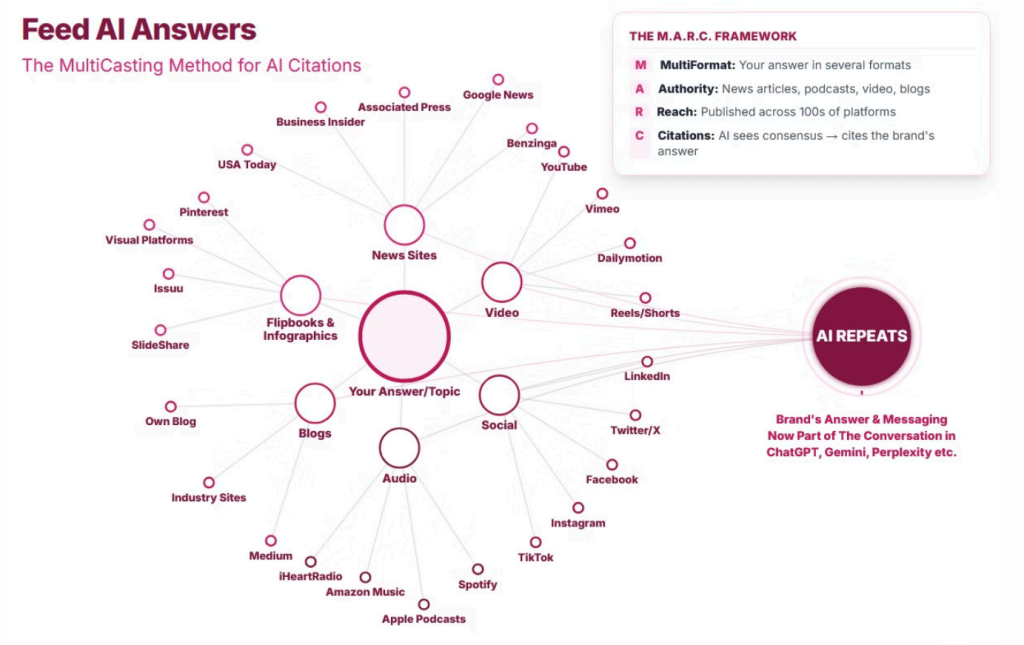
This effect is boosted significantly when you also publish similar information in multiple formats across the web using the MARC framework. AmpCast.AI is an AI-assisted tool that helps you do this.
The 5 AI Citation Signals (Backed by 129,000 Domains)
SE Ranking analyzed 129,000 domains and 216,524 pages to reverse-engineer what ChatGPT cites. Here are the five signals they found.
Signal #1: Domain Authority Dominates
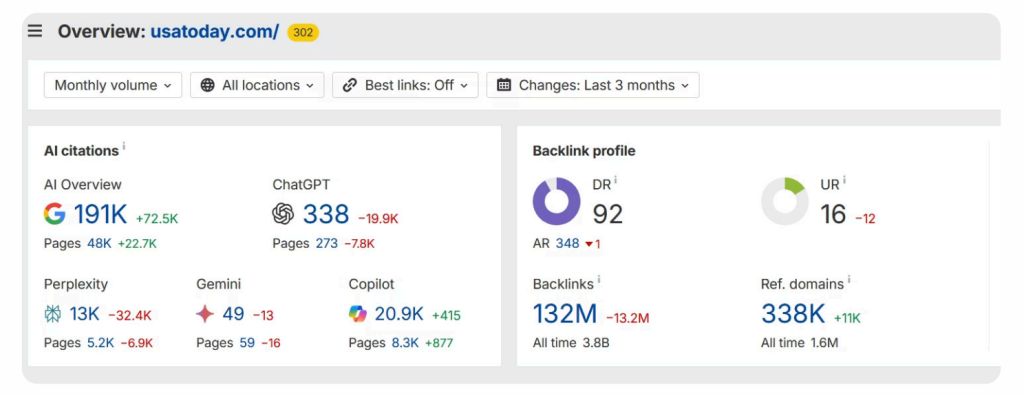
Sites with 32,000 or more referring domains average 8.4 citations. Sites below that threshold average just 1.6. Domain Trust scores above 90 earn nearly 4X as many citations as sites below DT 43. Page Trust scores above 28 average more than 8 citations.
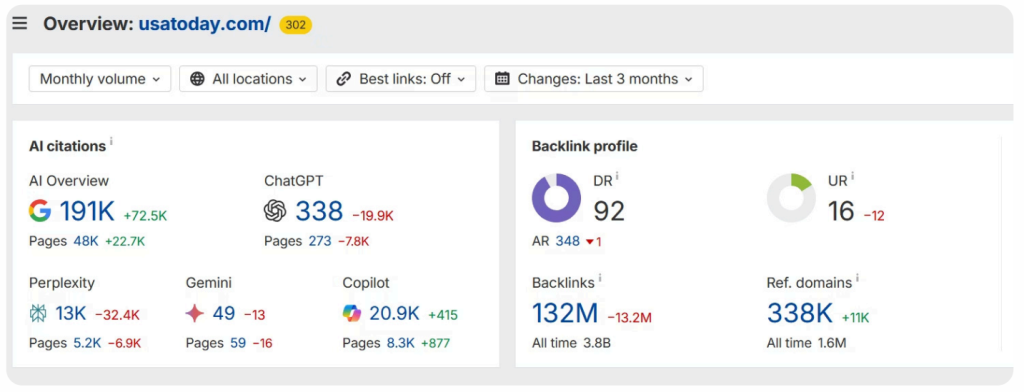
A big brand like USA Today is loved by Google but currently out of favor with ChatGPT, which prefers Business Insider or Medium. Which specific sites are in favor will change over time, but they are always big sites.
Signal #2: Clear, Direct Answers
90% of cited content has clear, self-contained answers at the top. Not buried paragraphs. Direct answers to the question being asked.
Here’s how to structure your content for this signal:
- Answer the main question in your first 100 words.
- Make your answer quotable and self-contained.
- Write in a factual, clear way throughout the content.
- Use simple, declarative sentences.
Our own AmpiFire client data agrees. Plus, we have found:
- DO NOT FOCUS ON BRAND VOICE OR PROMOTIONAL WRITING!
- Key takeaways and FAQs help.
- Repeat answers across the web in multiple places (inc. big news sites).
- Use frequent headings.
- In general, what helps the researching reader helps the researing AI.
- Technical fixes are overrated.
Using clear data, we often get cited as sources of information about competing (and sometimes outdated) traffic solutions, even though we are a self-funded, scrappy independent company, and those competitors are 100x bigger with billions of dollars behind them.
Signal #3: Freshness Matters
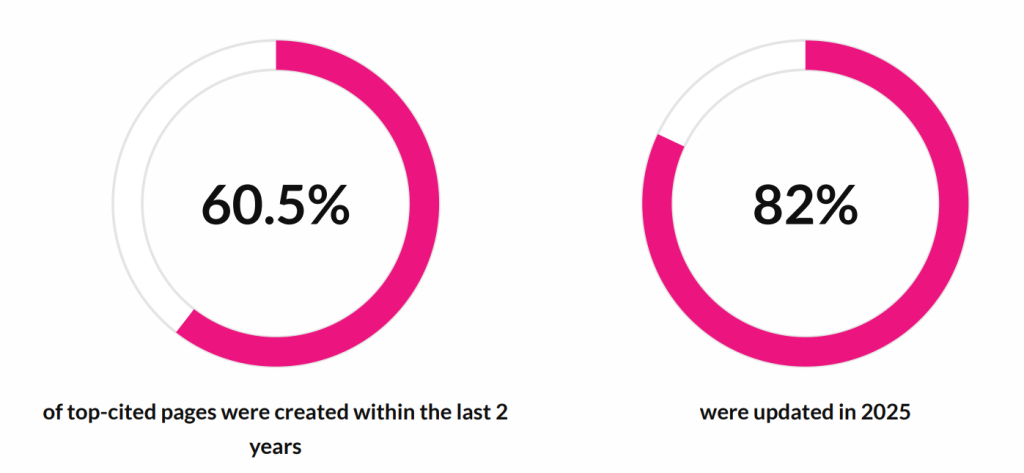
The Ahrefs data confirms this. 79.1% of blog lists cited by ChatGPT were updated in 2025, with 26% updated in just the past two months. AI strongly favors fresh content.
Here’s what you should do:
- Update old content regularly (not just republish, add new info).
- Add visible “Last updated” dates to your pages.
- Refresh stats, examples, and data points every year.
Signal #4: Encyclopedic Sources (Wikipedia & Reddit)
Wikipedia accounts for up to 13% of all ChatGPT citations. Reddit accounts for over 10% after algorithm adjustments in July 2025.
These are additional sources of citations worth considering, but they are not as widely used for product queries as expected due to abuse. Answering questions on Reddit or getting added to Wikipedia can help your brand appear in AI answers, but moderation is strict, and it holds less weight than it used to.
Remember the whistleblower story at the start? Many brands buy this influence on the influencer black market. Major corporations have operatives who infiltrate these platforms to plant information. Ethical brands can participate legitimately by providing genuine value on these platforms.
Signal #5: Traffic Thresholds & the Authority Shortcut
Sites under 190,000 monthly visitors all cluster in the same citation range, whether you have 20 visitors or 20,000. Cross that 190,000 threshold, and citations jump significantly.
This tells us ChatGPT weighs overall domain authority more heavily than individual page metrics. That’s why publishing on Big6 sites like USA Today and Business Insider (all well above this threshold) is so effective.
The Authority Shortcut: Publishing on Big Trusted Sites
The game is rigged toward authority. Big sites with massive link profiles get cited. Small sites get ignored. But you can inherit authority by getting published on sites that already have it.
The Big6 Sites AI Trusts Most
When you publish on high-authority sites, you’re not building your own authority from scratch. You’re borrowing theirs. These sites have massive domain authority, millions of referring domains, and trust signals that took 20 years to build. We mention these sites as it’s possible to publish to these sites through the AmpiFire platform, as well as 100s of other large sites.
| Site | Monthly Visitors | Domain Authority |
| USA Today | 52.3 Million | 94 |
| Business Insider | 80 Million | 94 |
| Medium | 66.9 Million | 95 |
| Associated Press | 43.8 Million | 92 |
| The Street | 8.1 Million | 87 |
| Street Insider | 134,000 | 83 |
| Barchart | 4.1 Million | 62 |
| Your website (typical) | Under 10,000 | 10–40 |
Platform-Specific Notes
USA Today
USA Today allows rich blog content (not just strict news articles), embedded video, and images with subheadings. It trains the YouTube algorithm to bring related visitors to your channel. It also consistently ranks high in Google and is a trusted source for AI Answers. USA Today is a preferred authority source for Google and Perplexity.
Business Insider & Medium
Business Insider and Medium are ChatGPT’s preferred sources. When users ask questions in ChatGPT, Business Insider & Medium citations appear disproportionately often.
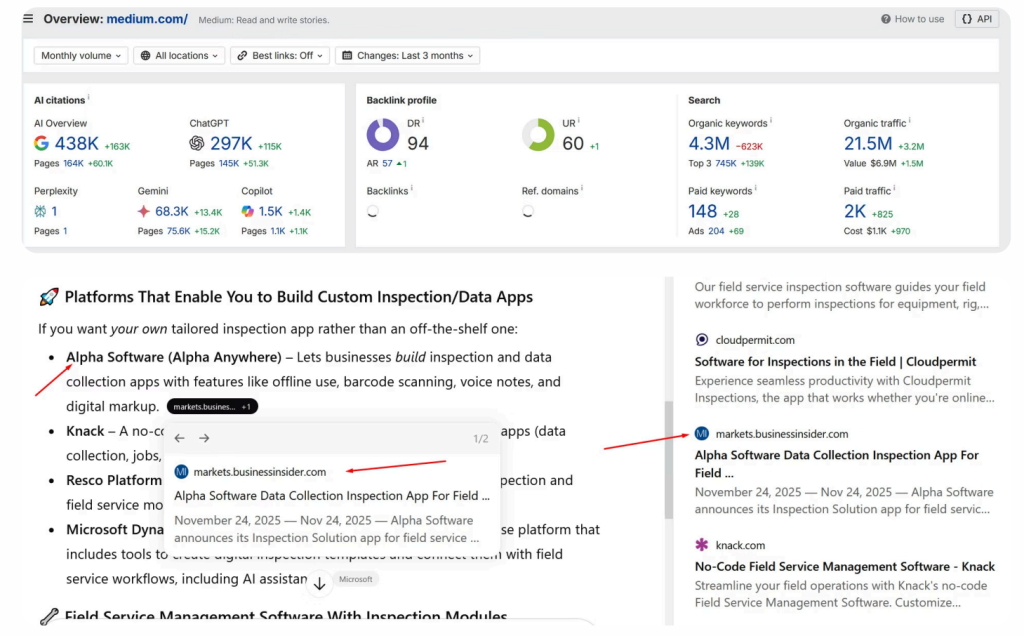
When your brand appears on these sites, you inherit their authority. AI sees you differently, immediately.
6 Powerful Uses for Authority Site Publishing
- Instant Reputation: When prospects Google your name, they see world-renowned authority brands talking about you. Media authority is something every business and professional should have. It helps you stand out and differentiates you as an expert. Association with major brands justifies higher prices and positions you as the obvious choice.
- Search Engine Rankings: Google trusts Big6 sites (like USA Today and Business Insider) so much that it ranks ANY content published on them immediately. This leads to instant traffic and sales. The sites have so much authority that your content appears on page one within hours, not months. We’ve seen #1 rankings for competitive terms right after publishing.
- Competition Hijacking: Target your competitors and hijack their traffic. When someone searches for a competitor, your Big6 article can appear, capturing buyer traffic while competitors pay for ads. Comparison content (“Brand A vs Brand B”) published on authority sites ranks fast and converts well because it captures high-intent search traffic.
- News Traffic: Premium Google News placement gets you weekly exposure. Newsjacking (riding the wave of breaking news stories) can deliver major traffic spikes. This is the exact strategy that generated six-figure traffic days by targeting major news events and positioning content on authority sites.
- AI Citation Shortcut: This is where it gets powerful. When AI sees your content on Big6 sites like USA Today, Business Insider, and AP, it cites you as a trusted source. This is a quick and powerful shortcut. If your website is too small to get cited on its own, Big6 publishing lets you bypass the authority gap entirely and start appearing in AI answers immediately.
- Build Your Own Domain Authority: Over time, Big6 publishing builds up your own domain authority. Each backlink from a DA 90+ site transfers authority to your website. Combined with other promotions, this compounds. Eventually, your own website gets cited more frequently in AI and Google, even without Big6 amplification. It’s a long-term investment that pays off increasingly over time.
AI Prefers Multiple Sources & Formats of Information
What AI Agents Check Before Recommending
AI agents consume information from multiple sources and formats before making recommendations. They watch videos, read blog posts, listen to podcasts, analyze social media, scan news sites, and review infographics.
A brand with content in just one or two places looks less authoritative than one with relevant content across dozens of platforms.
When making recommendations, AI agents check:
- YouTube videos reviewing or demonstrating products
- Blog posts explaining use cases
- Podcast discussions mentioning the brand
- Social media posts showing real applications
- News articles featuring the products
- Infographics comparing options
Why Visual Content Gives You an Edge
Visual content matters too. Google AI Overviews show and recommend videos directly in AI answers. ChatGPT displays infographics and images to support its responses. Having visual content increases your chances of being featured.
A product page with perfect optimization but zero external content still loses to a competitor with content across 50 platforms. AI agents weigh multiple sources before making recommendations.
The MultiCasting Effect
This is the MultiCasting effect: AI sees the same answer repeated across trusted sources and treats it as consensus truth. When your brand publishes the same information across news sites, YouTube, podcasts, social media, and blogs, AI treats that repetition as validation.
The real numbers prove this is not theoretical. ChatGPT drove 20% of Walmart’s referral traffic, 20% of Etsy’s, and nearly 15% of Target’s in late 2025. This isn’t theoretical. AI is already determining who wins.
The Implementation Strategy: How to Get Your Brand Cited by AI

Step 1: Answer the Questions Buyers Have Before Purchasing
What research do people do before buying in your category? Map the buyer journey from awareness to purchase.
Here’s an example for a treadmill company:
- Top of funnel: “Elliptical vs treadmills”(not decided yet)
- Middle: “Treadmills for someone over 200 pounds”
- Bottom: “Horizon vs NordicTrack”(comparing models)
- Ready to buy: “Price of Horizon 7.4 treadmill”
Don’t be afraid to talk about competitors. If you don’t explain how your product compares against competitors, then your opinion is essentially never going to exist in AI answers, and you don’t get your say.
Step 2: Publish Detailed Content on Your Own Website
Create comprehensive content that answers buyer questions. This includes top lists, comparisons, and detailed guides. Publish these on your own website first, on your blog. This is where factual, product-focused content lives that actually answers buyer questions. Don’t fill it with self-serving magazine-style content, random topics chosen by ChatGPT, or announcements. Save announcements for your newsletter or social media.
Your blog is primarily useful for showing up in Google and AI answers, so it should focus on buyer questions. Use a tool like Headline Pig to find buyer topics you can publish that answer real buyer questions.
Example content for your site:
- “7 Best Treadmills for Small Apartments in 2026”
- “Treadmill Buying Guide: What to Look For”
- “NordicTrack vs Horizon: Complete Comparison”
Step 3: The Big6 Authority Strategy
Now use high-authority publications to amplify what you’ve published. There are two approaches to how you should write this content.
Approach A: Link Back to Your Detailed Content
Create an announcement-style piece for authority sites that links to your detailed content. Think factual or news-release tone. The authority site piece should be dry and newsworthy, focusing on industry trends, research findings, or expert commentary. Within the article, link to your detailed guide as a resource.
Here’s how it works:
- Your site: “7 Best Treadmills for Small Apartments”(detailed, product-focused)
- USA Today piece: “BrandX Shows Home Fitness Equipment Sales Surge as Compact Options Gain Popularity”
- The USA Today piece mentions the trend and links to your detailed guide as a resource
Approach B: Include Top Lists Within Authority Site Content (Carefully)
As mentioned earlier, publishing a top list of products in your industry is a great way to show up in AI since they actively search top lists to decide what to recommend to users.
Product comparisons and specific use cases are also very useful. However, content like this cannot be published on the Big6 sites as they decline promotional content. So you should publish this content on your own site.
In option A, you simply reference your product-focused content on your blog and link to it to give it a boost in Google and AI answers in ChatGPT. But if you are smart, you can also work in a short version of your top list and associate your brand with larger competitors.
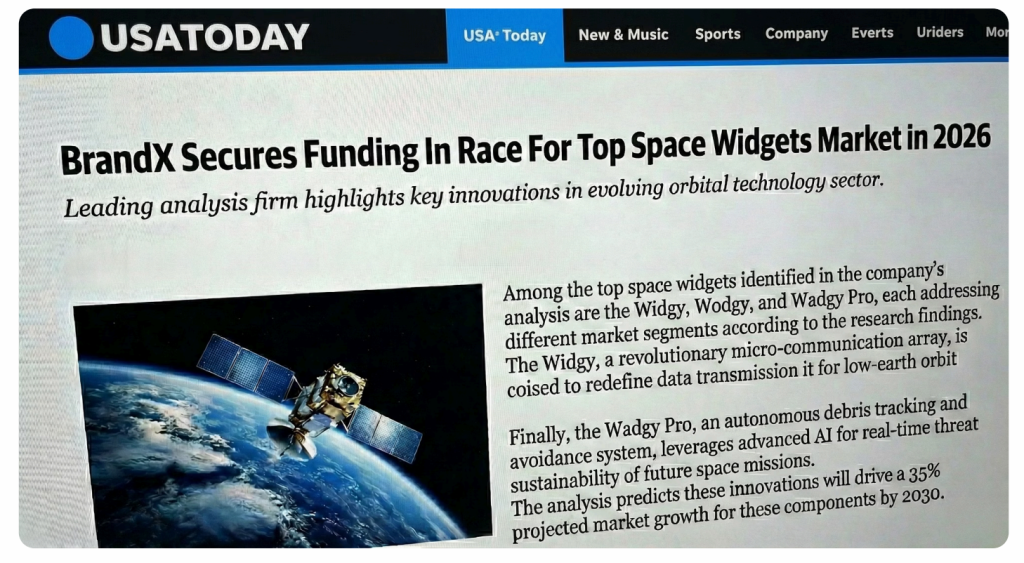
- How to Do This: Frame it as an announcement. Keep the list mentions casual and within the flowing paragraph content. This drastically increases AI pickup because the content appears directly on a DA 90+ site. But you must not be promotional; you need a genuine announcement.
- Example headline: “BrandX Secures Funding in Race for Top Space Widgets in 2026.”
- Example In-Content Mention: “Among the top space widgets identified in the company’s analysis are the Widgy, Wodgy, and Wadgy Pro, each addressing different market segments according to the research findings.”
- What NOT to Do: Don’t format it like a blog post with “#1: Widgy – This amazing widget…” followed by promotional descriptions. That style won’t pass editorial review on premium sites.
- Why This Works: When AI sees a DA 94 site mentioning specific products in a factual context, it treats that information as authoritative. The products get directly associated with the authority site, massively increasing citation likelihood.
Optional Steps: Additional Amplification
For most brands, authority site publishing, combined with buyer-question content on your own site, is the primary driver of AI citations. These optional steps add extra coverage.
Wikipedia & Reddit Mentions
If you want additional amplification, you can hire specialists (or build enough reputation on the platforms over time yourself) to create genuine contributions on Wikipedia or Reddit that reference your products. This is optional, but highly difficult since most content does not fit the purpose of the site, so options to do this are limited, and you should not spam these platforms.
For this reason, the Big6 authority sites, mixed with buyer-questions-content on your site, are typically the primary driver of AI citations for brands.
Publish Everywhere With Multicasting
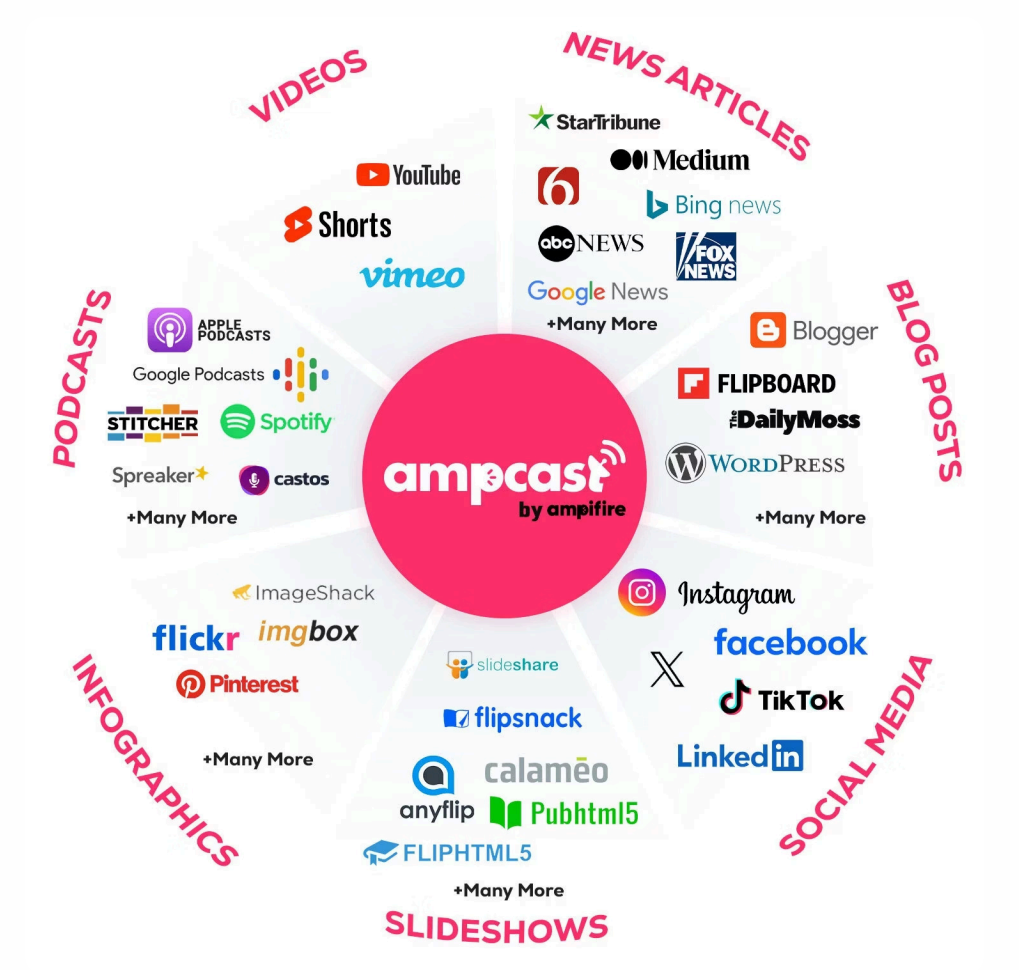
If you want additional chances of showing up in AI, plus to have your answers also show up on other platforms like YouTube, Spotify, and social media where people research products, then consider taking the same topic and publishing it across other channels.
You can do this manually or with a collection of AI and distribution tools, or just use AmpCast by AmpiFire, which is designed to publish your answers everywhere in an optimized format.
Real Results From This Strategy
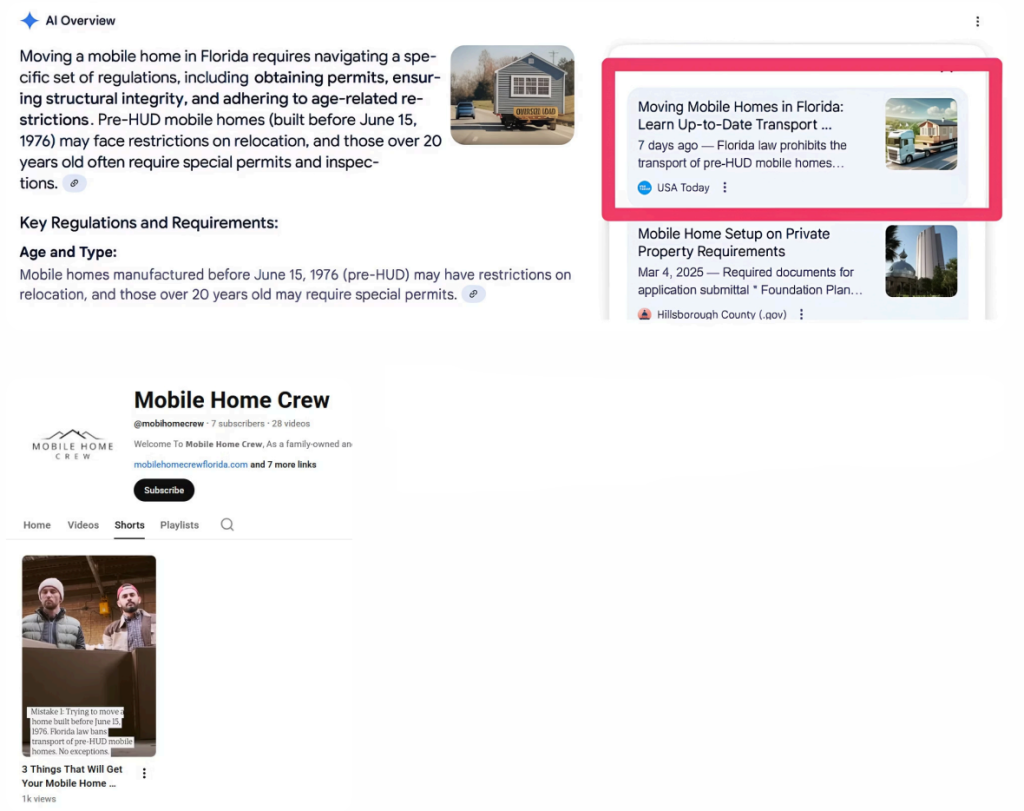
Mobile Home Transportation Company (Florida)
A mobile home moving company in Florida. Within 7 days of publishing their Big6 campaign with USA Today:
- Took over Google’s AI Answers for their market
- Became the go-to authority AI cites for mobile home moving
- Appeared within 48 hours in AI Answer boxes
- A small number of visitors watched the YouTube video in the USA Today article, which then fed the YouTube algorithm to recommend their new YouTube short to 1000 people in their market.
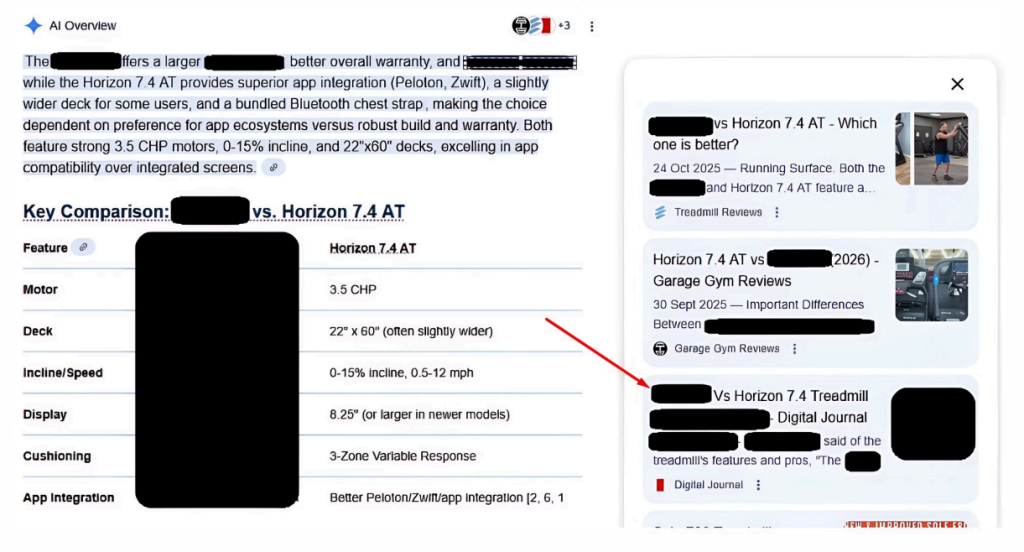
Home Fitness eCommerce Store
A small fitness equipment eCommerce store targeting product comparison traffic invested $5,000 per month in Big6 campaigns.
- Google AI Overview: Featured as the #1 source for comparison searches
- ChatGPT: Referenced their article for equipment recommendations
- Perplexity AI: Listed as a top authority on the topic
- Google now recommends their OWN brand products in related searches
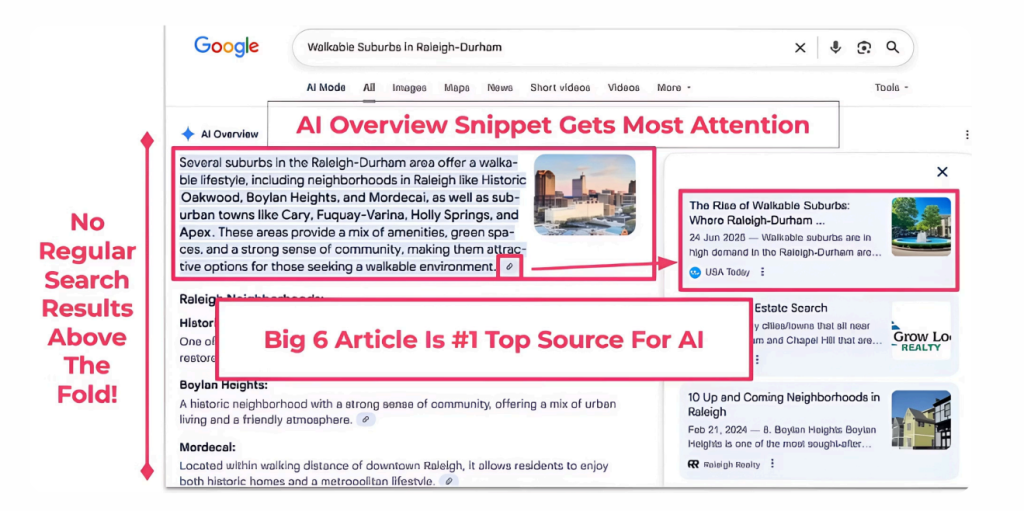
Real Estate Professional
A real estate professional ran a Big6 campaign and achieved these results:
- No regular search results above the fold
- AI Overview snippet gets the most attention
- Big6 article is the #1 top source for AI, claiming the prime real estate on search results
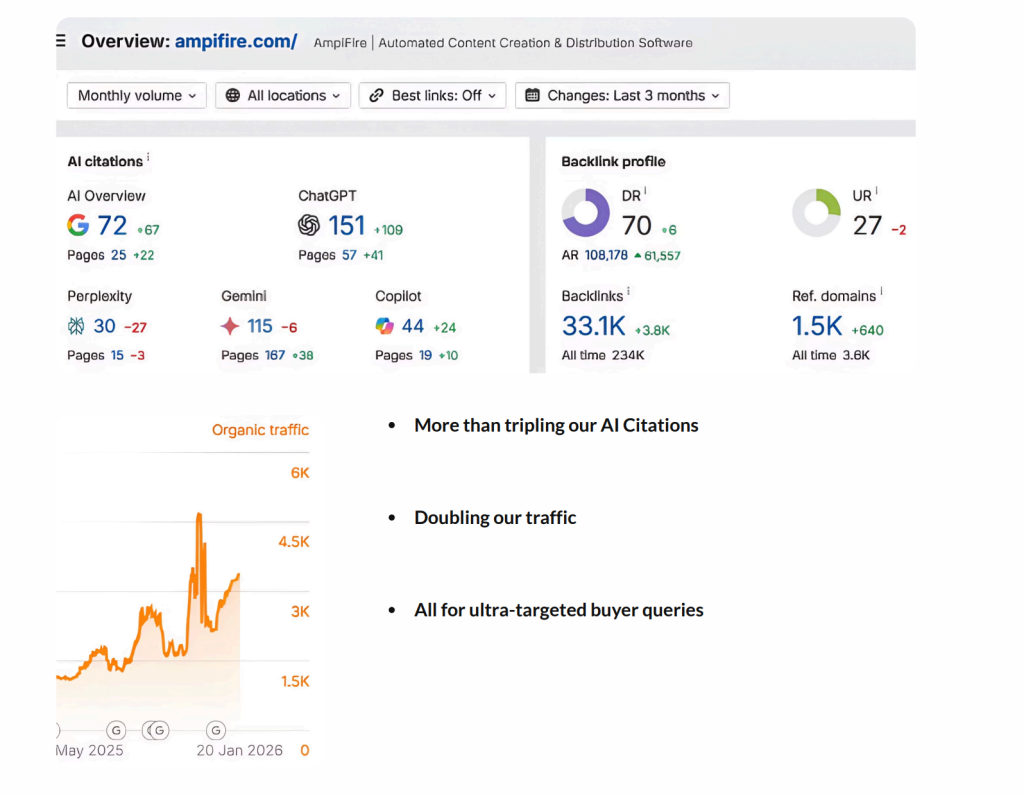
AmpiFire’s Own Brand
We grew our own 100% independent brand without funding, against 9-figure-funded brands, breaking all the rules. The results?
- More than tripling our AI Citations
- Doubling our traffic
- All for ultra-targeted buyer queries
The Window Is Open
AI is taking over search. The AI Answer Box appears ABOVE organic results. Traditional SEO (ranking #1 in organic results) isn’t enough anymore.
The same sites Google trusts for rankings are the sites AI trusts for citations.
Big corporations have teams dedicated to influencing AI. But they’re slow. Bureaucratic. Their approval processes take months.
The companies establishing authority now (before AI fully takes over search) will have massive advantages for years. Once AI decides you’re the trusted source in your category, that compounds. More citations lead to more trust lead to more citations.
The question isn’t whether AI will determine who wins online. It already does. The question is: Will you be the one AI recommends, or will it be your competitor?
Why AmpiFire Is the Fastest Way to Get Cited by AI
At AmpiFire, we built our platform to help your brand be everywhere your buyers look and AI recommends. AmpCast AI turns one topic into 8 content formats, including news articles, blog posts, interview podcasts, videos, reels/shorts, infographics, flipbooks, and social posts, then auto-publishes them across 300+ platforms.
Every campaign gets you on USA Today, Business Insider, Associated Press, Medium, The Street, and more, plus Google News, YouTube, Spotify, and major news networks. You also get up to 3 embedded hyperlinks and images, NAP citations for local rankings, editorial proofreading, and “As Seen On” trust badges for your website. Start building your authority advantage today and take control before your competitors do.
Frequently Asked Questions (FAQs)
How does ChatGPT decide which brands to recommend?
ChatGPT pulls from a mix of search sources, including Bing and Google data. It cross-references multiple review sites and comparison articles, aggregates the most recommended products across those sources, and then searches exact product names again for verification. It favors content published on big, trusted websites, especially “best of” lists that are recently updated and written in a clear, factual style. A study of 485,000 citations found that 43.8% come from “Best X” blog lists, and 79.1% of those lists were updated in the current year.
What type of content is most likely to get picked up by AI?
“Best of” lists, product comparisons, and buyer guides with clear, direct answers are the most commonly cited formats. 90% of cited content has clear, self-contained answers near the top of the page. AI specifically searches for these content types when making product and service recommendations, and it even adds modifiers like “best,” “reviews,” and the current year to search queries behind the scenes.
How fast can a brand start showing up in AI answers?
Some brands have appeared in Google’s AI Answers within 48 hours of publishing on authority sites. One fitness equipment brand became the #1 cited source for comparison searches across Google AI, ChatGPT, and Perplexity. Speed depends on the topic, competition, and content quality, but the impact can be much faster than with traditional content strategies.
How does AmpiFire help brands show up in AI recommendations?
AmpiFire uses AmpCast AI to create 8 content formats from a single topic, including news articles, social posts, reels/shorts, infographics, interview podcasts, flipbooks/slideshows, blog posts, and longer informational videos. These are published across 300+ platforms, including Google News, YouTube, Spotify, and major news networks like USA Today and Business Insider. This gives your brand the multi-channel presence AI needs before it recommends you, and each authority site backlink also builds your own domain authority over time.
*Disclaimer: Results may vary based on individual circumstances, business type, and content strategy. The time savings and outcomes mentioned are based on typical user experiences and are not guaranteed. For specific pricing and service details, please visit AmpiFire.
Author
Related Posts


Does Google Hate AI Content? ChatGPT’s Stance on Detection, SEO, Indexing, & Duplicate Penalties
Learn how Google views AI Chat GPT content through the lens of Chat GPT. Discover the impact of indexing, duplicate…

6 Tips That Will Help You Build Your Personal Brand & Gain Authority
It’s important to understand the importance of personal branding and find ways you can put your best foot forward in…


How To Increase Your Google Maps Rankings with AmpiFire’s Citation Building Services?
Explore how AmpiFire's citation building services can enhance Google Maps rankings for local businesses and attract more customers.

Amp Competitor Comparison Tool [Free]: Brand Mentions, Traffic, Backlinks & Pages
Enter your website and up to 9 competitor domains to instantly compare organic traffic performance and understand why certain sites…
How To Get Any Site Or Offer Published On 8-Figure Traffic Sites Like Bloomberg, Nasdaq, Yahoo! News & More
Borrow the Authority of established brands; get them talking about you. Get your site or offer published on sites people…

Blaze AI vs ChatGPT: Which is the Better AI Content Generator?
Compare Blaze AI vs ChatGPT for content creation. See which AI tool fits your needs and how AmpiFire amplifies reach…