

Key Takeaways
- Digital Economics is Dan Koe’s systems-based course that helps you build a one-person business through brand, content, offers, and automated promotions.
- The program runs in two tiers: the Bachelors at $499 and the Masters at $999, with the Masters adding the full monetization curriculum, extra templates, and a live product launch breakdown.
- Reviews on the Digital Economics site praise the clear content structure and the practical help with selling although independent reviews outside the platform are thin.
- Its main pros are the operating system and the depth of the monetization curriculum, though it mostly gives an edge to those who have already started creating.
- AmpiFire’s AmpCast AI extends what the program teaches about distribution by automatically creating content into multiple formats and publishing them across 300+ high-traffic platforms so a solo creator reaches audiences without a full team.
What Is Dan Koe’s Digital Economics?
Digital Economics, sold in Bachelors and Masters Degree tiers, is an accelerated, systems-based program for building a one-person business in the digital economy.
Instead of dumping hours of video on you, it is built around condensed, high-signal teaching paired with operational systems you plug into your own brand, dense and immediately applicable.
The core promise is learning to productize yourself: building a personal brand, creating content across platforms, developing an offer, and automating the promotions that drive sales. The program is delivered through a set of plug-and-play templates he calls the Creator Command Center, available in both Notion and Kortex, which act as your business operating system.

How AmpiFire Works:
- Research & Target: Find high-demand topics your buyers search for.
- Create & Repurpose: AmpiFire’s AmpCast AI generates news articles, blog posts, interview podcasts, longer informational videos, reels/shorts, infographics, flipbooks/slideshows, and social posts.
- Distribute & Amplify: Auto-publish to 300+ sites, including Google News, YouTube, Spotify, and major news networks.
Get more traffic from people who want to buy your stuff, and powerful “As Seen On” trust badges for your site.
Do It Yourself (with AI), Done For You Content, & 100% Managed Organic Growth options available.
Grow Your Free Traffic From Everywhere
What’s Inside Digital Economics
The curriculum is structured to take you from little context to an operational one-person business. Here is how it breaks down.
The Creator Command Center & Systems-Based Approach
One of the most distinctive elements of Digital Economics is the Notion hub Dan Koe calls the Creator Command Center. Instead of leaving you to work out how to apply the lessons, he hands you the operating system he uses to run his own brand, including research, content creation, time management, and project building in one place.
Brand, Content & Audience Education
The Bachelors curriculum covers the foundations of a one-person business: finding your niche, building a brand, crafting an impactful message, and developing your ideas and voice.
A recurring focus is a system for turning one content idea into posts, subscribers, and sales that can be maintained in about an hour a day.
The Bachelors content strategy phase also covers distribution, showing how to repurpose one piece of content so it performs across other platforms.
Marketing & Monetization Curriculum
The Masters tier is where the program moves into making money from your brand. It covers building an offer with his Minimum Viable Offer strategy, creating and selling products or services without a large following, writing landing pages and promotions, and automating client acquisition and sales.
The “Zip File” Learning Model
Dan Koe describes the format as a “zip file” for your brain. The idea is that non-institutional courses are condensed by design, so the curriculum aims to deliver high-density, immediately applicable knowledge instead of padding hours of video for perceived value. The intent is that you learn fast and implement faster.
Digital Economics Cost & Enrollment Options
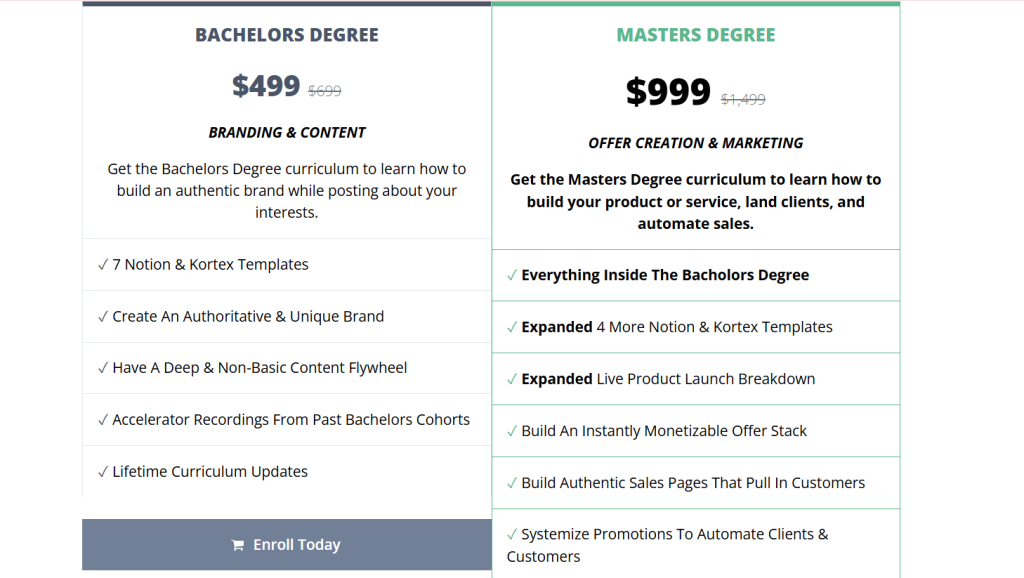
Digital Economics comes in two self-serve tiers. The Bachelors curriculum, focused on branding and content, is priced at $499, down from $699, while the Masters tier, which adds offer creation and marketing, is $999, down from $1,499.
Both tiers include the Creator Command Center templates in Notion and Kortex, accelerator recordings from past Bachelors cohorts, and lifetime curriculum updates, with the Masters tier adding four further templates and a live product launch breakdown.
Digital Economics Reviews: What People Are Saying
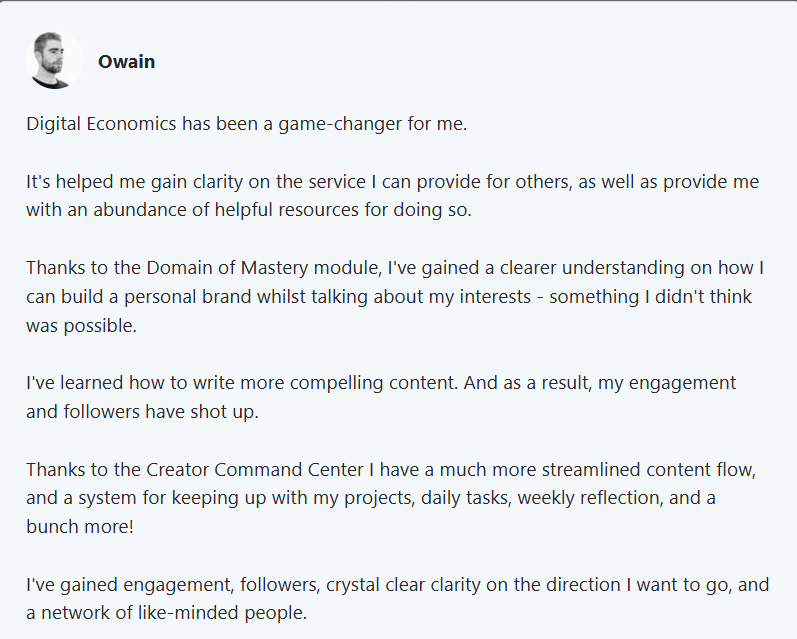
Among students who praise it, the most common themes are the clear path from the Bachelors foundations to the Masters monetization modules, and the practical help with articulating ideas, generating content, and selling without feeling pushy. Much of this praise comes from testimonials on Dan Koe’s own page, so it is worth reading alongside independent views.
Independent reviews are thin on the ground, and most surface-level coverage online comes from course-resale and download sites rather than genuine student reviews. So prospective students should verify any income claims for themselves and check whether his free content covers similar ground.
Digital Economics Pros & Cons
No course is perfect for everyone. Here is an honest look at where Digital Economics delivers and where it falls short.
Pros
- Systems over theory: the Creator Command Center gives you an actual operating system to run your brand, not just ideas to think about.
- Accelerator recordings included: a library of recorded accelerator sessions from past cohorts covering breakthroughs, common roadblocks, and how students tailored the system to their own brands.
- Built from his own practice: Dan Koe teaches the same systems he uses to run his business and build his own products, so the material comes from doing rather than theory.
- Condensed and efficient: the zip-file model keeps the teaching dense and immediately usable, with no bloated video library to wade through.
- Lifetime curriculum updates: both tiers include ongoing updates to the curriculum at no extra cost, so the material you buy keeps pace with changes in the platforms it teaches.
Cons
- Requires self-direction: the systems work if you work them, so anyone who prefers heavy hand-holding or external accountability may find the format demanding.
- Best suited for those already creating: complete beginners with no niche, audience, or content presence face a learning curve and may need to build some groundwork before the systems fully click.
- Higher-tier price: the Masters tier is a significant investment at $999, which is a lot to commit for someone still testing whether this path is right for them.
- Long sales page: the program is sold through a dense, claim-heavy sales page, which can make it harder to quickly assess what you are actually buying.
Get Your Brand Seen on Multiple Channels with AmpCast AI
Once you have built your offer and dialed in your content system, the next challenge is distribution: getting your message in front of more people consistently without burning out. Digital Economics teaches you to turn one idea into content for every platform, but doing that by hand, week after week, is the part that drains a solo creator’s time. The creators who win are the ones who keep that reach going without it swallowing their whole day.
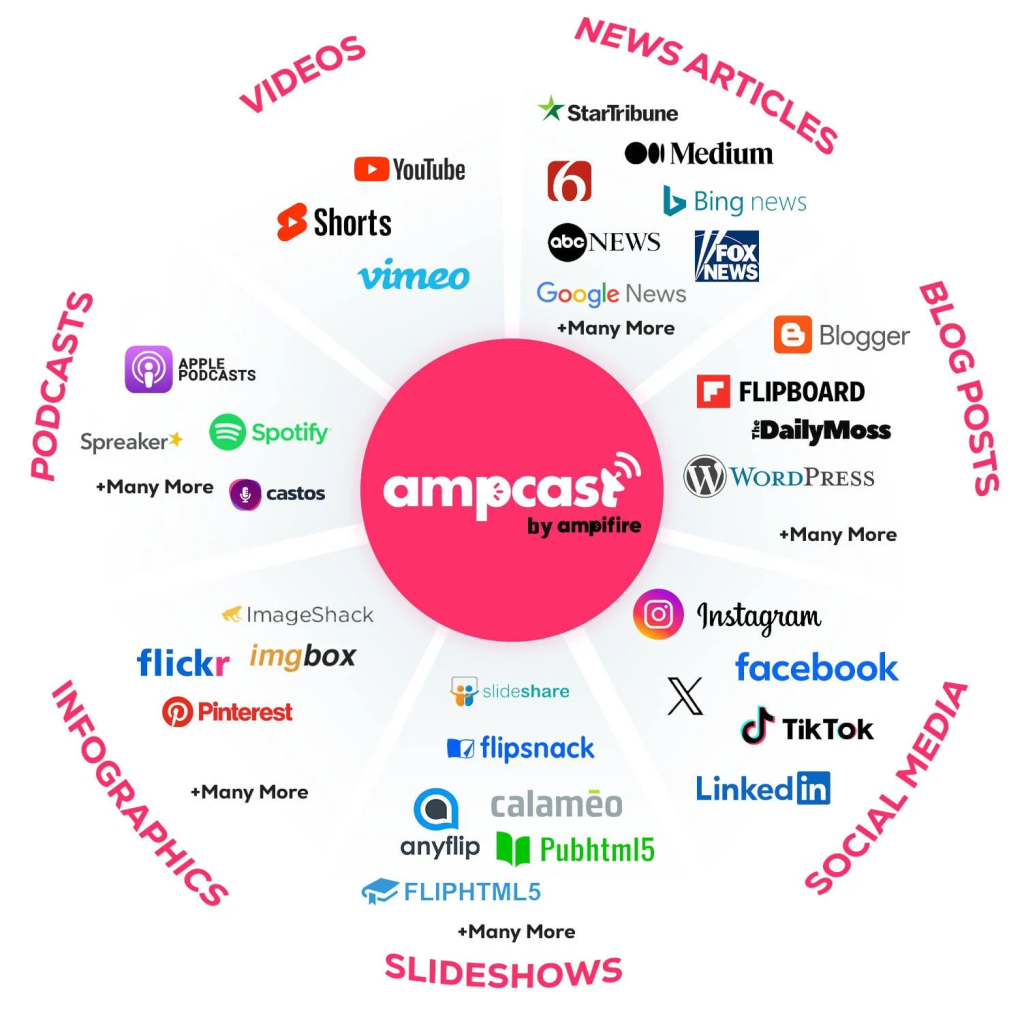
Our AmpCast AI takes one idea and builds it into eight content formats (news articles, blog posts, interview podcasts, longer informational videos, reels/shorts, infographics, flipbooks/slideshows, and social posts), then publishes them automatically across 300+ high-traffic platforms including YouTube, Spotify, and major news networks, so your brand shows up wherever your audience already is. It handles the distribution work the Digital Economics system points to, at a scale that would otherwise take a full team. Start using AmpCast AI to get your brand seen everywhere while you focus on the work only you can do.
Frequently Asked Questions (FAQs)
What is Dan Koe’s Digital Economics program?
Digital Economics is an accelerated, systems-based curriculum for building a one-person business in the digital economy. It covers brand building, content creation, offer development, and automated promotions, delivered through a Notion hub called the Creator Command Center that acts as your business operating system.
Is Digital Economics suitable for new brands?
It can be, though it works best when you already have some sense of your niche or the value you want to offer. Dan Koe’s own materials note that complete beginners face a learning curve, since much of the advantage goes to those who have already started creating.
How does Digital Economics differ from The 2 Hour Writer?
They solve different problems. The 2 Hour Writer focuses specifically on writing, teaching you to produce quality content efficiently, while Digital Economics is the broader system covering your brand, offer, marketing, and promotions.
What results can you realistically expect from Digital Economics?
Results depend almost entirely on how thoroughly you apply the systems, not on the course alone. The program gives you the frameworks and the operating system, but the outcome comes from your own consistent effort.
What is the best way to distribute my content across platforms?
Once your content system is built with the Digital Economics framework, distribution becomes the main lever for growth. AmpCast AI handles that by taking one idea and building it into multiple formats, then publishing them automatically across high-traffic platforms like YouTube, Spotify, Pinterest, LinkedIn, and Google News. Your brand stays visible across search, social, video, and audio, and even surfaces in AI tools when people ask for recommendations.
*Disclaimer: Results may vary based on individual circumstances, business type, and content strategy. The time savings and outcomes mentioned are based on typical user experiences and are not guaranteed. For specific pricing and service details, please visit AmpiFire.
Author
Related Posts


Tim Stoddart Copyblogger Academy: Cost, Reviews, Pros & Cons
Find out what Tim Stoddart Copyblogger Academy includes, how much it costs after the $1 trial, what members say, and…

Semrush Academy Content Marketing and SEO Fundamentals: Cost, Reviews, Pros & Cons
Find out what Semrush Academy Content Marketing and SEO Fundamentals covers, who it's for, what learners say, and how to…

HubSpot Academy Content Marketing Certification: Cost, Reviews, Pros & Cons
Find out what the HubSpot Academy Content Marketing Certification covers, how the exam works, what learners say, and how to…
Creator Science Lab: Cost, Reviews, Pros & Cons
Find out what Creator Science Lab includes across its three membership tiers, what members report, and who Jay Clouse's creator…
Justin Welsh Content Operating System: Cost, Reviews, Pros & Cons
Learn about Justin Welsh's Content Operating System with a full look at cost, reviews, pros, cons, and why AmpCast AI…


Mailchimp vs Constant Contact for Email Marketing Campaigns: Cost, Pros & Cons
Compare Mailchimp vs Constant Contact to find the best email marketing platform for your business. Learn the pricing, features, pros,…