
Key Takeaways
- The Content Operating System is a 90-minute course from Justin Welsh that teaches solopreneurs a repeatable framework for producing one newsletter and 6 to 12 written social posts each week.
- Priced at a one-time payment of $200, the course includes video modules, text-based bonus material, and cloneable templates.
- Its biggest strengths are the short runtime, ready-to-use templates, and battle-tested system from a well-known LinkedIn solopreneur, though it doesn’t cover visual content entirely.
- User reviews praise the affordability and clarity but note that the course suits intermediate creators with a defined niche and does not extend to video, podcasts, or news channels.
- Businesses that want to reach buyers across search, social, video, podcasts, and news can use AmpiFire’s AmpCast AI to turn one topic into 8 content formats and publish them on 300+ high-authority sites automatically.
Is Justin Welsh’s Content OS Worth It?
If you’ve ever stared at a blank screen wondering what to post this week, the Content Operating System was built for exactly that problem.
Justin Welsh is one of the most recognized solopreneurs in the digital business space, having grown his LinkedIn following to over 800,000 and his newsletter to hundreds of thousands of subscribers, all as a one-person operation.
His Content OS course distills that exact system into a 90-minute, no-fluff walkthrough you can apply immediately. For creators serious about building an audience through written content, it delivers real, repeatable results.

How AmpiFire Works:
- Research & Target: Find high-demand topics your buyers search for.
- Create & Repurpose: AmpiFire’s AmpCast AI generates news articles, blog posts, interview podcasts, longer informational videos, reels/shorts, infographics, flipbooks/slideshows, and social posts.
- Distribute & Amplify: Auto-publish to 300+ sites, including Google News, YouTube, Spotify, and major news networks.
Get more traffic from people who want to buy your stuff, and powerful “As Seen On” trust badges for your site.
Do It Yourself (with AI), Done For You Content, & 100% Managed Organic Growth options available.
Grow Your Free Traffic From Everywhere
What Is the Content Operating System?
The Content Operating System is a step-by-step content creation framework developed by Justin Welsh. Its core promise is straightforward: give creators a reliable system to produce one high-quality newsletter and 6–12 pieces of high-performance social media content every week, consistently, without burning out.
Unlike broad marketing courses that cover a little of everything, the Content OS is laser-focused on written content at scale. It teaches you how to build an idea engine, repurpose content efficiently, and use a structured workflow that removes the guesswork from what to create.
What Is Inside the Content OS Course?
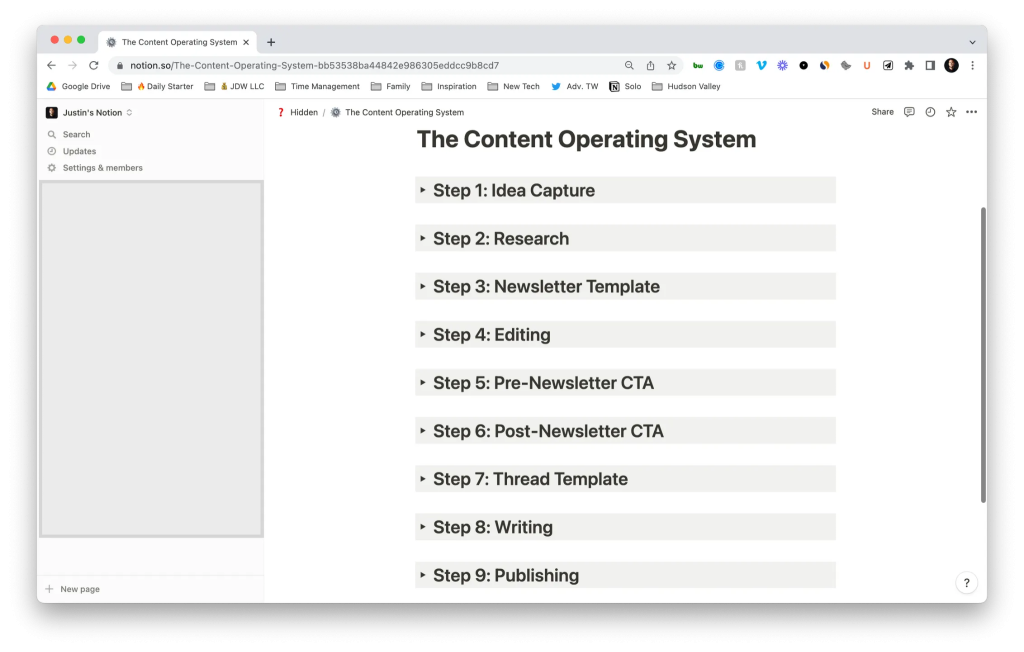
The course is built around a nine-step system inside Notion: Idea Capture, Research, Newsletter Template, Editing, Pre-Newsletter CTA, Post-Newsletter CTA, Thread Template, Writing, and Publishing. Each step builds on the last, moving from sourcing ideas through to distributing finished content across LinkedIn and Twitter/X. The total runtime is roughly 90 minutes, so you can complete it in a single sitting.
Justin Welsh calls the core framework a “Hub and Spoke” model. The newsletter acts as the hub, and every social post, thread, and promotional piece branches out from it. The course covers how to build a system for generating 10 or more content ideas a day, how to structure those ideas into posts that drive engagement using human psychology, and how to repurpose one newsletter into 6 to 12 separate pieces of social content.
The course also includes text-based bonus material that goes deeper on specific tactics, along with cloneable Notion templates covering idea capture, content structuring, and weekly publishing schedules.
Content OS Pricing: What Does It Cost?
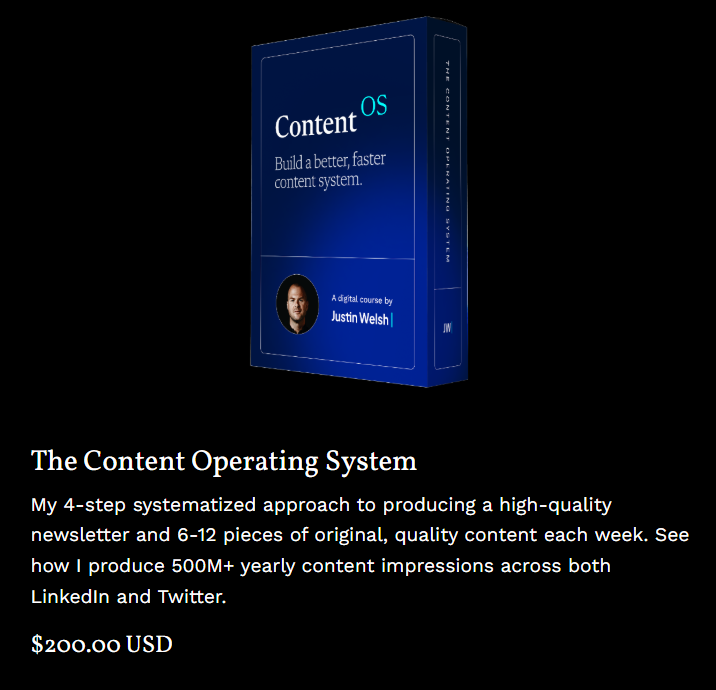
The Content Operating System is priced as a one-time purchase. At the time of writing, the course is available for $200, which puts it firmly in the “no-brainer” category for anyone serious about building a content system that actually works.
There’s no ongoing cost, and the cloneable templates alone are worth the price of admission for creators who’ve struggled to maintain a consistent publishing system.
Content Operating System Reviews
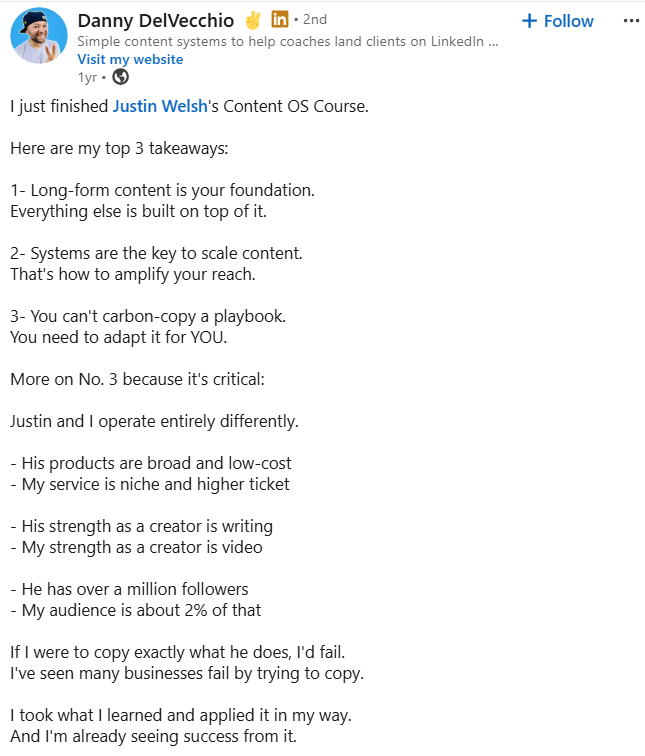
Reviews of Justin Welsh’s Content Operating System are largely positive, with users on Medium and independent review sites praising its affordability, clear structure, and practical templates. Most reviewers highlight that the course is short and delivers a straightforward framework for producing a newsletter and social posts each week, which makes it easy to finish and put to work quickly.
Common criticisms include the lack of personalized support and the fact that the course works best for intermediate creators who already know their niche and brand voice. Reviewers also note that the framework is focused specifically on written content for LinkedIn and Twitter, so creators looking to expand into video, podcasts, or news coverage would need additional tools to cover those channels.
Pros of the Content Operating System
Short Enough to Finish in One Sitting
The biggest barrier to most online courses is completion. People buy, get overwhelmed, and never finish.
The Content OS sidesteps this entirely by keeping the core course to a tight 90 minutes. For busy solopreneurs and creators juggling multiple responsibilities, that accessibility is a significant advantage over longer, more drawn-out programs.
Practical Templates You Can Use Immediately
The cloneable templates are ready to use from day one, which means your first week of implementation doesn’t require you to build any infrastructure from scratch.
This is particularly valuable for creators who already understand content marketing in theory but keep stalling on execution. Having a pre-built system removes friction and gets you publishing faster.
Built by a Solopreneur Hitting $10M Cumulative Revenue
Justin Welsh didn’t build the Content OS as a theoretical framework. It’s the exact system he used to scale a one-person business past $10 million in total revenue. Every module, every template, and every tactic in the course has been battle-tested on his own audience across LinkedIn and his newsletter.
Self-Paced With No Fluff
The course is fully self-paced, meaning you learn on your schedule without deadlines or live session commitments. Combined with its lean runtime, the Content OS respects your time in a way that most digital courses simply don’t.
Cons of the Content Operating System
No Email or Call Support Available
The Content OS is a self-serve product. There’s no dedicated support line, coaching calls, or community access included in the base purchase.
If you get stuck or have questions as you implement the system, you’re largely on your own. Creators who thrive with guidance and accountability may find the lack of structured support frustrating.
Heavily Focused on Written Content Only
The Content OS is built entirely around written content like blog posts, LinkedIn updates, Twitter/X threads, and newsletters. There is no coverage of video scripting, podcast production, short-form video strategy, or visual content creation.
Limited Value for Video-First Creators
YouTube creators, TikTok creators, and Instagram Reels-focused brands will find the Content OS has very little to offer them directly. The system is optimized for text-based platforms, and while some of the ideation principles are transferable, the core workflow and templates don’t translate to video production pipelines.
If your audience lives on video platforms, the Content OS alone won’t build your content system. You’d need to supplement it with additional resources, or consider a multi-channel content tool that handles both written and video formats in one place.
A Simpler Path to Multi-Channel Content with AmpCast AI
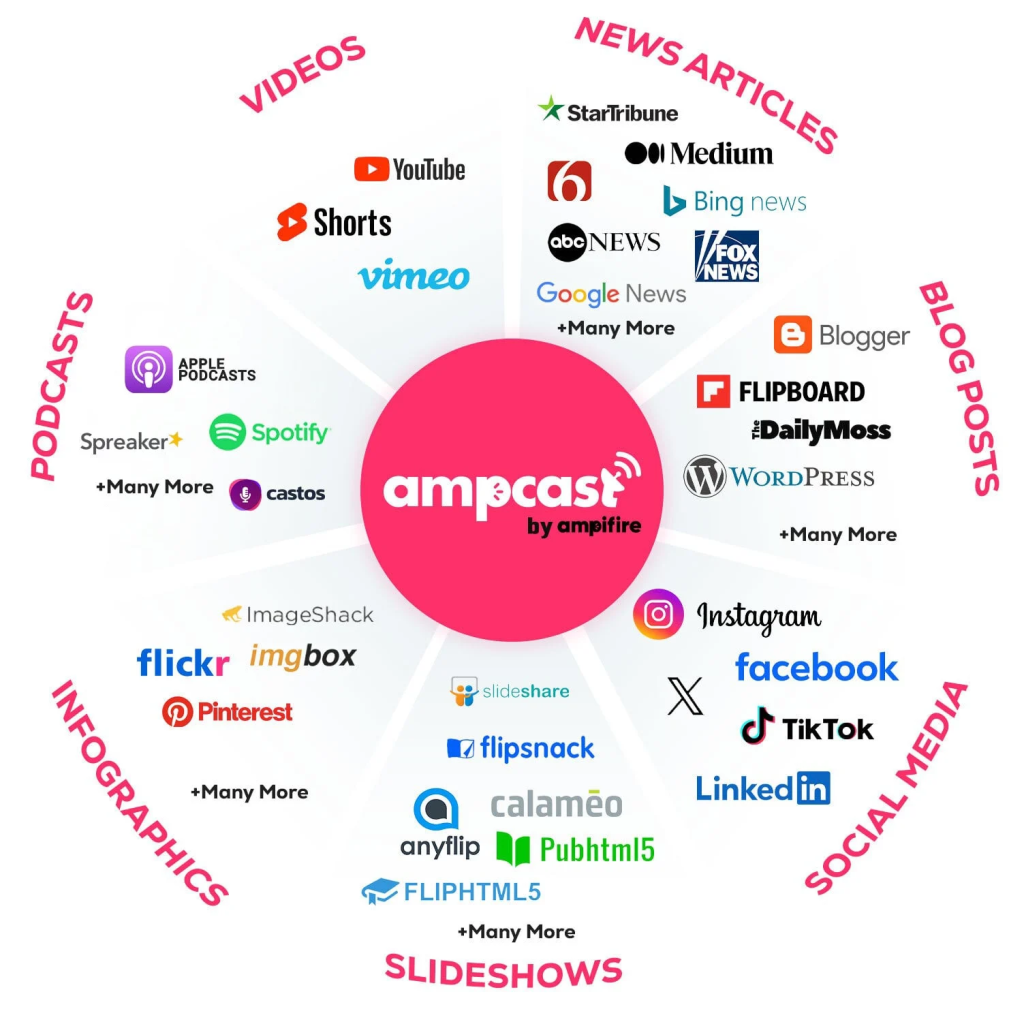
Justin Welsh’s Content Operating System gives solopreneurs a clear weekly routine for one newsletter and 6 to 12 social posts on LinkedIn and X, which makes the $200 course a solid pick if those platforms are where your audience lives. When your buyers also research purchases on Google, YouTube, Spotify, and news sites, AmpiFire’s AmpCast AI can cover those channels without a full content team.
It researches the topics your buyers search for before they purchase, turns each one into 8 formats (news articles, blog posts, interview podcasts, longer informational videos, reels/shorts, infographics, flipbooks/slideshows, and social posts), and publishes them across 300+ sites, including YouTube, Spotify, Apple Podcasts, Pinterest, Google News, and FOX affiliate sites. Because your traffic then comes from search, video, podcasts, and social at once, a slowdown on any one platform won’t cut off your leads, and any paid ads you run work harder when prospects find you in several places. See how AmpCast AI can put your brand in front of buyers today.
Frequently Asked Questions (FAQs)
Who is Justin Welsh?
Justin Welsh is a solopreneur, course creator, and LinkedIn strategist who built a one-person business generating over $10 million in total revenue. He left the corporate world in 2019 to build his own business and has since grown one of the most-followed personal brands on LinkedIn, with an audience exceeding 800,000 followers.
Does the Content OS work for platforms other than LinkedIn and Twitter?
The Content OS is primarily designed with LinkedIn and Twitter/X in mind. The templates, workflows, and content structures are optimized for short-form written posts and newsletters, which map directly to those two platforms. That said, the ideation and repurposing frameworks are transferable.
Is there a refund policy for the Content Operating System?
Justin Welsh offers a 14-day refund window on the Content OS. If you complete the course and don’t feel it delivered value, you can request a full refund within 14 days of purchase.
Is the Content OS different from Justin Welsh’s LinkedIn Operating System?
Yes, the two courses serve different purposes. The LinkedIn Operating System (LinkedIn OS) is focused specifically on growing your LinkedIn profile, optimizing your presence on the platform, and building an engaged following. The Content Operating System, on the other hand, is about producing a high volume of quality written content consistently across platforms, including your newsletter.
Do I need a big team to run a multi-channel content strategy?
No, you don’t need a big team. AmpCast AI handles the heavy lifting that used to require writers, editors, video producers, and social media managers, so a solo founder or lean marketing team can run a full strategy on their own. The platform takes care of research, production, and publishing at a fraction of the cost of building an in-house content team.
*Disclaimer: Results may vary based on individual circumstances, business type, and content strategy. The time savings and outcomes mentioned are based on typical user experiences and are not guaranteed. For specific pricing and service details, please visit AmpiFire.
Author
Related Posts


HubSpot Academy Content Marketing Certification: Cost, Reviews, Pros & Cons
Find out what the HubSpot Academy Content Marketing Certification covers, how the exam works, what learners say, and how to…
Semrush Academy Content Marketing and SEO Fundamentals: Cost, Reviews, Pros & Cons
Find out what Semrush Academy Content Marketing and SEO Fundamentals covers, who it's for, what learners say, and how to…


Mailchimp vs Constant Contact for Email Marketing Campaigns: Cost, Pros & Cons
Compare Mailchimp vs Constant Contact to find the best email marketing platform for your business. Learn the pricing, features, pros,…


Brandwatch vs Sprout Social: Features, Pros & Cons
Compare Brandwatch vs Sprout Social features, pros, and cons, and see how AmpiFire's multi-platform distribution extends reach beyond social media.
ContentStudio vs Hootsuite for Social Media Management: Features, Pros & Cons
Compare ContentStudio vs Hootsuite, their features, pros, cons, and find a smarter way to grow reach beyond social media with…


SEO vs PPC Advertising for Traffic Growth: Examples, Pros & Cons
Learn the key differences between SEO and PPC advertising for traffic growth, with real-world examples, pros and cons, and tips…