

Key Takeaways
- Transforming your blog content into slideshows helps you reach visual learners and extend your content’s lifespan.
- Avoiding common pitfalls like text overload and poor visual hierarchy can prevent the doom most blog-to-slideshow conversions face.
- Follow a proven 5-step process that makes conversion efficient and produces professional results.
- Strategically sharing your slideshow on platforms where your target audience already consumes visual content can improve visibility.
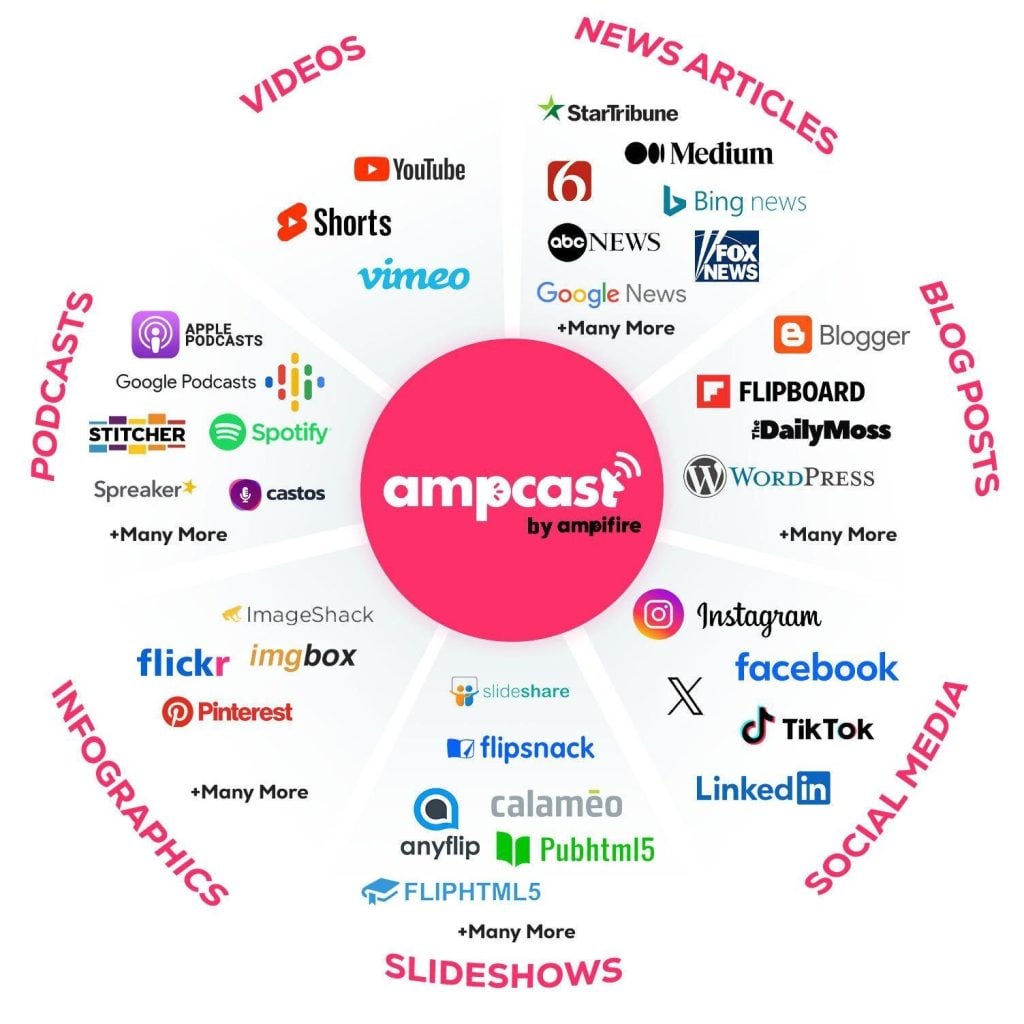
- AmpiFire’s AmpCast AI converts your content into 8 formats (news articles, blog posts, interview podcasts, longer informational videos, reels/shorts, infographics, flipbooks/slideshows, and social posts) and auto-publishes everything to 300+ sites.
Convert a Blog Into a Slideshow: Here’s How to Do It
Converting a blog into a slideshow takes five steps: extract your key points, build a visual storyboard, design your slides, add supporting visuals, and refine before publishing. Done right, the result is a format built for visual processing, one that reaches new audiences and extends your content’s lifespan well beyond the original post.
Once your blog becomes a slideshow, it opens up new distribution channels you weren’t using before. Slideshows work as webinar material, conference assets, and social content, giving a single blog post multiple ways to reach people without requiring you to start from scratch each time.

How AmpiFire Works:
- Research & Target: Find high-demand topics your buyers search for.
- Create & Repurpose: AmpiFire’s AmpCast AI generates news articles, blog posts, interview podcasts, longer informational videos, reels/shorts, infographics, flipbooks/slideshows, and social posts.
- Distribute & Amplify: Auto-publish to 300+ sites, including Google News, YouTube, Spotify, and major news networks.
Get more traffic from people who want to buy your stuff, and powerful “As Seen On” trust badges for your site.
Do It Yourself (with AI), Done For You Content, & 100% Managed Organic Growth options available.
Grow Your Free Traffic From Everywhere
What Are the 5 Steps to Convert a Blog Post Into a Slideshow?

- Extract Your Key Points. Begin by identifying the essential messages from your blog post. Scan through your content and highlight the main arguments, supporting statistics, memorable quotes, and actionable takeaways, as these elements will become the backbone of your slideshow. For a typical 1,500-word blog post, you’ll likely extract around 10–15 key points worth turning into slides, though the exact number depends on your content’s structure and how visual each point can be made.
- Create a Visual Storyboard. Before jumping into design, map out your slideshow structure using a simple storyboard approach. Determine how your key points will flow from one slide to the next, creating a logical progression that builds toward your conclusion. Your storyboard doesn’t need to be fancy. Just map out which content goes on each slide and add notes about any visuals or design ideas you want to include.
- Design eye-catching slides. With your storyboard complete, select a consistent design template that matches your brand aesthetics and the content tone. For each slide, craft a concise headline that communicates the core message at a glance. Support this with minimal text, transforming paragraphs into brief bullet points that highlight only the essential information.
- Add supporting visuals. For each slide, identify images, icons, charts, or diagrams that reinforce your message. Skip generic stock photos. Choose visuals that add genuine value by explaining concepts, highlighting relationships, or evoking specific emotions related to your content. When creating data visualizations, prioritize clarity over complexity.
- Review and refine. Before sharing your slideshow, review it critically from your audience’s perspective. Look for opportunities to further simplify text, enhance visual clarity, or strengthen transitions between concepts. The most effective slideshows often result from several refinement cycles that strip complex ideas down to their clearest, simplest form.
Where Should You Share Your Slideshow for Maximum Impact?
Use AmpCast AI for Distribution
Choosing the right platform for every audience is time-consuming. AmpiFire’s AmpCast AI removes that burden entirely. Once your content is submitted, AmpCast AI automatically distributes it across 300+ high-authority sites, including YouTube, Pinterest, Google News, and major news networks. Your content reaches professional audiences, social browsers, and search engines simultaneously, without you manually uploading to a single platform.
Embedding Options for Your Website
Your own website provides the perfect home base for your slideshow content, with several embedding options depending on your goals.
The simplest approach uses SlideShare or Google Slides embed codes to display your presentation directly within blog posts or dedicated pages, providing interactive viewing without sending visitors elsewhere.
Let AmpiFire’s AmpCast AI Handle Your Blog-to-Slideshow Conversions
We’ve outlined every step it takes to manually convert a blog into a compelling slideshow. It works, but it takes hours per post. Scale that across a full content calendar and repurposing quickly becomes a full-time job.
AmpCast AI takes care of all of it. Give us a blog post or topic and AmpCast AI transforms it into 8 content formats (news articles, blog posts, interview podcasts, longer informational videos, reels/shorts, infographics, flipbooks/slideshows, and social posts) and publishes them across 300+ high-authority platforms including Google News, YouTube, Spotify, and Pinterest, without you uploading a single file.
Frequently Asked Questions
How long should my slideshow be compared to my original blog post?
For a 1,500-word blog post, somewhere in the range of 15–25 slides is a reasonable starting point, though the ideal count will vary based on how much visual content your subject supports. Focus on distilling your most valuable insights rather than including everything from the original post. Your slideshow should serve as a visual complement to your blog, not a complete replacement.
Can I convert any type of blog post into a slideshow?
While virtually any blog post can be transformed into slideshow format, some content types convert more naturally. List-based articles, how-to guides, and posts with distinct sections translate seamlessly into slide format. Narrative-heavy content or philosophical pieces may require more creative restructuring. The key is identifying clear, standalone points that can be extracted and supported with visual elements.
Do I need design skills to create professional-looking slideshows?
Basic design principles help, but specialized skills aren’t necessary thanks to modern tools and templates. Focus on fundamental principles: consistent visual hierarchy, limited color palettes (3–4 colors), ample white space, and text brevity. When in doubt, simplify, one slide, one idea works best.
Should I create a slideshow first or write the blog post first?
While traditional workflow starts with blog creation, creating the slideshow first can be more effective. This forces disciplined thinking about core messages and key points, building a visual outline. Visual thinkers may prefer starting with slideshows, while verbal processors might find blog-first development more natural. Experiment with both workflows to find which produces better results for your content.
Can AmpiFire automatically convert my existing blog posts into slideshows?
Yes, AmpiFire’s AmpCast AI technology transforms blog content into 8 formats (news articles, blog posts, interview podcasts, longer informational videos, reels/shorts, infographics, flipbooks/slideshows, and social posts) automatically. Simply provide your blog post or topic, and AmpCast AI automatically generates a visually structured flipbook distributed to slideshow and document-sharing platforms. It publishes all 8 formats to 300+ sites, no design skills or manual uploading required.
*Disclaimer: Results may vary based on individual circumstances, business type, and content strategy. The time savings and outcomes mentioned are based on typical user experiences and are not guaranteed. For specific pricing and service details, please visit AmpiFire.
Author
Related Posts


How to Turn a Blog Into an Infographic: Step-by-Step Guide
Learn how to turn a blog into an infographic with our step-by-step guide. Repurpose content into engaging visuals that boost…

Make.com AmpCast Integration | RSS to Blog, Email & More
Make.com is a powerful automation platform that lets you connect an RSS feed to a huge number of apps and…
Zapier & AmpCast RSS Integration | Autopost to Email, Blog & More
Zapier supports reposting RSS feed content, much like Make.com, though with a slightly different app ecosystem. Here’s a comprehensive list…

How to Repurpose Blog Content: Tips & Examples
Learn how to repurpose blog content with tips and examples. Discover strategies to triple your content output and reach new…

How to Turn Your Podcast Into a Blog Post: 7 Easy Steps
Learn how to turn your podcast into a blog post with 7 easy steps. Repurpose audio content to reach more…

Blog Post Traffic & Volume Calculator & Graph
Use this calculator to see exactly when you’ll hit your content goals and outpace competitors. What This Calculator Shows You:…