

Key Takeaways
- Quillbot’s standalone scanner returns a clear percentage score, while Grammarly folds AI identification into its editor alongside an Authorship tool that tracks writing sessions in real time.
- Independent tests put Quillbot’s accuracy near 75%–80% on unedited AI text, and both tools lose reliability once content turns casual or gets lightly edited by a human.
- Quillbot’s free detector covers up to 1,200 words per scan, while Grammarly’s advanced features like sentence-level highlighting sit behind a paid plan.
- AmpiFire’s AmpCast AI turns one topic into 8 original content formats grounded in real research, then distributes them across 300+ sites so your content never needs to dodge a detector.
Comparing Quillbot & Grammarly’s AI Detection Accuracy
Grammarly’s AI detector produces less consistent scores than Quillbot’s in independent testing, but neither tool holds up well against writing that has been edited by a human. Most people assume an AI detector gives a definitive answer, when really both tools are estimating probability based on writing patterns like sentence rhythm and predictability.
That uncertainty matters more than it seems. Treating either score as final can lead to real problems, since student work gets flagged unfairly or lightly edited AI content slips through review entirely. The bigger question for anyone producing content isn’t which detector to trust, but whether relying on generic AI text is the right approach in the first place.
AmpiFire’s AmpCast AI sidesteps the detection question by building content from real research and audience data at the outset, then producing eight distinct content formats around it. That approach removes the guessing game around whether a piece will pass or fail a scan.

How AmpiFire Works:
- Research & Target: Find high-demand topics your buyers search for.
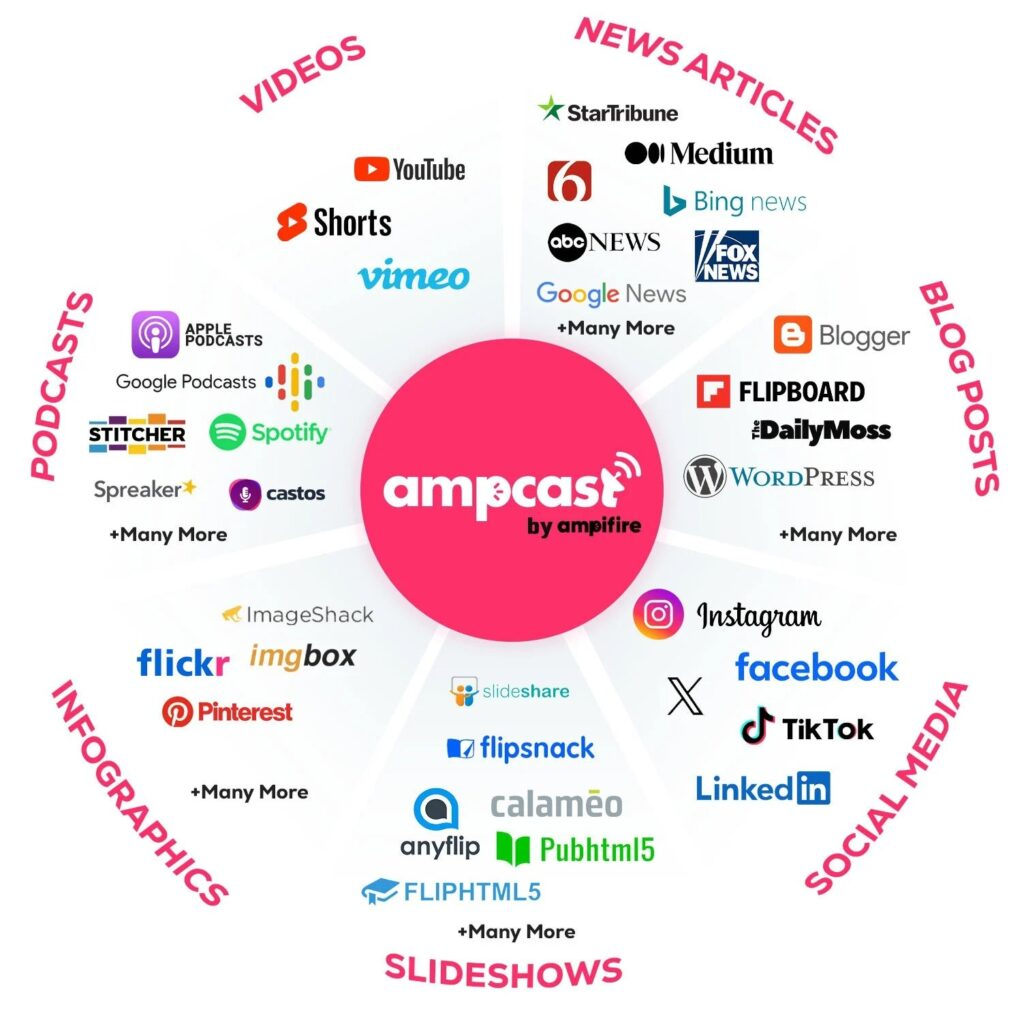
- Create & Repurpose: AmpiFire’s AmpCast AI generates news articles, blog posts, interview podcasts, longer informational videos, reels/shorts, infographics, flipbooks/slideshows, and social posts.
- Distribute & Amplify: Auto-publish to 300+ sites, including Google News, YouTube, Spotify, and major news networks.
Get more traffic from people who want to buy your stuff, and powerful “As Seen On” trust badges for your site.
Do It Yourself (with AI), Done For You Content, & 100% Managed Organic Growth options available.
Grow Your Free Traffic From Everywhere
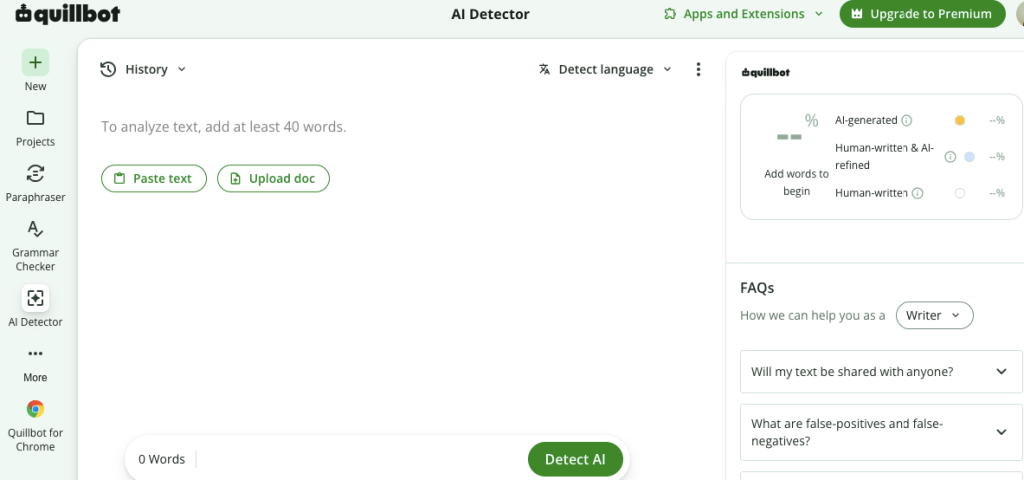
How Does Quillbot’s AI Detector Work?
Quillbot started as a paraphrasing tool and has expanded into a broader writing assistant with grammar checking, summarization, and AI detection. Its AI detector is built into the platform, and it works by analyzing text for patterns associated with machine-generated writing, including predictable sentence structures, low perplexity scores, and repetitive phrasing rhythms. Independent tests place its detection accuracy at roughly 75%–80% on unedited AI text.
Quillbot’s free AI detector lets users scan up to 1,200 words per check at no cost. For most standard pieces of content, that’s a workable limit. You paste the text, hit scan, and get a result broken down by sentence or paragraph highlighting.
Quillbot’s detector tends to flag text that follows highly predictable grammatical patterns, uses low variation in sentence length, or reads with an unusually smooth, error-free consistency. These are hallmarks of AI writing when prompts are formal or structured.
The tool performs reasonably well on content that hasn’t been refined, humanized, or edited, but its accuracy drops significantly once the text takes on a more casual voice or has been lightly edited by a human.
How Does Grammarly’s AI Detector Work?
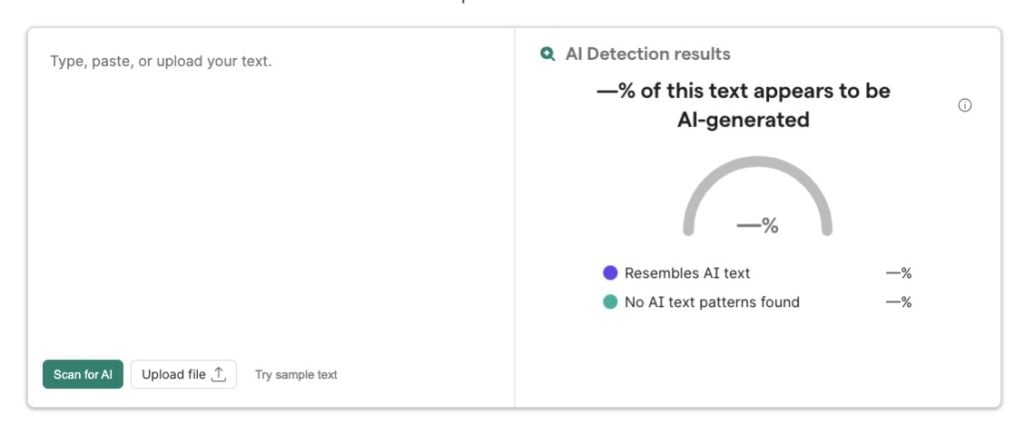
Grammarly built its reputation as the gold standard for grammar correction, and it added an AI detection feature as demand for content authenticity tools grew. The detection works by analyzing writing patterns, sentence predictability, and stylistic consistency. It is conceptually similar to Quillbot but embedded differently within the platform. Rather than a standalone detector, Grammarly weaves its AI identification into the broader writing feedback interface.
The key difference is in how Grammarly presents the results. Grammarly’s standalone AI detector does provide a percentage score, similar to Quillbot. Separately, Grammarly offers an Authorship feature that tracks writing sessions in real time within Google Docs and Microsoft Word, logging how much content was typed, pasted, or generated by AI tools.
Grammarly’s basic AI detection is available for free at grammarly.com/ai-detector with no sign-up required. Basic Authorship tracking in Google Docs and Microsoft Word is also included on the free plan, though advanced features like sentence-level highlighting and detailed external-source attribution require a paid plan. This narrows the accessibility gap with Quillbot, though Quillbot’s free tier supports more words per scan.
Quillbot’s Strengths Beyond AI Detection
Quillbot’s core strength has always been paraphrasing. Its paraphrasing tool offers multiple rewriting modes, giving writers granular control over how text is restructured. This is particularly useful for academic writers, ESL learners, and content creators who need to reframe ideas without changing their meaning.
Beyond paraphrasing, Quillbot also delivers solid performance in catching standard grammatical errors with reliable consistency and condensing long-form content into key points quickly.
It also scans for duplicate content across web sources and automatically formats references in APA, MLA, and Chicago styles.
Grammarly’s Strengths Beyond AI Detection
Grammarly operates at a deeper level of writing analysis. Where Quillbot focuses on restructuring, Grammarly focuses on refining. Its grammar suggestions provide more than surface-level corrections. It identifies tone inconsistencies, flags wordiness, suggests vocabulary upgrades, and even adapts its feedback based on the goal and audience you set for a specific document.
Grammarly also edges ahead in AI humanization. In some independent comparisons, Grammarly’s suggestions produced more natural, varied output than Quillbot’s humanizer, though results vary by content type.
Quillbot vs Grammarly vs AmpCast AI: Comparison Table
| Feature | AmpiFire’s AmpCast AI | Quillbot | Grammarly |
| Primary Function | Multi-format content creation + auto-distribution | Paraphrasing + writing assistance with AI detection | Advanced grammar correction + writing analysis with AI detection |
| AI Detection | Focuses on creating original, research-driven content | Free, up to 1,200 words per check | Free basic detection available; advanced tracking requires paid plan |
| AI Humanizer | Not applicable: produces original content from topic research | Available, basic performance | Stronger, more natural output |
| Grammar Checker | Built into content generation workflow | Solid for standard errors | Advanced, context-aware suggestions |
| Content Generation | 8 different content formats from one high-demand topic | Single-document focus | Single-document focus |
| Distribution | Platform-otimized and auto-published to 300+ sites | No, production only | No, production only |
| Best For | Marketers and brands focused on multi-channel reach | Students, researchers, ESL writers | Professionals, content teams |
AmpiFire’s AmpCast AI Moves Past the Detection Debate
Quillbot and Grammarly each solve a narrow problem: catching or refining AI text after it’s already written. Neither guarantees accuracy, especially once content gets lightly edited or shifts into a casual tone. For anyone building a long-term content strategy, choosing a detector matters less than deciding how that content gets created in the first place.
At AmpiFire, we built AmpCast AI to sidestep that debate entirely. Instead of trying to disguise AI writing, our platform focuses on producing content grounded in real research about your buyers and their search behavior. It turns a single topic into 8 different content formats and distributes them across 300+ high-authority sites (e.g., YouTube, Pinterest, Spotify, and more) automatically. This results in original, multi-channel coverage that generates real visibility and click-building from the channels your buyers actually use. Try AmpCast AI today to produce content that meets your buyers wherever they are.
Frequently Asked Questions (FAQs)
Is Quillbot the most accurate AI detector?
Quillbot performs reasonably well as an accessible AI detector, but it’s not the most accurate on the market. Specialized tools like Originality.ai and GPTZero generally achieve higher accuracy, particularly for content that has been lightly edited or written in a more casual tone. Quillbot’s main advantage is being free up to 1,200 words per check, making it a practical first-pass tool rather than an institutional-grade solution.
Is Grammarly the most accurate AI checker?
Not always. Grammarly’s AI detection is often lower than Quillbot’s and below that of most dedicated detection tools. Where Grammarly stands out is in the editor experience and real-time tracking of writing sessions, which can be more practical for some workflows even if the raw detection accuracy isn’t class-leading.
What is the disadvantage of using Grammarly?
Grammarly’s biggest disadvantage is its price relative to its competitors. While basic AI detection is free, many of the platform’s most useful features are behind a paid subscription, limiting full functionality for casual users, students, and budget-conscious teams.
Can Quillbot be wrong?
Yes, Quillbot’s AI detector can produce both false positives and false negatives. Its accuracy drops significantly when content has been lightly edited, written in a casual tone, or carefully humanized. No AI detector on the market is perfectly accurate, and treating Quillbot’s results as definitive (rather than as one signal among several) is a common mistake.
How does AmpiFire’s AmpCast AI compare to Quillbot or Grammarly?
AmpiFire’s AmpCast AI operates in a fundamentally different space than either Quillbot or Grammarly. Where those tools focus on editing and detection, AmpCast AI is built for content creation and distribution at scale, generating news articles, blog posts, interview podcasts, longer informational videos, reels/shorts, infographics, flipbooks/slideshows, and social posts designed to rank and reach audiences across multiple platforms simultaneously. It’s a production engine for content teams that need volume and visibility without sacrificing quality.
*Disclaimer: Results may vary based on individual circumstances, business type, and content strategy. The time savings and outcomes mentioned are based on typical user experiences and are not guaranteed. For specific pricing and service details, please visit AmpiFire.
Author
Related Posts

GPTZero vs Grammarly: AI Detector: Which One Can Detect AI Content Better?
Compare GPTZero and Grammarly's AI detection capabilities. Discover which tool better identifies AI-generated content for your writing needs.
GPTZero vs Quillbot AI Detector: Which One Can Detect AI Content More Accurately?
Compare GPTZero and Quillbot AI Detector on accuracy and methods. Discover which tool excels at spotting AI-written content in our…
Grammarly Premium Account for Free: Online Grammar & Plagiarism Checker Download Guide 2026
Are you looking to take your writing skills to the next level? If so, you’ve probably heard of Grammarly, the…
GPTZero vs Copyleaks: Which is the Better AI Detector?
Compare GPTZero vs Copyleaks AI detectors. Learn accuracy rates, features, pricing, and which tool works best for different business needs…

Quillbot: Features, Benefits & Pricing – Grammar, Paraphrasing and Summarizing Tool Uncovered [Discount & Free Download]
Did you know that Google receives a whopping 3.5 billion searches every single day? That’s a mind-boggling amount of information…


GPTZero vs ZeroGPT AI Detector Mega Test: Best Accuracy & False Positives?
We tested GPTZero and ChatGPT on dozens of AI- and human-written texts (including casual blogs, short stories, and even political…