


Key Takeaways
- Press releases provide third-party credibility and authority, while social media fosters immediate two-way engagement and direct customer relationships.
- Social media offers superior real-time analytics and tracking, whereas press release success is often measured through proxy metrics like media placements.
- While press releases offer high message control for official announcements, social media provides greater flexibility but less control over audience perception.
- Combining both channels creates a powerful integrated strategy that uses official brand authority with continuous, authentic community storytelling.
- AmpiFire’s AmpCast AI amplifies brand awareness by transforming core messages into 8 distinct formats and distributing them across over 300 high-traffic channels.
Press Release Distribution vs Social Media: The Brand Awareness Battle
Press release distribution and social media marketing drive brand awareness differently. The former secures third-party authority through news media, while the latter builds direct community engagement. Distribution services deliver official, structured announcements to journalists and major news networks to establish brand credibility. Social media prioritizes two-way conversations and real-time shareability to humanize a brand and reach customers directly.
While social media offers faster interaction and granular analytics, press releases provide a permanent, high-authority record of company milestones. Most brands achieve maximum visibility by integrating both, using press releases for “gatekeeper” validation and social media for continuous storytelling. Strategic tools like AmpiFire’s AmpCast AI further bridge this gap by converting core announcements into multiple digital formats for distribution across 300+ high-traffic platforms.

How AmpiFire Works:
- Research & Target: Find high-demand topics your buyers search for.
- Create & Repurpose: AmpiFire’s AmpCast AI generates news articles, blog posts, interview podcasts, longer informational videos, reels/shorts, infographics, flipbooks/slideshows, and social posts.
- Distribute & Amplify: Auto-publish to 300+ sites, including Google News, YouTube, Spotify, and major news networks.
Get more traffic from people who want to buy your stuff, and powerful “As Seen On” trust badges for your site.
Do It Yourself (with AI), Done For You Content, & 100% Managed Organic Growth options available.
Grow Your Free Traffic From Everywhere
4 Key Differences Between Press Releases and Social Media
A press release is an official written statement issued to media outlets announcing something newsworthy about your organization. Unlike press releases, social media creates two-way conversations rather than one-way announcements.
1. Audience Reach & Demographics
Press releases primarily target journalists, editors, and industry analysts who act as gatekeepers, potentially amplifying your message to their audiences if they find it newsworthy. This gatekeeping function provides valuable third-party credibility but limits guaranteed visibility.
Social media eliminates intermediaries, allowing direct communication with current and potential customers. Platform-specific demographics shape which audiences you can effectively reach. LinkedIn skews older and more professional, while TikTok primarily reaches younger audiences.
Press releases reach specific industry verticals through trade publications and broader audiences through general news outlets.

2. Message Control & Brand Voice
Press releases offer superior message control but limited expressiveness. Their structured format ensures your exact wording, key messages, and strategic positioning reach media outlets intact.
When picked up by publications, your core announcement remains consistent, though journalists may add context or commentary.
Social media provides greater voice flexibility but sacrifices some message control. Audience interactions, shares, and comments shape how users perceive content and can take conversations in unexpected directions.
3. Measurement Metrics & ROI Tracking
Social media platforms offer comprehensive, real-time analytics that press release distribution typically doesn’t. Platforms provide immediate data on impressions, engagement rates, click-throughs, video views, and the demographics of those who interacted with your content.
Press release measurement is more challenging and often relies on proxy metrics like potential reach (based on publication circulation), actual placements (tracked through media monitoring), message pull-through, and resulting website traffic.
Advanced distribution services offer analytics like audience demographics and engagement metrics, but these still lag behind social platforms in depth and immediacy.
4. Relationship Building Opportunities
While press releases help build relationships with media contacts, social media excels at creating direct connections with customers and communities.
Press release distribution can position your brand as a valuable source for journalists covering your industry, potentially leading to future coverage opportunities beyond your formal announcements.
Social platforms, however, foster ongoing conversations through comments, messages, shares, and interactive content marketing. This continuous engagement builds community around your brand, generating advocacy that amplifies awareness through authentic word of mouth, a result that press releases rarely achieve directly.
Example of a Press Release
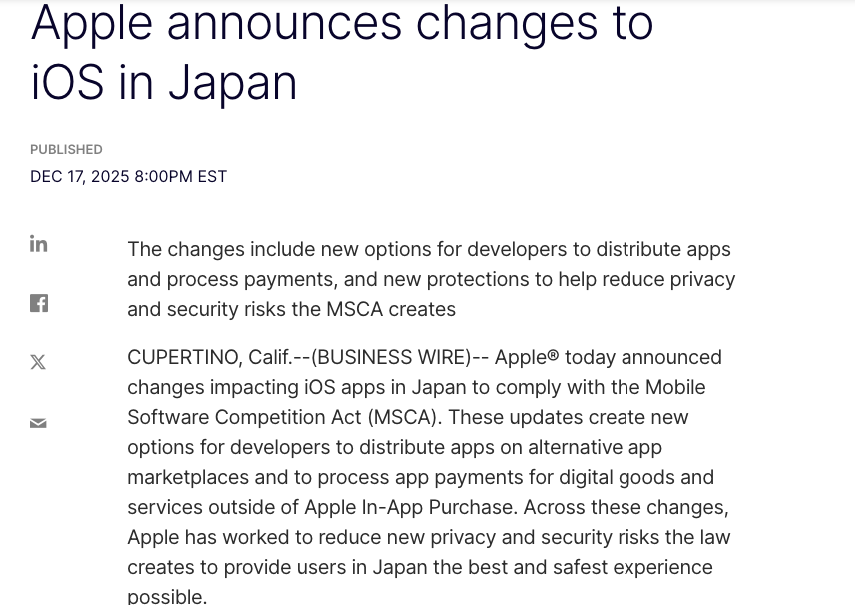
Apple’s iOS Change Press Release
When Apple announced changes to iOS that affected apps in Japan, it issued a press release to announce the update. The press release was distributed globally, leading to thousands of news articles, analysis pieces, and media discussions that repeatedly exposed the brand to new and existing audiences, thereby increasing overall brand awareness.
Here’s an excerpt from this press release:
Examples of Social Media Campaigns
Spotify’s Wrapped Campaign
Successful social media marketing campaigns demonstrate how brands can capture attention and build awareness through creative, platform-specific approaches. Spotify’s annual “Wrapped” campaign exemplifies this perfectly.
By transforming user listening data into shareable, personalized stories, Spotify creates content that users eagerly post across their social networks, essentially turning customers into brand ambassadors. The campaign consistently trends each December globally, engaging over 200 million users in 2026 alone with minimal direct advertising costs.
Dove’s #ShowUs Campaign
Another standout example is Dove’s #ShowUs campaign, which challenged beauty stereotypes by featuring real women rather than models. By partnering with Getty Images and female photographers worldwide, Dove created a library of 10,000+ diverse images that better represent women.
The campaign generated millions of impressions across social platforms and strengthened Dove’s brand positioning around authentic beauty and self-acceptance. It showcased how social media can amplify values-based messaging to build deeper brand connections.

Press Release Distribution vs Social Media Marketing: Comparison Table
| Feature | Press Release Distribution | Social Media Marketing |
| Primary Audience | Journalists, editors, industry analysts | Current and potential customers directly |
| Communication Style | One-way official announcements | Two-way conversations and engagement |
| Message Control | High: Exact wording reaches media intact | Lower: Audience interactions shape perception |
| Brand Voice Flexibility | Limited: Structured, formal format | Greater: Creative, platform-specific expression |
| Credibility | Third-party validation through media coverage | Built through community trust and engagement |
| Audience Reach | Gatekeeper-dependent; requires media pickup | Direct; no intermediaries needed |
| Analytics & ROI Tracking | Challenging; relies on proxy metrics (placements, circulation, traffic) | Comprehensive real-time data (impressions, engagement, click-throughs) |
| Cost Structure | Higher upfront costs | Flexible; ranges from free organic posting to scaled ad budgets |
| Relationship Building | Builds media contacts and journalist relationships | Creates direct customer connections and community |
| Best Content Type | Complex information, official announcements | Creative storytelling, shareable and interactive content |
| Recommended Frequency | 4–8 times annually for mid-sized businesses | 3–5 posts weekly on primary platforms |
| Best For | B2B companies, regulated industries, major announcements | Consumer brands, younger demographics, community building |
The Verdict: Integrated Visibility Wins
The most effective approach to brand awareness combines press releases and social media in proportions appropriate to your specific business objectives, industry context, and audience preferences.
B2B companies and those in regulated industries typically benefit from press release-dominant strategies supplemented by LinkedIn and Twitter engagement. Consumer brands, particularly those targeting younger demographics, often find greater awareness impact from social-first approaches, with press releases reserved for major company announcements.
The question isn’t which channel to use but how to strategically integrate both for maximum impact.
Press releases provide the official, credible foundation for your brand narrative, while social media animates that narrative through creative storytelling, community building, and direct engagement.
How does AmpiFire’s AI AmpCast Amplify My Brand Awareness Efforts?
Combining the authority of news coverage with the engagement of social platforms requires a strategic approach. AmpiFire’s AmpCast AI simplifies this through MultiCasting—converting a single announcement into 8 distinct formats including news articles, videos, and podcasts to ensure your message fits every major channel.
High visibility happens when your brand appears across a network of over 300 high-traffic platforms simultaneously. Using these various placements allows businesses to reach wider audiences without increasing their internal production workload. Use AmpiFire’s AmpCast AI to strengthen your brand presence through smarter automated distribution.
Frequently Asked Questions (FAQs)
What is the difference between PR and social media marketing?
Public relations (PR) focuses on building relationships with media, influencers, and the public to shape brand perception through third-party channels.
On the other hand, social media marketing involves direct audience engagement across platforms such as Instagram, Twitter, Facebook, LinkedIn, and TikTok. It prioritizes community building, two-way conversation, and relationship development with end users.
How does social media marketing increase brand awareness?
Social media increases brand awareness by creating regular visibility through consistent posting, keeping your brand top-of-mind without requiring newsworthy announcements. It also leverages network effects when followers engage with content, exposing your brand to their connections through shares, comments, and algorithmic recommendations.
Which costs more: press release distribution or social media marketing?
Press release distribution typically requires higher upfront costs but reaches specialized audiences with decision-making authority. Social media marketing offers more flexible cost structures ranging from free organic posting to precisely scaled advertising budgets.
How often should I distribute press releases versus posting on social media?
Press releases should be reserved for truly newsworthy developments, typically 4–8 times annually for mid-sized businesses. Social media, conversely, requires consistent frequency, typically 3–5 weekly posts on primary platforms, to maintain algorithm visibility and audience engagement.
How can AmpiFire’s AmpCast amplify the reach of my press releases?
AmpiFire’s AmpCast AI can amplify your press releases by transforming them into multiple content formats (videos, news articles, podcasts, social posts, etc.) and distributing them across 300+ high-traffic channels. This extends your reach well beyond traditional press release distribution and helps increase long-term brand visibility.
*Disclaimer: Results may vary based on individual circumstances, business type, and content strategy. The time savings and outcomes mentioned are based on typical user experiences and are not guaranteed. Pricing is variable and subject to change. For specific pricing and service details, please visit AmpiFire.
Author
Related Posts

Native vs Display Advertising for Brand Awareness: Differences, Examples & Costs
Learn the key differences between native and display ads in terms of cost, placements, and real examples to choose the…

AI Press Release Distribution: What Is It & Example Tools
Learn how AI press release distribution uses machine learning to target the right journalists, personalize outreach, and improve media coverage…

Organic vs Paid Social Media Marketing for Reach: Differences & Examples
Organic vs paid social media marketing differ in cost, speed, and control. Learn how to use both together and how…


How to Submit a Press Release on Nasdaq – The Cost for Publishing News Articles & Journalists’ Email Contact Methods
Learn how you can get any site, business or offer published on Bloomberg, Nasdaq, Yahoo! News and more.

How to Submit a Press Release to Google News
Learn how to submit a press release to Google News and boost your online presence with these essential steps.

How to Submit a Press Release to Yahoo News
Learn the steps to submit a press release to Yahoo News for maximum visibility and reach your target audience effectively.