

Key Takeaways
- Hypotenuse AI is worth it for e-commerce stores that need product descriptions, clean product data, and edited catalog images at scale, but it’s a weaker pick for anyone focused on long-form blog writing.
- Its core features are an AI description writer, product data enrichment, bulk image editing, and search optimization (including GEO for AI search), all run by specialized AI agents that pass work between each other.
- Pricing is customized and quote-based, with a free trial to start, though some users report renewal costs climbing after the first year. It bills in US dollars, which adds cost for buyers outside the US.
- For a busy store with a large catalog, it saves real time on repetitive listing work. For a distinctive brand voice or 2,000-word articles, the output usually requires heavy editing, and reviewers note that it becomes repetitive as volume grows.
- If your goal is to build organic traffic, AmpiFire creates content in 8 formats from a single high-demand topic and publishes it across 300+ sites to bring new visitors to your store.
Is Hypotenuse AI Tool Worth It?
For the right store, Hypotenuse AI earns its cost. If you manage a large catalog and spend hours writing descriptions or fixing product data, the bulk tools and Shopify publishing pay back the subscription quickly. The time saved on repetitive listing work is where most of the value sits.
It is harder to justify for small catalogs or blog-first users. With under a hundred products, custom pricing may cost more than the work it replaces, and long-form writers will spend heavily on editing. Try the free trial on your own products first, and confirm renewal pricing before you sign up.

How AmpiFire Works:
- Research & Target: Find high-demand topics your buyers search for.
- Create & Repurpose: AmpiFire’s AmpCast AI generates news articles, blog posts, interview podcasts, longer informational videos, reels/shorts, infographics, flipbooks/slideshows, and social posts.
- Distribute & Amplify: Auto-publish to 300+ sites, including Google News, YouTube, Spotify, and major news networks.
Get more traffic from people who want to buy your stuff, and powerful “As Seen On” trust badges for your site.
Do It Yourself (with AI), Done For You Content, & 100% Managed Organic Growth options available.
Grow Your Free Traffic From Everywhere
What Is Hypotenuse AI Used For?
Hypotenuse AI is a content and data platform built specifically for e-commerce. You feed it product details, and it writes product descriptions, titles, and bullet points, fills in missing product information, tags and categorizes items, and edits product photos, all in bulk.
The platform is organized around a set of AI agents, each handling one job. One agent cleans and enriches product data, another writes the copy, a third edits images, and a fourth handles search optimization. They pass work between each other, so a messy product feed can come out the other side as finished, ready-to-publish pages.
Beyond product pages, it also creates SEO blog articles, meta titles, category pages, social captions, and email copy. It runs content through a brand and channel guideline checker before publishing, and it can act as your central store for product data if you do not already use a PIM. It supports more than 40 languages and connects directly to Shopify and systems like Salsify and NetSuite, and optimizes content for Amazon, Walmart, and other marketplaces.

Hypotenuse AI Features
Product Data Enrichment
If your product data is incomplete, Hypotenuse AI fills the gaps. It pulls missing attributes from product images, spec sheets, UPC codes, or web pages, then standardizes everything into one consistent format. This helps stores with thousands of SKUs where manual data entry is slow and prone to errors.
Product Descriptions & Content
The description generator turns a product title and a few details into search-ready copy. It adapts output for different marketplaces, so an Amazon listing reads differently from a Shopify page. On enterprise plans, you can train it on your brand guidelines so that wording stays consistent across the whole catalog.
Image Editing
The image tools remove or replace backgrounds, upscale photos, and place products into lifestyle scenes in bulk. This lets stores refresh visuals for seasonal campaigns without booking a new photoshoot, which keeps catalogs looking current with less effort.

SEO, GEO & Blog Writing
Hypotenuse AI includes an SEO blog writer with SERP research, content gap analysis, and automatic linking. It also optimizes product content for both traditional search and AI search tools, which the company calls GEO, so your listings can surface in AI answers as well as Google. There is also HypoChat for web-connected research and HypoArt for generating images from text prompts.
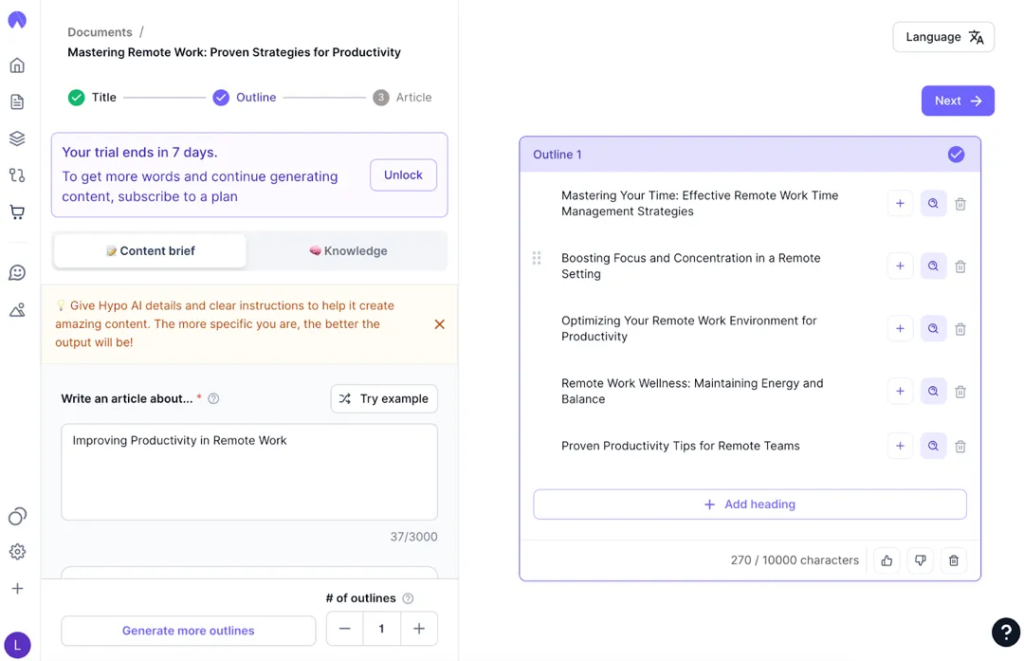
How Hypotenuse AI Works
For a store setting it up for the first time, the workflow usually follows these steps:
- Connect your store or import your product data through Shopify, a spreadsheet, or a PIM system.
- Let the data agent fill in missing attributes and standardize your product information.
- Generate product descriptions, titles, and bullet points in your chosen format and language.
- Edit product images in bulk and run content through the brand and channel guideline checker.
- Publish the finished content back to your store or marketplace, then track how listings perform.
Hypotenuse AI Pricing
Hypotenuse AI uses custom, quote-based pricing for its e-commerce plans. Its e-commerce plans, including a Basic option for stores under 100 products, an Ecommerce Pro tier for teams generating content in bulk, and an Enterprise option for larger teams with complex workflows, are all quote-based, so you contact the company for a custom price. A free trial lets you test the platform first without a credit card.
Two things are worth checking before you commit. Several users report that renewal prices rise noticeably after the first year, so ask about long-term costs up front. Pricing is also billed in US dollars, which can add cost for buyers dealing with exchange-rate swings.
Hypotenuse AI Customer Reviews
Hypotenuse AI holds a 4.7-star rating on G2. Reviewers most often mention the time it saves, the simple interface, and how quickly it turns product data into usable descriptions. Complaints tend to center on output that reads as generic, longer articles losing their thread, and pricing that feels steep for people who use it mainly for blogging.
On the positive side, store owners with large catalogs point to bulk generation as the biggest win, since it removes hours of repetitive writing. Shopify users also single out the direct integration, which lets them sync a store, generate descriptions, and publish new content straight back in a few clicks. Short blog posts and subject lines earn steady approval when lightly edited, and many reviewers say the tool cut research and drafting time from days to minutes.
The recurring frustration is repetition. Several long-term users say the same sentence patterns start appearing across pieces after a few months, and the brand voice drifts as volume grows. Buyers outside the US add that dollar-based pricing and post-trial renewal increases make the tool harder to budget for over time.
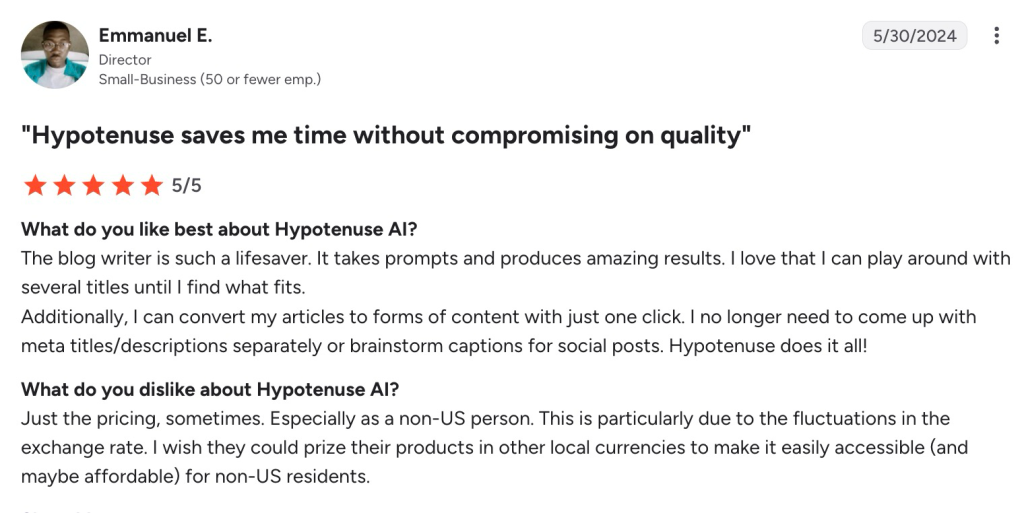
Hypotenuse AI Pros & Cons
Here is a quick summary of the trade-offs:
Pros
- Fast bulk creation of product descriptions and data cleanup for large catalogs
- Direct publishing to Shopify, Amazon, Walmart, and major product data systems
- Strong for short product copy and blog posts under 1,200 words
- Support for more than 40 languages
Cons
- Output can get repetitive and usually needs human editing
- Long-form content over 1,500 words tends to lose flow
- Brand voice consistency slips as volume grows
- Quote-based pricing and reported renewal increases make budgeting harder
Who Should Use Hypotenuse AI
Hypotenuse AI makes the most sense for e-commerce stores managing hundreds or thousands of products that need consistent descriptions and clean data without hiring more writers. Teams that treat it as a fast first-draft engine, then edit for quality, get the best results from it.
It is a poor fit if you mainly publish long-form articles, need a highly original brand voice, or want content you can post without review. Bloggers and publishers focused on 2,000-word pillar pieces will likely find that a dedicated writing tool serves them better.
Hypotenuse AI Writes the Copy, AmpiFire Brings the Buyers

For a store buried in product listings, Hypotenuse AI is ideal because it writes and cleans catalog content faster than a human team and publishes it straight to your store. For long-form articles or a voice that has to sound truly yours, plan on editing every draft, and treat the quote-based pricing as a real line item rather than an afterthought.
That said, even the best product page only earns sales if buyers actually reach it. Getting them there is the part we handle at AmpiFire. We identify what your shoppers search for before they buy, build 8 unique content formats around those topics (e.g., news articles, blog posts, interview podcasts, longer informational videos, reels/shorts, infographics, flipbooks/slideshows, and social posts), and place them where they research across 300+ sites like Pinterest, YouTube, Google News, Fox affiliate sites, Spotify, and more. That way, new customers are more likely to find your store instead of a competitor’s. If you want steady organic traffic feeding the products you already sell, start with AmpiFire today.
Frequently Asked Questions (FAQs)
Is Hypotenuse AI good for writing blog posts?
It can write blog posts, and shorter articles under 1,200 words come out well-structured with light editing. Longer pieces over 1,500 words tend to repeat points and lose flow, so writers focused on in-depth articles usually pair them with manual editing or pick a dedicated long-form tool instead.
Does Hypotenuse AI integrate with Shopify?
Yes. Hypotenuse AI connects directly to Shopify, so you can sync your store, generate product descriptions in bulk, and publish the finished copy back to your listings without manual copy-paste. It also integrates with Amazon, Walmart, and product data systems like Salsify and NetSuite.
Is content from Hypotenuse AI detected as AI-written?
AI detection tools are unreliable, and their results shift constantly, so passing or failing them says little about actual content quality. What matters more is that your content is accurate, useful, and edited by a person before publishing. Most platforms reward helpful content, not detector scores.
Can Hypotenuse AI handle a large product catalog?
Yes. It is built for bulk work and handles anywhere from a few thousand to millions of SKUs. Its AI agents enrich product data, write descriptions, and tag items across the whole catalog at once, which is why it suits stores that would otherwise need extra writers to keep up.
What is the difference between Hypotenuse AI and AmpiFire?
Hypotenuse AI writes and organizes the content that lives on your own store. AmpiFire works on the step before a sale, helping new buyers find your store while they research, so the products you already list reach more shoppers. AmpiFire offers DIY, done-for-you, and fully managed options depending on how much you want to run the content campaigns yourself.
*Disclaimer: Results may vary based on individual circumstances, business type, and content strategy. The time savings and outcomes mentioned are based on typical user experiences and are not guaranteed. For specific pricing and service details, please visit AmpiFire.
Author
Related Posts


Writesonic Features & Pricing: Is This AI Writing & SEO Assistant Worth It? [2026 Review]
Learn Writesonic's features, pricing, AI SEO tools, and user experience in 2026 to see if it's the right AI writing…


Rytr Features & Pricing: Is It the Best AI Writing Tool? [2026 Review]
Discover Rytr’s features, pricing, and performance to see if it’s the ultimate AI writing tool in 2026.

SEOTesting Features, Reviews & Pricing: Is This SEO Tool Worth It?
Read our SEOTesting review to learn about features, pricing, and user feedback, then decide if this SEO testing and performance-tracking…

SiteGuru Reviews, Pricing & Features: Is This SEO Tool Worth It?
Read SiteGuru reviews, pricing, and key features. Find out if this SEO tool is worth your investment for boosting site…

Social Champ Reviews, Pricing & Features: Is This Social Media Management Tool Worth It?
Get honest Social Champ reviews. Learn pricing, features, and if this social media management tool is worth your investment for…


Surfer SEO Reviews, Pricing & Features: Is This AI Visibility Tool Worth It?
Discover Surfer SEO's features, pricing, and reviews in 2026, and learn how it stacks up for content optimization. Find out…