

Key Takeaways
- Content amplification tools help cut through digital noise, boosting content visibility beyond organic distribution alone.
- Free options like Buffer and Hootsuite provide essential scheduling capabilities, while paid solutions like AmpiFire and Outbrain offer advanced targeting and broader reach.
- The right mix of amplification tools should align with your specific content types, audience demographics, and business goals.
- AmpiFire’s AmpCast transforms a single topic into 8 formats and publishes to 300+ sites, automating your entire content distribution process.
What Are the Best Content Amplification Tools in 2026?
AmpiFire’s AmpCast AI is the most complete content amplification tool available in 2026, turning a single topic into eight content formats and publishing them across 300+ high-authority sites automatically. Other strong options include Buffer, Hootsuite, IFTTT, and Outbrain. But AmpCast AI’s combination of reach, automation, and format variety puts it in a category of its own.
Choosing the right tool depends on your budget, content type, and how much of the process you want to handle yourself. Free tools cover the basics, paid platforms add targeting and scale, and AmpCast AI removes most of the production and distribution work entirely. Below is a closer look at each option, with both free and paid tools listed together, followed by how to pick the right mix for your goals.

How AmpiFire Works:
- Research & Target: Find high-demand topics your buyers search for.
- Create & Repurpose: AmpiFire’s AmpCast AI generates news articles, blog posts, interview podcasts, longer informational videos, reels/shorts, infographics, flipbooks/slideshows, and social posts.
- Distribute & Amplify: Auto-publish to 300+ sites, including Google News, YouTube, Spotify, and major news networks.
Get more traffic from people who want to buy your stuff, and powerful “As Seen On” trust badges for your site.
Do It Yourself (with AI), Done For You Content, & 100% Managed Organic Growth options available.
Grow Your Free Traffic From Everywhere
Top 5 Content Amplification Tools
1. AmpiFire’s AmpCast AI: Multi-Channel Content Distribution
AmpiFire’s AmpCast AI is the only content amplification tool that handles both creation and distribution in a single platform.
Give it one topic and it produces eight publish-ready formats: news articles, blog posts, interview podcasts, longer informational videos, reels/shorts, infographics, flipbooks/slideshows, and social posts. It then automatically publishes all eight across 300+ high-authority sites, including Google News, YouTube, Spotify, Apple Podcasts, and major news network affiliates. AmpCast AI is a paid platform with DIY, Done-For-You, and fully managed plans available.
What separates AmpCast from every other tool on this list is speed and scale. A full multi-format campaign can be generated and distributed in roughly 20 minutes, a process that would take days or weeks to do manually across individual platforms. The platform also generates RSS feeds compatible with Zapier and Make.com, so distribution can extend well beyond its built-in network.
Each published piece builds your brand’s visibility across search engines, podcast directories, video platforms, and social feeds simultaneously. That multi-platform presence also qualifies your site for “As Seen On” trust badges from recognizable media outlets, adding credibility that single-channel tools simply cannot provide.
2. Buffer: Schedule & Manage Social Media Posts
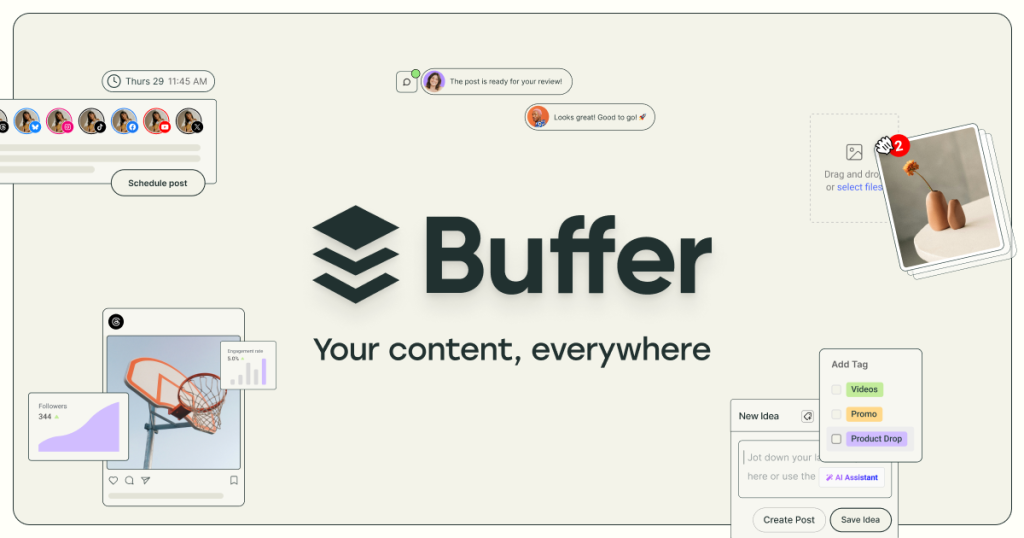
Buffer lets you schedule posts across multiple social platforms from one dashboard. The free plan covers up to three channels with 10 scheduled posts per channel, which works well for small teams or solo marketers managing a basic posting calendar.
The platform also includes analytics that track post performance, audience engagement, and optimal posting times. Over time, this data helps you adjust your schedule and content mix to get better organic reach without paying for promotion.
3. Hootsuite: Social Media Management Dashboard
Hootsuite provides a 30-day free trial of its Professional or Team plans, though you’ll need to enter credit card details and cancel before the trial ends to avoid charges. The website also has a few standalone free tools, including an AI caption generator, a business name generator, and a brand sentiment analyzer.
The platform’s Streams feature lets you monitor multiple feeds, mentions, and hashtags in one view. That makes it easier to spot relevant conversations and respond in real time, which can help your content gain traction through direct community interaction.
4. IFTTT: Automate Content Distribution Across Platforms

IFTTT lets you build automated workflows that move content between platforms without manual effort. For example, you can set it to automatically share new blog posts across multiple social networks, cross-post Instagram content to Twitter, Facebook, and Pinterest, push RSS feed updates to email newsletters, or reshare evergreen content on a set schedule.
The platform has a free plan that supports two applets, with paid Pro plan at $2.99/month for 20 applets, or Pro+ at $8.99/month for unlimited applets. It connects to over 700 services, so you can set up distribution chains that fit your specific channels and audience. Once a workflow is active, it runs on its own, which keeps content moving even when you’re focused on other tasks.
5. Outbrain (Teads): Native Advertising for Content Promotion
Outbrain — now operating under the Teads brand — places your content (articles, videos, and slideshows) inside the feeds of major publisher sites like CNN, MSN, and Sky News. Because the content appears alongside regular editorial pieces, readers encounter it while they’re already browsing, which tends to produce stronger engagement than standard display ads.
The platform includes targeting options based on interests, behaviors, and demographics, so you can control who sees your content. Its algorithms also adjust campaign delivery over time based on performance data, gradually shifting budget toward the placements and audiences that convert best. Outbrain is a paid platform with a minimum campaign budget of $20/day, running on a cost-per-click (CPC) model.
How Do You Choose the Right Content Amplification Tool for Your Business?
The right tool depends on your goals, budget, and how much of the production process you want to handle yourself. Free tools like Buffer and IFTTT are solid starting points if you’re managing a small operation and need basic scheduling or automation. Paid platforms like Hootsuite and Outbrain add targeting and reach when your distribution needs to scale. If you want to remove the manual work entirely — creation, formatting, and publishing across 300+ sites — AmpiFire’s AmpCast AI handles the full process in a single run.
Amplify Your Content & Free Up Your Time With AmpiFire
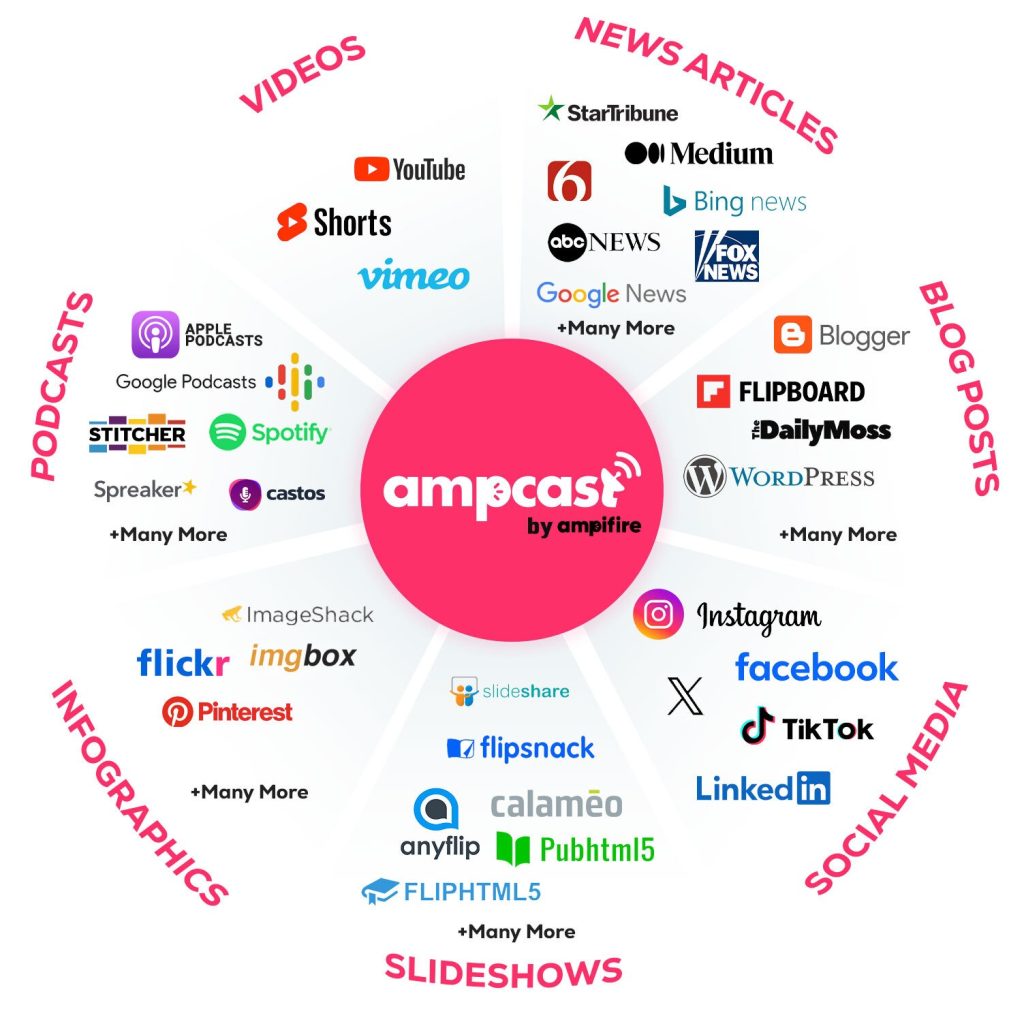
AmpiFire’s AmpCast AI transforms any topic into 8 different content formats: news articles, blog posts, interview podcasts, longer informational videos, reels/shorts, infographics, flipbooks/slideshows, and social posts. The platform then automatically publishes this content across 300+ high-authority sites.
With production and distribution handled, you get your time back to focus on what actually grows your business: client relationships, product improvements, and the decisions only you can make.
Frequently Asked Questions (FAQs)
What exactly do content amplification tools do?
Content amplification tools distribute your content to more people across different platforms. They automate sharing, target specific audiences, and help your content reach people who would never find it through organic search alone.
Are free content amplification tools worth using?
Yes, free tools like Buffer and Hootsuite provide solid scheduling and basic analytics. They work well for small businesses or anyone starting with content distribution before investing in paid solutions.
How much should I budget for content amplification?
Many marketers suggest spending 30%–40% of your content budget on amplification. The logic: if you create content worth $10,000 per month, setting aside $3,000–$4,000 to distribute it means the work you’ve already paid for actually gets seen.
Can content amplification improve my search rankings?
Yes. When your content appears on multiple platforms, more people see it, share it, and link back to it. That wider presence builds authority across search engines, video platforms, and social feeds — not just on Google.
How does AmpiFire’s AmpCast AI work for content amplification?
AmpCast AI takes one topic and turns it into eight content formats: news articles, blog posts, interview podcasts, longer informational videos, reels/shorts, infographics, flipbooks/slideshows, and social posts. It then publishes everything automatically to 300+ sites, including YouTube, Spotify, Pinterest, and Google News, covering the entire creation and distribution process in one run.
Note: Price ranges are approximate and subject to change based on market conditions. Contact individual providers for the most up-to-date pricing.
*Disclaimer: Results may vary based on individual circumstances, business type, and content strategy. The time savings and outcomes mentioned are based on typical user experiences and are not guaranteed. For specific pricing and service details, please visit AmpiFire.
Author
Related Posts


Best 8 Web 2.0 Submission Sites with High DA in 2026 [Free & Paid]
Discover top Web 2.0 submission sites with high Domain Authority (DA) in 2026. Build powerful backlinks with proven strategies for…


5 Best YouTube to TikTok Converter Apps [Free & Paid]
Compare the 5 best YouTube to TikTok converter apps, free and paid. AmpiFire's AmpCast AI automates the full process, from…


Hootsuite vs Buffer Social Media Management Tools: Free Plan & Pricing Comparison
See how Buffer and Hootsuite compare on pricing, free plans, and features. Learn which social media management tool has the…

What is Content Amplification & Why Is It Important?
Learn what content amplification is and why it matters for your marketing success. Find the right strategies to expand your…

How to Measure Content Amplification Strategy & Key Metrics to Track
Learn how to measure content amplification across 300+ platforms. Track the key metrics that drive organic traffic, prove business ROI,…
AI Press Release Distribution: What Is It & Example Tools
Learn how AI press release distribution uses machine learning to target the right journalists, personalize outreach, and improve media coverage…