Key Takeaways
- ROAS dropped 7% on average across 3,014 ecommerce advertisers tracked through Meta’s Andromeda rollout (prospecting ROAS dropped 13%), and the new ~8.4× baseline appears to be the floor rather than a temporary dip, so plan around this level instead of waiting for a rebound.
- Andromeda now reads ad creative directly and uses visuals, copy, audio, and on-screen text as the main targeting signal, which means narrow interest stacks and lookalike audiences no longer work, and broad targeting paired with diverse creative built around different awareness states (problem-aware, solution-aware, product-aware) is the structure that performs.
- The March 3, 2026, click attribution change moved engagement actions like likes, shares, and saves out of click-through reporting, which dropped reported ROAS by 15% to 30% overnight without any real sales decline, so annotate March 3, 2026, in your reporting and reset baselines from that point, rather than reacting to dashboard changes.
- Catalog Ads at 60% or more of conversion budget deliver 44% higher ROAS and 68% lower CPA compared to allocations under 30%, while Advantage+ Shopping Campaigns produce 17% to 22% lower CPA than manual setups, making these two structural shifts the largest single levers available in 2026..
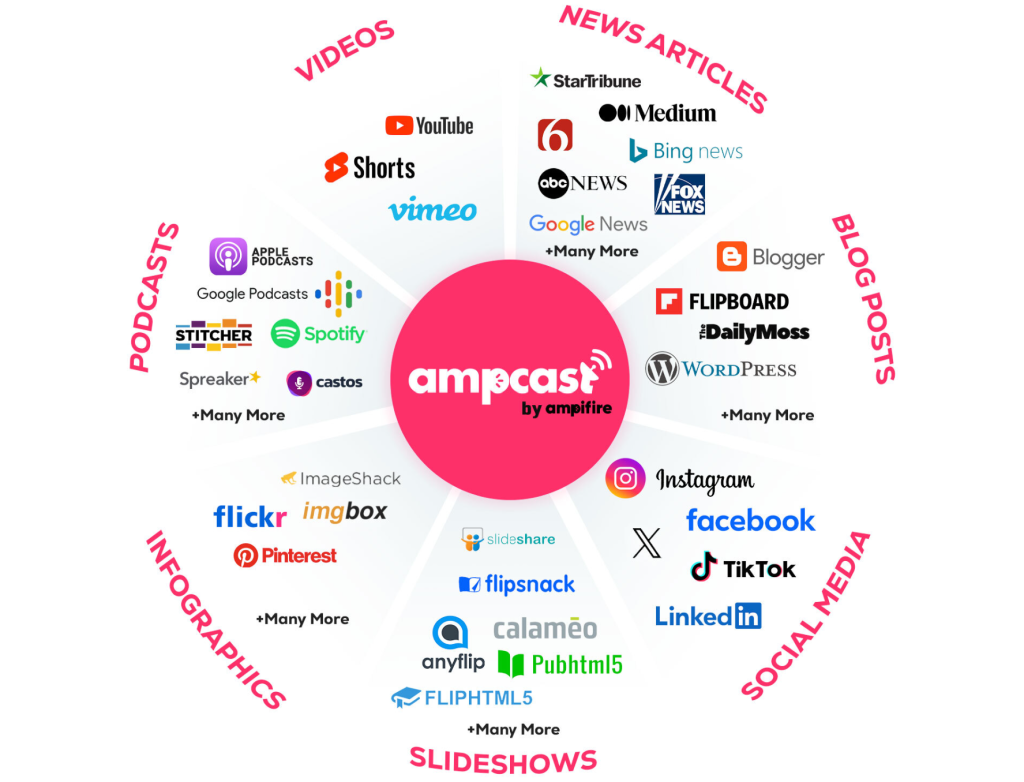
- Reducing single-channel Meta dependency by building organic traffic alongside paid is the most sustainable path to recovering ROAS, and AmpiFire helps ecommerce brands do this by turning one topic into 8 content formats (news articles, blog posts, interview podcasts, longer informational videos, reels/shorts, infographics, flipbooks/slideshows, and social posts) and distributing them across 300+ sites, including Google News, YouTube, Spotify, and Pinterest.
Recover Your Meta ROAS in 2026: What Changed and How to Fix It
If your Meta ROAS dropped in 2026 and you’re not sure why, you’re in good company. Across 3,014 ecommerce advertisers tracked by Confect.io through Meta’s Andromeda rollout, average ROAS fell 7%. Prospecting ROAS fell 13%. The new platform-level baseline (~8.4× from 9× pre-Andromeda) appears to be the floor, not a transient dip.
Here’s what most agency content marketing won’t tell you: the platform changes are real, but they’re not the full story. Across the accounts that have actually recovered in 2026, operational discipline explains a larger share of the gap than the algorithm changes do. The brands hitting strong ROAS this year are running structurally different accounts than the brands collapsing. Same platform. Same Andromeda. Different operations.
This is a working playbook, not a theory piece. Part 1 walks through what actually changed in Meta and Google between 2021 and 2026. Part 2 gives you the specific fixes recovering brands are running right now. Part 3 is the audit checklist.

How AmpiFire Works:
- Research & Target: Find high-demand topics your buyers search for.
- Create & Repurpose: AmpiFire’s AmpCast AI generates news articles, blog posts, interview podcasts, longer informational videos, reels/shorts, infographics, flipbooks/slideshows, and social posts.
- Distribute & Amplify: Auto-publish to 300+ sites, including Google News, YouTube, Spotify, and major news networks.
Get more traffic from people who want to buy your stuff, and powerful “As Seen On” trust badges for your site.
Do It Yourself (with AI), Done For You Content, & 100% Managed Organic Growth options available.
Grow Your Free Traffic From Everywhere
Part 1: What Happened
What Andromeda Actually Did
Meta deployed Andromeda gradually through 2024 and completed the global rollout in October 2025. The technical details, summarized from Meta’s own engineering blog and well explained in DOJO AI’s marketer-friendly version:
- Andromeda is the retrieval engine that runs before the ad auction. It narrows tens of millions of active ads to ~1,000 candidates per user impression.
- It runs on NVIDIA Grace Hopper Superchips at 10,000× the model complexity of the previous system.
- It reads creative directly: visual composition, copy, audio, on-screen text. Audience settings function as suggestions that Andromeda can override.
- It assigns each ad an Entity ID based on a visual pattern. Two ads sharing visual + layout but different headlines register as the same entity, even if the copy is different (ALM Corp explains the mechanism).
- A second-stage system called GEM ranks the ~1,000 candidates and selects the winner. GEM optimises winning ad sequences, not winning individual ads.
The practical consequence: your creative is now your targeting. The narrow interest stacks that worked through 2023 are mostly redundant. Lookalike audiences were removed from Ads Manager in February 2026. Broad targeting plus diverse creative is the structure Andromeda rewards.

How Meta Targeting Evolved (And Why Your 2023 Playbook Stopped Working)
Andromeda is the latest entry in a 5-year series of changes that progressively dismantled the Meta playbook ecom brands relied on through 2020. If you’re still running anything close to the 2023 setup, the timeline below explains why each piece of it has stopped working.
April 2021: iOS 14.5 + App Tracking Transparency
Most iOS users opted out of ATT (industry consensus puts opt-in around 11% by 2026). Meta lost direct visibility into roughly half its mobile audience. Pixel-based optimization started missing 30%–40% of conversions immediately.
Reported ROAS in Ads Manager went from “roughly accurate” to “directionally indicative at best.” Brands that didn’t move to CAPI saw their dashboards become progressively less reliable from that point on (DOJO AI’s full attribution breakdown covers this in depth).
2021–2023: Detailed Targeting Reductions
Sensitive interest categories removed. Detailed Targeting Plus is enabled by default. Manual interest selections started behaving as suggestions that Meta could expand beyond.
The narrow interest stack that worked in 2019 (luxury travel + golf + iPhone users + parents 35–55) progressively stopped containing your audience. Targeting got broader by default, whether you wanted it or not.
2022: Advantage+ Shopping Campaigns Launched
ASC reportedly delivers 17%–22% lower CPA than manual setups across ecom verticals (JetFuel has the data). The manual campaign structures that worked through 2021 became actively underperforming. Brands clinging to manual ABO/CBO setups for ecom started losing on cost without realizing why.
October 2025: Andromeda Full Global Rollout
Narrow targeting became counterproductive. Splitting the budget across many narrowly-targeted ad sets started starving each one of the data Andromeda needs to learn. Consolidated structures with broad targeting and diverse creative became the structure that performs.
November 2025: GEM Launched
Turning off your TOFU prospecting ad now breaks your MOFU and BOFU performance, because GEM was reading the funnel as a sequence. The “kill the underperformer” instinct started causing collateral damage downstream.
January 12, 2026: Attribution Windows Removed
Meta removed 7-day-view and 28-day-view from Ads Manager. Reported conversions dropped 15%–30% overnight. That’s a measurement change, not a performance change, but most ecom operators looked at their dashboards and concluded their accounts had broken. Many made panic decisions based on a number that hadn’t actually moved.
February 2026: Lookalike Audiences Removed
Force-migrated to Advantage+ Predictive Audiences. The 1% LLA from the CRM data workflow that worked for years is gone.
March 3, 2026: Click Attribution Reclassified
This is the change most ecom operators are still misreading.
The March 2026 Click Change: What Actually Happened
For years, Meta’s “click-through attribution” counted any click on an ad as a click. Likes, shares, saves, comments, profile taps, image expansions: all classified as clicks for attribution. Someone tapping the heart icon on your ad and buying three days later showed up in Ads Manager as a click-through conversion.
On March 3, 2026, Meta announced it was narrowing the definition. Click-through attribution now requires an actual link click, the same standard Google Analytics has used for years. Everything else moved into a renamed “engage-through attribution” category with a 1-day window. The video engaged-view threshold was also cut from 10 seconds to 5 seconds.
What happened in ecom dashboards over the following weeks:
- Reported click-through conversions dropped 15%–30% across many accounts overnight. Not a performance change. A measurement change.
- CPMs rose 15%–40% in the first two weeks of March 2026, most severe in consumer goods and financial services (Triple Whale data, 11,000+ ecom accounts, via Zentric Digital).
- Reported CPAs appeared 15%–30% higher. Reported ROAS appeared lower. Same actual business. Different scale.
- Remarketing campaigns got hit hardest because they were the heaviest beneficiaries of the old engagement-counted-as-click model.
The harder problem came in the months after. Ecom brands began reporting a drop-off in conversion volume and worse audience quality through Q1 and Q2 2026. The structural cause: when Meta reclassified what counted as a conversion signal, the data feeding Andromeda’s learning loop got stricter and noisier.
Andromeda was now optimizing against a tighter conversion definition with less of the engagement-driven signal it had previously used. Its ability to find converting audiences degraded as a result. Your targeting felt like it was falling apart because, for the conversion events, Andromeda could now see that it actually was.
Brands measuring on CRM and post-purchase survey data felt this less, because their backend numbers held while their dashboards collapsed. The gap told its own story.
The Numbers Every Ecom Operator Should Know
Headline metrics from Confect.io’s 3,014-advertiser study:
- Average ROAS down 7%. Prospecting ROAS down 13%.
- Effective creative lifespan compressed from 6–8 weeks pre-Andromeda to 2–4 weeks post.
- Category page traffic down 24%.
- Catalog Ads at 60–100% of conversion budget produce 44% higher ROAS, 68% lower CPA, and 63% higher CTR than allocations under 30%.
- Broad targeting delivers 49% higher ROAS than lookalike targeting in like-for-like tests (Wonderful summarizes the Lebesgue data).
- Brands testing 20+ new ads per month see 65% higher ROAS than brands testing under 10 (ScaledOn data).
- ASC delivers 17% lower CPA than manual setups; some sources put it at 22% lift.
- Founder-led creative produces 2–3× the ROAS of brand-style video.
Now the fixes.
Part 2: How to Fix It
Fix #1: Wire CAPI Properly and Audit Event Match Quality Monthly
The Problem
Without CAPI sending server-side events, Andromeda’s retrieval gate is working with degraded data. Shopify integrations are particularly prone to deduplication issues.
The Fix
- Implement CAPI on every conversion event (purchase, add to cart, initiate checkout, view content).
- Audit Event Match Quality in Events Manager monthly. Target above 7.
- Check deduplication settings if you’re on Shopify; double-counted events look like over-attribution and confuse the algorithm.
- Match-back conversions to CRM data weekly to catch tracking gaps before they compound.
Fix #2: Restructure for Advantage+ Shopping (ASC)
The Problem
Manual campaign structures that worked through 2021 are now actively underperforming. ASC reportedly delivers 17–22% lower CPA than manual setups for ecom.
The Fix
- ASC as your primary structure for conversion objective campaigns; aim for 60%+ of total ecom Meta spend in ASC.
- Keep one manual campaign for testing new creative concepts before promoting winners into ASC.
- Don’t fight the platform direction; ASC is the structure Meta is optimizing for.
Fix #3: Test Catalog Ads at 60%+ of Conversion Budget
The Problem
Most ecom brands are still under 30% Catalog Ad allocation. The Confect data shows that’s the single largest performance gap they identified.
The Fix
- Move 60%+ of conversion budget into Catalog Ads if you’re not already.
- Each Catalog Ad reportedly generates 3.6× the revenue of a static.
- Catalog Ad ROAS premium reaches +44% at high allocation.
- This is the largest single lever in the post-Andromeda environment for ecom.
Fix #4: Run Broad Targeting With Diverse Creative
The Problem
Narrow targeting was the structure Andromeda penalizes. Lookalikes are gone. The brands testing tight interest stacks against broad in 2026 are systematically losing.
The Fix
- Default to Advantage+ Audience / Open targeting on prospecting campaigns.
- Use Customer Match for high-value seed audiences (top customers, repeat buyers).
- Use detailed targeting only as an audience signal, not as an exclusion.
- The +49% ROAS lift for broad versus lookalike is a like-for-like figure, not a hypothetical one.
Fix #5: Brief Creative by Awareness State, Not Product Features
The Problem
AdMove documented two ads run by the supplement brand Lemme for the same probiotic SKU:
- Ad A (Problem frame): close-up stomach shot with a “Bloated?” overlay. Minimal copy. The product appears in the last second.
- Ad B (Solution frame): product hero shot. Benefit bullets (probiotics, microbiome, digestion). Clinical language.
Both ran simultaneously without any manual audience separation. Andromeda routed Ad A to problem-aware audiences and Ad B to solution-aware audiences automatically. Both outperformed a single ‘balanced’ creative trying to address both stages.
The takeaway: a brief that says “make 5 versions of our hero product video” produces 5 ads with the same Entity ID and the same audience reach. A brief that specifies awareness states produces 5 distinct concepts mapped to different audience pools.
The Fix
- Brief by awareness state explicitly: 1 problem-aware, 1 solution-aware, 1 product-aware, 1 brand-aware, 1 social proof.
- Vary the visual concept, not the headline, on the same visual.
- Different formats (static, video, carousel, UGC), different talent (founder, creator, customer), different core messages.
- Background color swaps and font changes do not count as new concepts.
Fix #6: Refresh Creative on a 3-Week Cycle (Not Reactively)
The Problem
Pre-Andromeda creative lifespans of 6–8 weeks have compressed to 2–4 weeks. Reactive replacement (waiting for performance to drop, then rushing new creative) is too slow. By the time you notice the decline, you’re already two weeks into recovery.
The Fix
- 8–12 distinct concepts live per active campaign.
- 4–5 fresh statics per month minimum, planned in advance.
- Hard kill rule: any ad with $500 spend and zero conversions gets replaced. Don’t wait for “more data.”
- The brands doing 30+ fresh concepts per month outperform substantially, but 4–5 is the floor.
Fix #7: Stretch Your Measurement Window Past 7-Day-Click

The Problem
The 7-day-click default in Ads Manager is the only window Meta still gives you. For most ecom brands, that window is too short to capture true LTV.
A $50 first-purchase customer in most ecom categories is worth $200–$500 over a 12-month LTV. Killing campaigns based on first-purchase ROAS at day 7 systematically kills profitable acquisition. The brands that recovered Meta ROAS in 2026 mostly did it by changing what they measured against, not by changing what they were running.
The Fix
- Use 7-day-click for early creative-quality signal only, never for scaling decisions.
- Layer a 60–180 day cash-collected ROAS view from your CRM for true performance.
- Annotate March 3, 2026, in your reporting and reset your baseline from mid-March onward (comparing pre/post without annotating that change is comparing two different measurement systems).
- Read MER (Marketing Efficiency Ratio) at the portfolio level.
- Use post-purchase survey data (“how did you hear about us?”) to triangulate against Ads Manager.
Fix #8: Add a Parallel Organic Engine
The Problem
If your acquisition is paid-only, you’re carrying single-channel risk that compounds with every algorithm shift. The brands hitting strong 2026 numbers all have organic traffic equity running underneath their paid.
ALM Corp’s analysis of 16,000+ queries showed paid search click share doubled in 12 months. Classic organic click share dropped 11–23 percentage points across every vertical. AI Overviews now appear on 13.14% of all queries; on informational queries, organic CTR fell from 19.70% (June 2024) to 6.34% (Sept 2025).
The number that should change how every ecom operator thinks about Google: brands cited inside AI Overviews receive 35% higher organic CTR and 91% higher paid CTR compared to non-cited competitors on the same queries. AI Overview citation is now a paid-performance lever, no longer purely an organic concern.
The Fix
- Build content distribution across authority sites that feed AI Overview citations: Google News, major publishers, podcast directories, video platforms, and SlideShare networks.
- Treat AI Overview citation rate as a measurable input to your paid Search performance, not as a separate organic metric.
- Reduce single-channel paid dependency by building organic traffic that compounds independently and survives algorithm shocks.
- AmpiFire is one path to this: it syndicates content (8 formats from one brief) across 300+ such authority sites. One AmpiFire reference brand (a treadmill ecom site) invested $5,000/month over 15 months and produced 60,000 monthly organic clicks at month 15, equivalent to roughly $180,000/month in paid value at the brand’s CPC. The organic compound, while paid, ran alongside.
Part 3: The Self-Audit
Walk through your own account against these checks. Each one maps to a specific fix above.
- Is your CAPI implemented with EMQ above 7? If no, fix this first; nothing else compounds without it.
- Are you running ASC for the majority of your ecom Meta spend? If no, restructure.
- Are Catalog Ads at 60%+ of your conversion budget? If no, this is your largest available lever.
- Are you defaulting to Advantage+ Audience / open targeting on prospecting? If you’re still running tight interest stacks, broad will likely outperform by ~49%.
- Are your creative briefs specifying awareness state, or just product features? Brief by awareness state.
- Is your creative refresh cadence at least 4–5 fresh concepts per month, planned in advance? If reactive, you’re always two weeks behind.
- Are you killing campaigns based on 7-day-click ROAS? Layer a 60–180 day cash-collected view from your CRM.
- Have you annotated March 3, 2026, in your reporting and reset your baseline? If not, you’re misreading the gap.
- Do you have a parallel organic engine compounding alongside paid? If your acquisition is paid-only, you’re carrying single-channel risk that’s getting more expensive every year.
The brands recovering Meta ROAS in 2026 aren’t doing anything radical. They’re running disciplined operations under different rules than they ran in 2023, measuring on the right window, and hedging single-channel dependency before the next shift hits. All three moves are available to any ecom operator willing to step off the dashboard and run the audit.
We wrote another piece for those who want to get more ecom clients: How to Acquire Ecom Clients With Paid Ads in 2026: What Changed and How to Fix It.
AmpiFire: The Organic Layer You Need
The most reliable way to recover and scale ROAS in 2026 is to reduce your dependency on Meta, not just patch the account. The brands seeing consistent performance today are building multi-channel visibility, so they’re not relying on a single platform to drive all their revenue.
At AmpiFire, we help brands turn one topic into 8 unique content formats and distribute them across 300+ authority sites, so you can generate consistent organic traffic alongside your paid efforts. Instead of depending entirely on Meta or Google, you’re building a compounding traffic engine that supports and stabilizes your overall ROAS.
Frequently Asked Questions (FAQs)
Is Meta targeting still effective in 2026?
Traditional targeting methods like detailed interests and lookalikes have significantly weakened or been removed. In 2026, broad targeting combined with strong creative variation is the most effective structure for scaling.
Why did my reported ROAS drop, but sales stayed the same?
This is mainly due to attribution changes, especially the March 2026 update that redefined click tracking. Many engagement-based interactions were removed from click-through attribution, making dashboards appear weaker even when actual revenue remained stable.
What is the biggest factor improving ROAS today?
The strongest performance lever in 2026 is creative strategy. Brands testing high volumes of diverse creatives, especially aligned to different awareness stages, are consistently outperforming those relying on a few static ads.
How important is ASC (Advantage+ Shopping Campaigns)?
ASC has become a core structure for e-commerce advertising. It generally outperforms manual setups by optimizing delivery automatically, and many high-performing accounts now allocate the majority of their budget to ASC campaigns.
How can I reduce dependency on Meta ads?
The best approach is building a parallel organic traffic system through content distribution and multi-platform visibility. This helps stabilize revenue and reduces reliance on a single ad platform’s algorithm changes.
A structured way to do this is through AmpiFire, where we turn a single topic into 8 content formats (news articles, blog posts, interview podcasts, longer informational videos, reels/shorts, infographics, flipbooks/slideshows, and social posts) and distribute them across 300+ authority sites.
This helps you build consistent organic reach that runs alongside paid ads, so your growth isn’t tied to Meta’s algorithm shifts alone.
*Disclaimer: Results may vary based on individual circumstances, business type, and content strategy. The time savings and outcomes mentioned are based on typical user experiences and are not guaranteed. For specific pricing and service details, please visit AmpiFire.
Author
Related Posts

How to Acquire Ecom Clients With Paid Ads in 2026: What Changed and How to Fix It
Understand 2026 Meta ad changes, why ecom client acquisition is harder now, and the exact fixes needed to improve performance,…

Average Cost per Lead on TikTok in 2026: Ads & Content
TikTok lead costs run $5 to $45 paid and $50 to $2,000 per organic video. See how AmpiFire lowers your…
Facebook Average Cost per Lead in 2026: Ads vs Content
Facebook's average CPL in 2026 runs $28-$50+. See how AmpiFire's organic content approach lowers your effective cost per lead over…
Average Cost per Lead on YouTube: 2026 Ads vs Content Comparison
YouTube cost per lead in 2026 averages $8.42 for ads and $15 to $50 for organic content. See how format,…
Average Cost per Lead Instagram 2026: Ads vs Content
Instagram CPL in 2026 averages $5 to $30 for ads and $95 for organic. Learn how AmpiFire helps lower costs…
LinkedIn Average Cost per Lead in 2026: Content vs Ads Compared
LinkedIn CPL in 2026 ranges from $45 to $164. Compare paid vs organic costs and see how AmpiFire amplifies content…