


Key Takeaways
- Sellfy is a legit company that has operated since 2011 as UAB Sellfy in Lithuania, charges zero transaction fees, and pays sellers directly through Stripe or PayPal.
- Sellfy pricing runs $39, $79, or $159 monthly, dropping to $29, $59, or $119 with yearly billing across the Starter, Business, and Premium plans.
- Each plan caps yearly sales at $10,000, $50,000, or $200,000, with a 2% overage fee once revenue passes the limit.
- Sellfy averages 4.5 stars on Capterra and 4.0 on G2, with praise for fast setup and complaints about limited design control.
- Sellfy handles checkout but sends no new buyers your way. AmpiFire’s AmpCast AI builds content that puts your products in front of shoppers still researching before they buy.
How Legitimate Is Sellfy for Creators?
Sellfy is a legitimate e-commerce platform for creators, registered as UAB Sellfy in Lithuania since 2011, with clear pricing and no hidden transaction fees. Most doubts about newer creator tools come from unclear payment structures, but Sellfy sends every sale straight to your own Stripe or PayPal account instead of holding your balance.
The real question isn’t whether Sellfy is honest, but whether its limits fit your business. A seller who grows fast can hit a plan’s sales cap mid-year, which triggers a 2% overage fee that changes the math on which tier actually makes sense before you sign up.
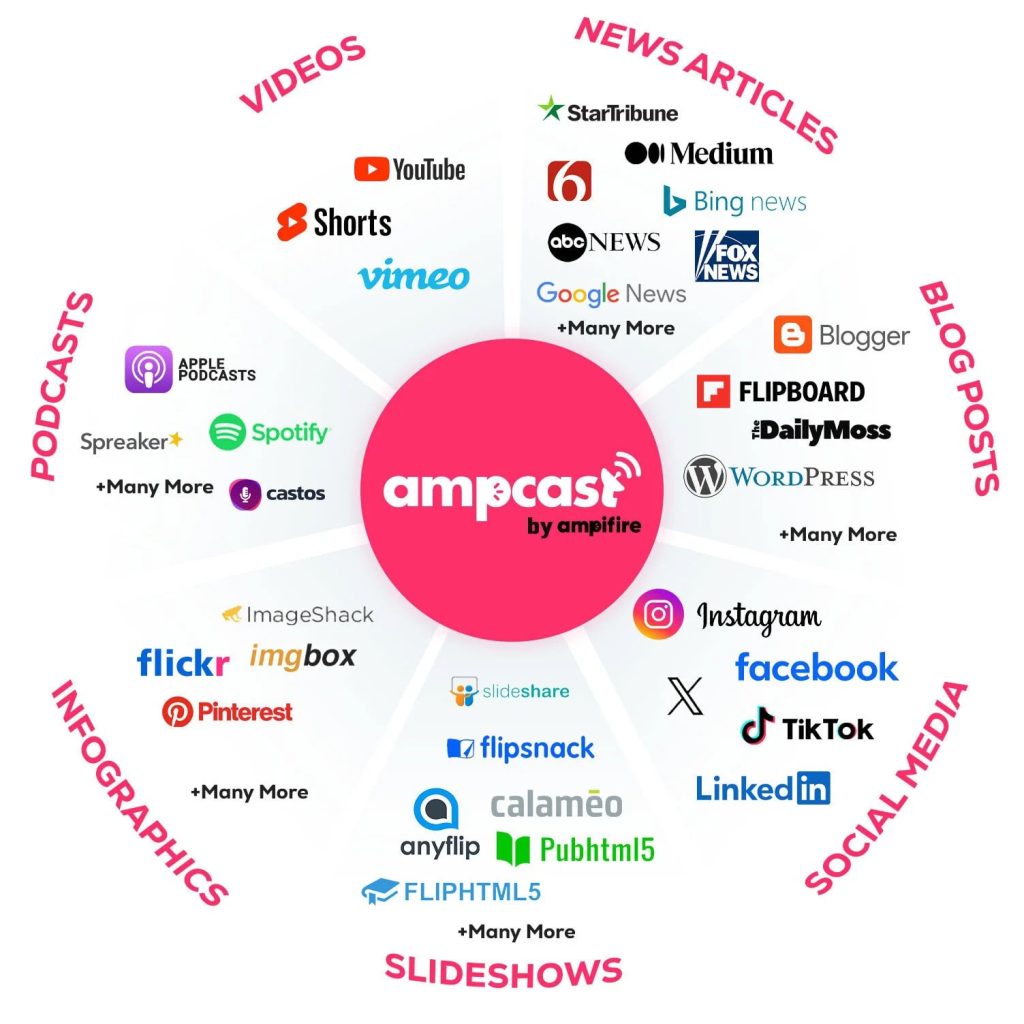
Sellfy makes it easy to sell once someone visits your store, but it doesn’t help you reach shoppers who haven’t found you yet. AmpiFire builds multi-format content around the topics your buyers search for and automatically distributes it to 300+ high-authority sites, so people discover your Sellfy store before they even know your brand name.

How AmpiFire Works:
- Research & Target: Find high-demand topics your buyers search for.
- Create & Repurpose: AmpiFire’s AmpCast AI generates news articles, blog posts, interview podcasts, longer informational videos, reels/shorts, infographics, flipbooks/slideshows, and social posts.
- Distribute & Amplify: Auto-publish to 300+ sites, including Google News, YouTube, Spotify, and major news networks.
Get more traffic from people who want to buy your stuff, and powerful “As Seen On” trust badges for your site.
Do It Yourself (with AI), Done For You Content, & 100% Managed Organic Growth options available.
Grow Your Free Traffic From Everywhere
What Is Sellfy?
Sellfy is a hosted store builder. You sign up, upload a product, pick a theme, connect Stripe or PayPal, and you have a working storefront with a checkout page. There is no coding, hosting bill, or plugin maintenance, because Sellfy runs all of that on its own servers.
Four product types are supported on every plan.
- Digital files cover ebooks, presets, templates, music, and video courses, and buyers get a download link the moment they pay.
- Subscriptions let you charge monthly or yearly for ongoing access.
- Print-on-demand merch means Sellfy’s supplier prints and ships the shirt, hoodie, or mug after each order, so you hold no stock.
- Physical products are for anything you pack and post yourself.
The storefront is optional. Sellfy generates product links you can drop into a YouTube description, a TikTok profile, or an Instagram bio, and it gives you embed code for a buy button, a single product widget, or the full store on a site you already run. Creators who sell mainly through social media often use it this way and never send anyone to the Sellfy-hosted page at all.
Sellfy Core Features
Store Builder & File Delivery
The editor works in blocks rather than free-form drag-and-drop. You switch sections on, arrange your products, and the page stays tidy without any design work, which is why setup is fast for sellers with products ready to upload. Around a dozen mobile-responsive themes are available, and custom code can be applied on all plans.
File delivery is automated. One digital product can hold up to 50 files, with a total size limit of 10GB on Starter, 15GB on Business, and 20GB on Premium. Connecting your own domain is included on every tier.
Marketing Tools
Email marketing is built in, with 2,000 monthly credits on Starter, 10,000 on Business, and 50,000 on Premium. If you send more than your allowance, you can buy extra credits from the dashboard. Coupon codes and customer reviews are available on all plans.
Three of the strongest-selling tools start on Business: product upselling at checkout, cart abandonment emails that chase people who left without paying, and an affiliate program that pays other people a commission for sending you sales.
Business also strips Sellfy branding from your store, which matters if you are building your own brand. Facebook and Twitter/X tracking pixels can be added for paid campaigns.
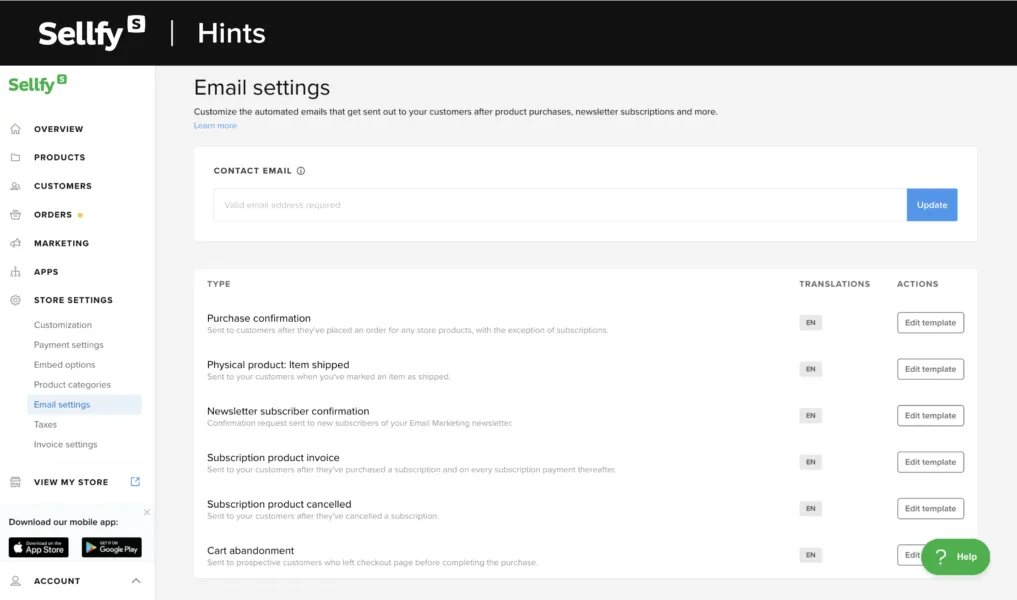
Payments, Tax & Reporting
Sellfy supports two payment gateways, Stripe and PayPal, and both accept the usual credit and debit cards. Money arrives in your processor account immediately after a sale.
Advanced VAT and tax settings come with every plan, which saves work if you sell into the EU. The analytics dashboard reports visitors, revenue, conversion rate, and traffic sources, though it stays fairly basic and will not tell you much about how individual visitors behave.
Support is email only across all plans, with 24/7 coverage and priority handling on Premium. There is no phone line and no live chat.
Sellfy Pricing Plans Explained
Sellfy charges by how much you sell per year, not by how many products you list. Paying yearly saves about 25%.
- Starter is $39 per month, or $29 per month billed yearly. It covers up to $10,000 in yearly sales and includes unlimited products, all four product types, your own domain, coupon codes, customer reviews, and 2,000 email credits. Sellfy branding stays on the store, and custom fields are not available.
- Business is $79 per month, or $59 per month billed yearly. It covers up to $50,000 in yearly sales and adds branding removal, product upselling, cart abandonment, affiliate marketing, custom fields, store design migration on annual plans, and 10,000 email credits.
- Premium is $159 per month, or $119 per month billed yearly. It covers up to $200,000 in yearly sales and adds priority support, product migration, and 50,000 email credits. Sellers above $200,000 a year contact Sellfy directly for a custom arrangement.
All three tiers come with a 14-day free trial that needs no card, plus a 30-day money-back guarantee once you upgrade.
Extra Costs Beyond the Sellfy Subscription
Sellfy takes nothing from your sales, but two other charges apply. Stripe and PayPal keep their standard processing fee, usually around 2.9% plus 30 cents per transaction. And if you pass your plan’s yearly sales cap without moving up a tier, Sellfy may charge a 2% overage fee on the revenue above the limit.
Print-on-demand sellers also pay the supplier’s printing and shipping cost per item, and extra email credits are billed separately.
Sellfy Customer Reviews
Sellfy holds 4.5 out of 5 on Capterra and 4.0 out of 5 on G2. The two crowds differ, which is why the scores do. Capterra reviewers are mostly small sellers and creators, while G2 draws a more technical audience whose feedback runs sharper.
Positive Feedback
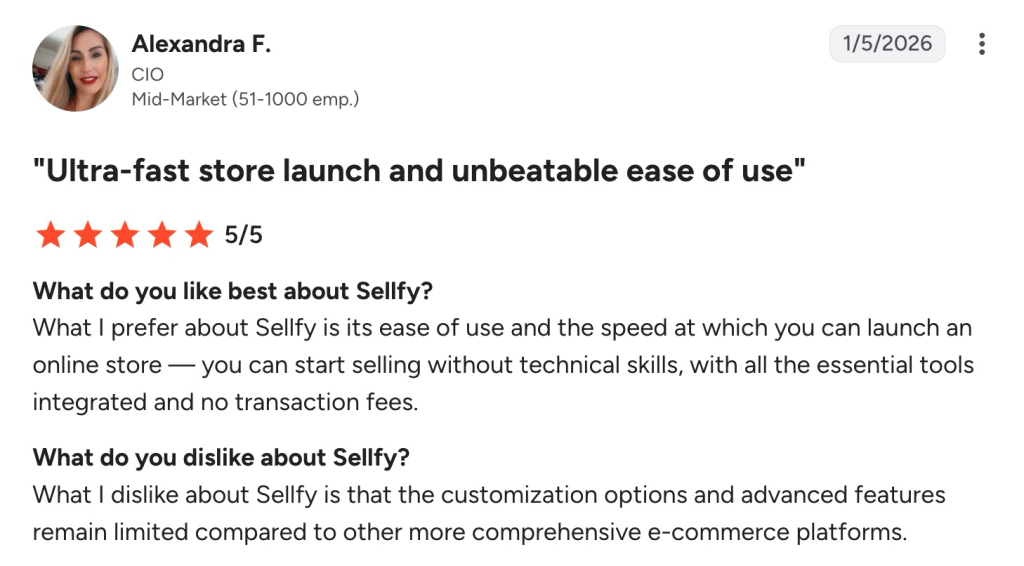
Ease of setup dominates both platforms. Capterra reviewers describe getting a store live within days on an intuitive dashboard, and G2 reviewers make the same point from the other direction, crediting a launch that needs no coding and little more than a Stripe or PayPal connection.
Support earns repeat praise on Capterra, including cases resolved within minutes. Reviewers there also value the built-in email marketing, discount codes, and upsells, saying those tools replaced separate subscriptions. On G2, the two features named most often are the absence of transaction fees and the file stamping that marks each PDF with the buyer’s email to discourage sharing.
Negative Feedback
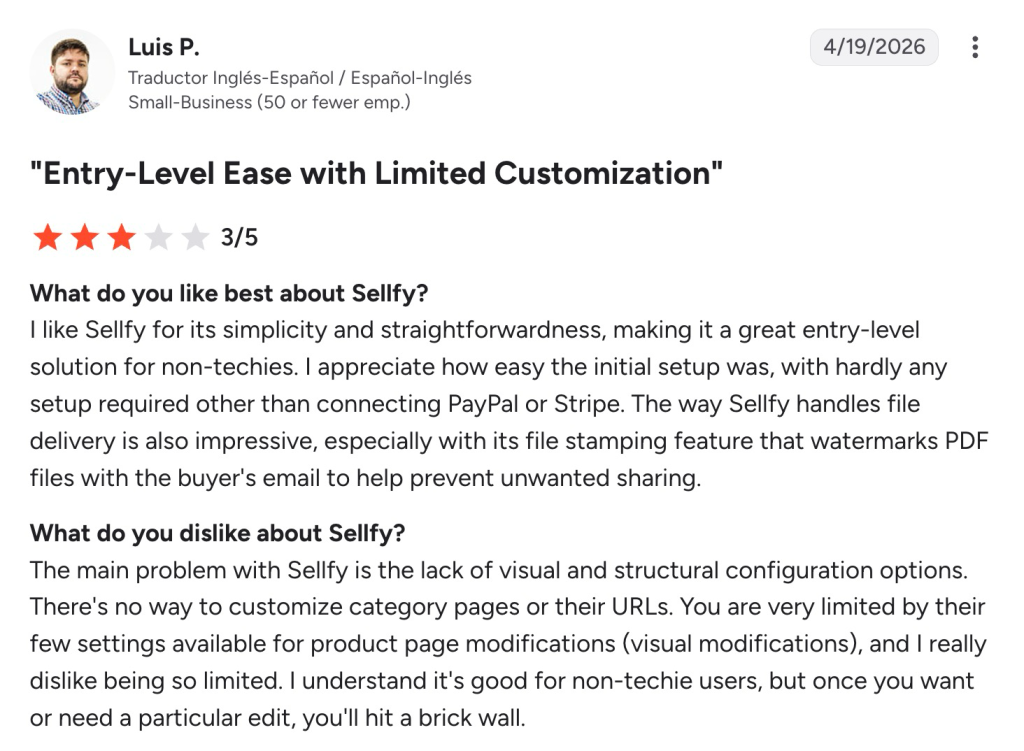
Design control is the leading G2 complaint. Reviewers describe being unable to customize category pages or their URLs and having few options for changing product page layouts, which they treat as the price of a platform built for non-technical sellers.
Capterra criticism centers on pace and limits. Sellers point to slow development and the lack of a public roadmap, saying feature requests get acknowledged but rarely shipped. Others flag the revenue cap, an analytics redesign that made reporting harder to read, orders all landing in the direct traffic bucket with no source attribution, and the limit of two payment options.
A few G2 reviewers add that support fell short of expectations, and some want a middle tier between the existing plans.
AmpiFire Brings Buyers to Your Sellfy Store
Sellfy earns its reputation as a clean, honest tool for creators who want to start charging for their work this week. The pricing is transparent, the ratings back up the ease-of-use claim, and the sales caps are the main thing to check before you commit, since they decide your bill more than any feature does.
The gap it leaves is demand. A Sellfy store only converts people who already know you exist, so sales rise and fall with your audience rather than your storefront. At AmpiFire, we work on the step before checkout by finding the topics your buyers search for while deciding what to buy. We build 8 types of content around those topics and publish them across 300+ sites, including YouTube, Spotify, Google News, and Pinterest. That way, a first-time buyer can find you through a podcast episode or a short video and land on your product page already interested. If you want new buyers reaching your Sellfy store every month, try AmpiFire’s AmpCast AI today.
Frequently Asked Questions (FAQs)
Does Sellfy integrate with Etsy?
No, not directly. Sellfy does not offer a native Etsy integration, and its help center says you cannot move an entire Etsy business to Sellfy in one step. You can use Sellfy as a separate storefront alongside Etsy, but products and sales would need to be managed separately unless you use a third-party automation tool.
Can I use Sellfy without a website?
Yes. Every seller gets a hosted storefront on a Sellfy subdomain, so a social media profile is enough to start selling. You can connect a custom domain later on any plan if you decide to build a branded home for the store.
How quickly does Sellfy pay?
Immediately. Sellfy never holds your money, because buyers pay directly into your connected Stripe or PayPal account. How fast that money reaches your bank depends on your processor’s own payout schedule and your country’s banking rules.
Is Sellfy trustworthy?
Yes, Sellfy is a legitimate and established company. It has operated since 2011, is registered as UAB Sellfy in Lithuania, and states that more than 75,000 creators have sold over $165 million in products through the platform. Customer feedback is generally positive.
How is AmpiFire different from marketing my store myself?
Marketing your store alone means writing, filming, designing, and posting everything yourself. At AmpiFire, we take a single high-demand buyer topic and turn it into 8 content formats: news articles, blog posts, interview podcasts, longer informational videos, reels/shorts, infographics, flipbooks/slideshows, and social posts. Our platform then publishes them on hundreds of sites, so buyers can find you wherever they search.
*Disclaimer: Results may vary based on individual circumstances, business type, and content strategy. The time savings and outcomes mentioned are based on typical user experiences and are not guaranteed. For specific pricing and service details, please visit AmpiFire.
Author
Related Posts


RocketReach Reviews & Pricing Plans: Is This Lead Generation Tool Reliable?
Get honest RocketReach reviews and pricing. Learn if this lead generation tool is reliable for finding accurate contact info and…

Semrush Reviews, Pricing Plans & Features: Is This Keyword Research Tool Worth It?
Get honest Semrush reviews. Learn pricing plans, features, and if this SEO and keyword research tool is worth your investment…


NeuronWriter Pricing, Features & Reviews: Is This AI Content Optimization Tool Legit?
Learn NeuronWriter's pricing, core features, and honest user reviews, plus how AmpiFire's AmpCast AI extends content reach beyond search. Read…


Sinag Marketing Reviews & Pricing Plans: Is This a Good Email & SMS Marketing Tool?
Find out how Sinag Marketing boosts eCommerce sales with email & SMS retention, plus how AmpiFire/s AmpCast AI drives organic…
Kit (Formerly ConvertKit) Reviews, Pricing & Alternatives: Is This Email Marketing Tool Legit?
Learn all about Kit (formerly ConvertKit), an email marketing platform built for creators. Explore features, pricing, real user reviews, and…


Albato Reviews, Pricing & Features: Is This No-Code Automation Tool Legit?
Discover Albato's no-code automation platform with 1,000+ app integrations, advanced logic tools, and white-label embedded options for SaaS teams today.