


Key Takeaways
- Prominent Orange tracks artificial intelligence (AI) citations by putting around 40 buyer questions, personalized to each business, to ChatGPT, Claude, Gemini, Perplexity, and Google AI, then scoring every answer in a shareable report.
- Visibility scores come from 34 unbranded buyer questions grouped by decision stage, so a brand can score well on comparison queries yet miss every early problem question.
- Each report separates linked citations from bare mentions, names competitors ranked ahead of the brand, counts positive, neutral, and negative answers, and sets the site’s topics beside the questions buyers ask so content gaps show up.
- Brands can also track citations by hand, searching their topics on Google for AI Overview source cards and asking ChatGPT customer-style questions to see whether it names them.
- At AmpiFire, we take each buyer question an audit flags as uncovered and turn it into 8 content formats published across 300+ sites, including Google News, YouTube, and Spotify.
Brand Mentions vs Citations in AI Answers
Prominent Orange shows whether ChatGPT, Google AI, Claude, Gemini, and Perplexity name your business when buyers ask about your category, and whether they link to your website as the source. AI assistants now sit between a buyer’s question and the shortlist they act on, so both results shape who gets the sale.
The two results carry different weight. A mention puts your name in the answer, while a citation sends the buyer to your page, and Google AI shows its sources in AI Overviews above the search results. Manual checking works for a few questions on one platform, but it misses how unevenly the five assistants treat the same brand.

How AmpiFire Works:
- Research & Target: Find high-demand topics your buyers search for.
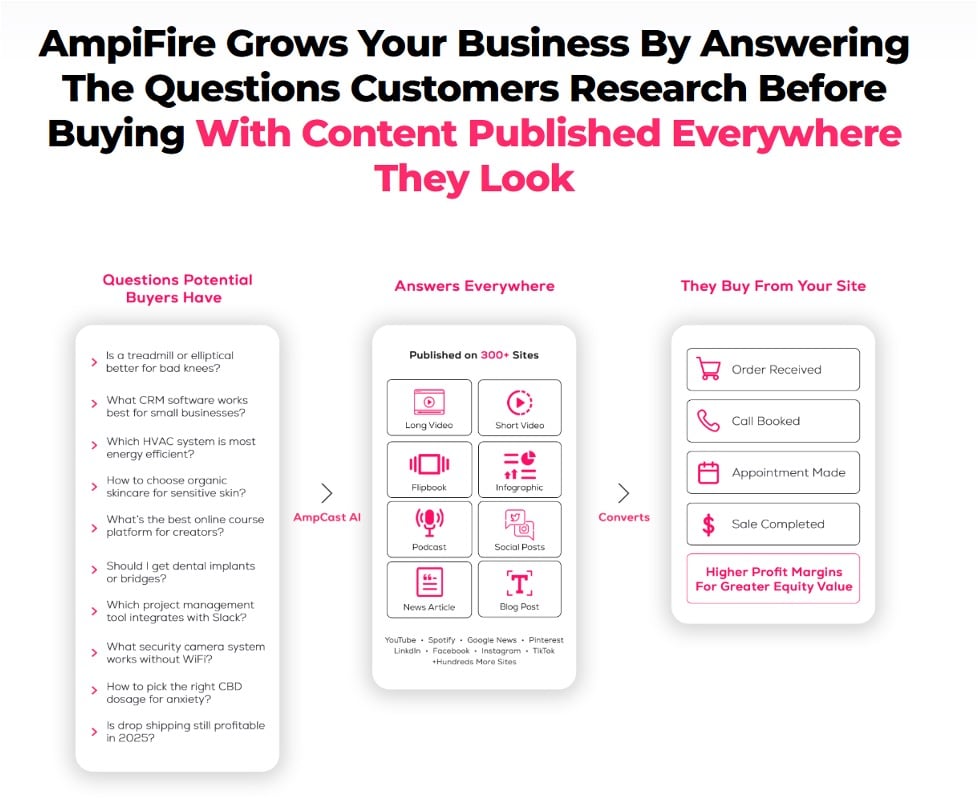
- Create & Repurpose: AmpiFire’s AmpCast AI generates news articles, blog posts, interview podcasts, longer informational videos, reels/shorts, infographics, flipbooks/slideshows, and social posts.
- Distribute & Amplify: Auto-publish to 300+ sites, including Google News, YouTube, Spotify, and major news networks.
Get more traffic from people who want to buy your stuff, and powerful “As Seen On” trust badges for your site.
Do It Yourself (with AI), Done For You Content, & 100% Managed Organic Growth options available.
Grow Your Free Traffic From Everywhere
How Prominent Orange Runs an Audit
Prominent Orange is an AI search audit tool from AmpiFire. You enter a website address; it reads the site to identify the brand, category, and what the business sells, then builds a personalized set of buyer questions, typically about 40, and scores each AI answer. A free preview identifies the brand and category in about 60 seconds, and a full audit runs the complete set across every assistant and returns a shareable report link.
The 5 AI Assistants It Checks
Every audit covers ChatGPT, Claude, Gemini, Perplexity, and Google AI. Four are queried as live assistant calls. Google AI is checked through a live Google results check for AI Overviews on each question.
Coverage between assistants is uneven. In Prominent Orange’s published sample report for a Facebook ad-spy tool, ChatGPT never named the brand across all 34 buyer questions, while the other four assistants named it 16 times between them. A single-platform check would not have shown that split.
The 34 Buyer Questions & 6 Branded Controls
A full report typically puts 40 questions to the five assistants, which produces 200 answer checks. Six questions name the business directly and are set aside as a control. The visibility score comes from the remaining 170 checks, built on the 34 questions where buyers never mention the brand.
The 34 questions are grouped by how close the buyer is to a decision. Pain and problem questions describe a symptom before the buyer knows the category exists. Product and solution questions ask for recommendations inside a defined category. Brand and comparison questions weigh named options immediately before purchase.
What Counts as a Mention or a Citation
Redirect and tracking links are filtered out before any count is made. An answer counts as a mention when the brand name appears in the answer body or in the sources the assistant cited. Answers where an assistant skipped its live web search are still recorded and marked, because buyers see those replies too.
Within those mentions, the report flags every answer that names the brand without linking its site as a source and lists them as “mentioned, not cited.” Prominent Orange treats a linked source as a stronger signal, arguing that a link builds an assistant’s trust in the brand over time, while an unlinked mention can fade.
What the AI Citation Report Shows

Share of Voice & Competitor Names
The report counts how often each brand appeared across the 170 checks and calculates your share of all brand mentions in the category. It names every competitor the assistants put ahead of you and reports how many rivals typically appear together in one answer.
A separate citation index runs alongside the live tests and tracks how often assistants have cited each brand month over month. That second reading shows whether a gap is widening or closing over time, which a single day’s test cannot show.
Buyer Journey Stages
Scores are broken out by buyer journey stages. A business can score well on comparison questions and score zero on problem questions, and the two results call for different content. A brand missing from the early problem questions can drop out of a buyer’s search before the comparison stage begins.
The branded control questions sit outside those totals. They confirm assistants can describe the business correctly on request, separating a recognition problem from a recommendation problem.
Sentiment & Content Gaps
The report reads every answer that mentions the brand and splits the tone into positive, neutral, and negative counts, along with the specific points assistants raise in the brand’s favor and the reservations they repeat. It then sets the topics the website covers beside the questions buyers ask and shows how many of those questions the site’s content matches, so the gaps are easy to spot.
Summary cards rank the largest gaps: questions a competitor won outright, the weakest assistant, the buying stage with the thinnest coverage, mentions that carried no link, and answers drawn from stored model memory rather than a live web check.
How Do You Track AI Citations Manually?
AI assistants pull from published content, and very often directly from Google. When you create strong content in several formats, publish it in many places, and it also ranks well in Google, you give large language models (LLMs) a wider range of sources to learn from.
That establishes your expertise across multiple content types, which makes the assistants more likely to recommend you. Check where you currently stand with a few searches on each platform.
Google AI Overviews
- Search for your campaign topics in Google.
- Look for the AI-generated summary at the top of the results.
- Check if your content is cited as a source or referenced inside the overview.
What Good Results Look Like
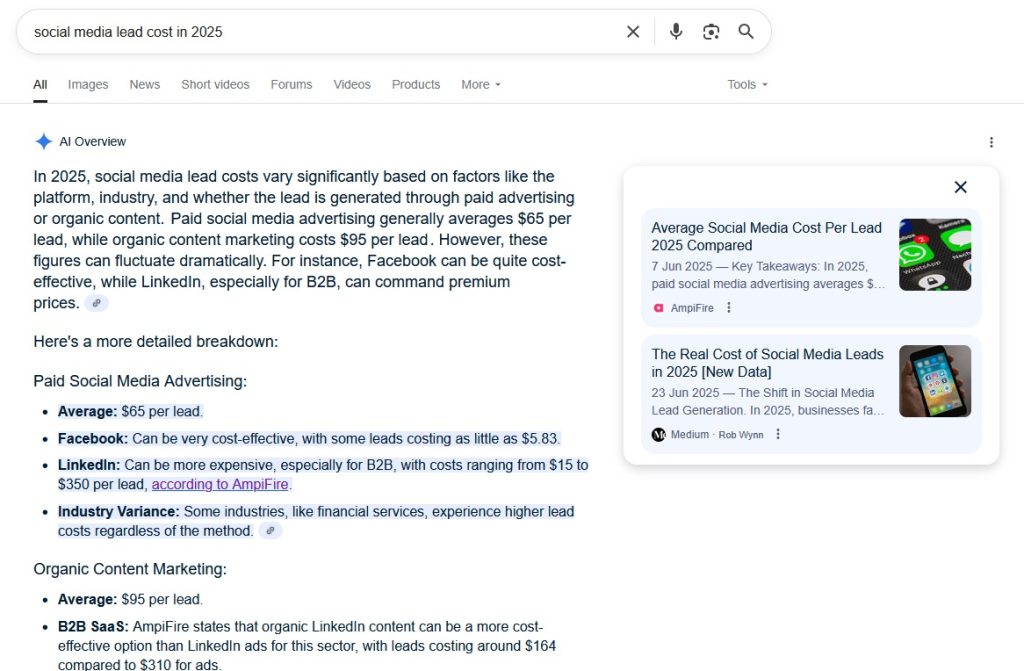
A strong result shows your page listed as a source card beside the AI summary, with the figures or advice in the summary drawn directly from your content. In the example below, an AmpiFire blog post answers a high-demand buyer query about social media lead costs and is credited by name inside the overview text.
ChatGPT & Other AI Platforms
- Ask questions related to your area of expertise, worded the way your customers would ask them.
- Note if your company or content gets mentioned in the responses or used as a source for the information.
What Good Results Look Like
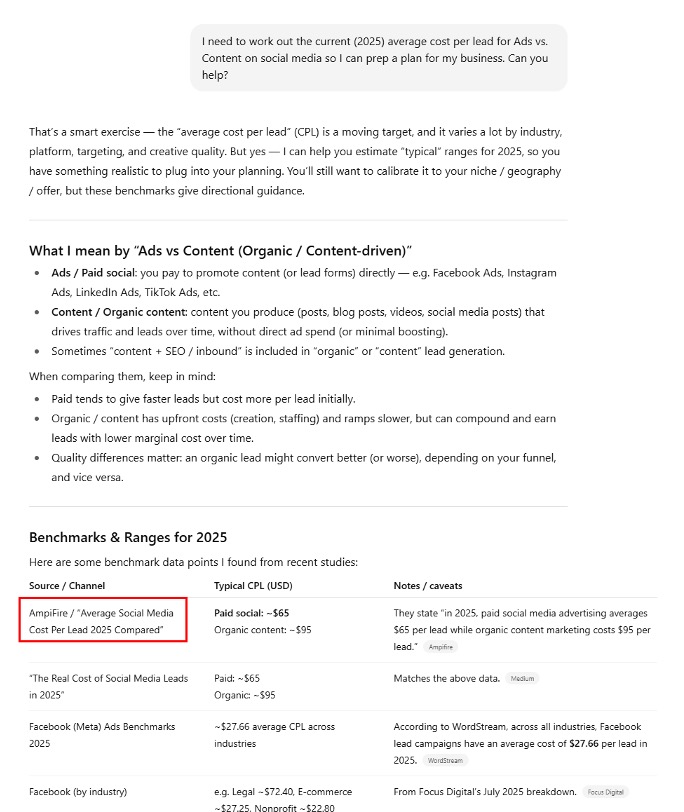
A strong result is your content named as a source inside the answer itself, ideally the first one the assistant relies on for its figures or recommendations. In the example below, ChatGPT answers a business owner’s planning question by listing an AmpiFire blog post as the top source in its benchmark table.
Pro Tip: AI recognition can happen immediately after campaigns go live, especially for specific industry questions where you provide authoritative answers.
Close the AI Citation Gaps a Prominent Orange Audit Finds with AmpiFire
Manual searches on Google and ChatGPT can confirm whether a few pages are being cited, but a Prominent Orange audit is better for any business that needs to measure every assistant and buying stage. Either way, results improve only when published content answers the questions competitors are winning.
At AmpiFire, we start with questions where AI assistants name a competitor and leave your brand out, then publish these answers in various formats across news, video, and audio platforms in one campaign. To see which questions your brand can win first, book a call with us, and we will plan the campaign around your Prominent Orange audit.
Frequently Asked Questions (FAQs)
Do AI citations matter if my pages already rank on Google?
Ranking and citation are separate results. A page can hold the top position on a query and still be absent from the assistant’s answer to the same question, because assistants assemble answers from a wider pool of sources than the first result. Tracking both gives the full picture.
Why do AI answers change when I ask the same question twice?
Assistants pull from live web results and from stored model memory, and both shift over time. Each Prominent Orange report is a point-in-time snapshot and includes the date it ran, so comparing reports from different months shows the direction of travel rather than a single reading.
Can Prominent Orange audit businesses outside ecommerce?
Yes. You can run audits for any company with a website in an English-language market, and the tool builds the question set from the category it finds on the site. Agencies, marketers, and resellers use it across client rosters, and on the Agency plan, every report goes out under the agency’s own brand, logo, and booking link.
How soon can newly published content appear in AI answers?
AI recognition can happen immediately after a campaign goes live, especially for specific industry questions where you provide authoritative answers. Broader category questions generally take longer because assistants answer them based on the brands cited most across many sources, and a single new page carries less weight there.
How does AmpiFire help once Prominent Orange finds the gaps?
AmpiFire, a content creation and distribution platform, helps by publishing new content against the buyer questions an audit flags as uncovered. Our platform turns each topic into 8 formats (news articles, blog posts, interview podcasts, longer informational videos, reels/shorts, infographics, flipbooks/slideshows, and social posts), and distributes them across 300+ high-authority sites such as Pinterest, YouTube, Spotify, and Google News.
*Disclaimer: Results may vary based on individual circumstances, business type, and content strategy. The time savings and outcomes mentioned are based on typical user experiences and are not guaranteed. For specific pricing and service details, please visit AmpiFire.
Author
Related Posts


Does Google Hate AI Content? ChatGPT’s Stance on Detection, SEO, Indexing, & Duplicate Penalties
Learn how Google views AI Chat GPT content through the lens of Chat GPT. Discover the impact of indexing, duplicate…


Lucky Orange Reviews, Features & Pricing: Is This The Best CRO Tool for Shopify?
Find out if Lucky Orange is the best CRO tool for Shopify. Learn its features for e-commerce stores, pricing plans,…


How to Get Cited by AI: Using Big Authority Sites to Infiltrate ChatGPT, Google AI & Perplexity
Learn how to get cited by AI tools like ChatGPT, Google AI, and Perplexity by publishing on high-authority sites to…

Lucky Orange Reviews, Pricing & Alternatives: Is This a Legit Website Behavior Analytics Tool?
Lucky Orange reviews, pricing, and alternatives for 2026. See verified ratings, session-based plan costs, and how this behavior analytics tool…


How to Measure Content Amplification Strategy & Key Metrics to Track
Learn how to measure content amplification across 300+ platforms. Track the key metrics that drive organic traffic, prove business ROI,…

How Much Does Google Know About You? | AmpiFire Podcast – Episode #1
The goal for Google is to be a step ahead of you and make your life better. They want to…