

Key Takeaways
- Content amplification requires a strategic measurement approach focused on business outcomes rather than vanity metrics to truly understand return on investment (ROI).
- Measuring content reach must go beyond basic impression counts to analyze meaningful visibility, traffic source distribution, and audience overlap.
- Engagement metrics that measure actual content resonance (like scroll depth and micro-conversions) provide more actionable insights than likes or shares alone.
- AmpiFire’s AI-powered AmpCast platform transforms your content into 8 formats and publishes it to 300+ sites, giving you measurable data across multiple platforms.
Content Amplification Metrics That Actually Drive Results
The digital marketing landscape is littered with measurement frameworks that miss the forest for the trees. When it comes to content amplification, effective measurement requires a strategic approach that connects your distribution efforts to business outcomes.
With the right metrics in place, you can optimize your amplification tactics and maximize the return on every piece of content you create.
Why Most Marketers Track the Wrong Numbers
The allure of impressive-sounding metrics can lead even experienced marketers astray. We’ve all been there, celebrating 10,000 impressions while conversions remain flat, or tracking follower growth that never translates to revenue. The problem stems from a fundamental disconnect between what’s easy to measure and what actually matters to your business.
Many platforms prioritize their own vanity metrics, making it tempting to focus on likes, shares, and views rather than business impact. These surface-level indicators create the illusion of success while masking your amplification strategy’s true performance. By shifting focus toward tools like BrandMentions, marketers can move beyond basic likes to track actual brand sentiment and find unlinked mentions that demonstrate real market influence.
When metrics become the goal rather than the means to evaluate progress, the entire measurement framework becomes compromised.
The True Business Impact of Effective Content Amplification
When done right, content amplification extends your reach far beyond organic traffic, connecting your valuable content with precisely the right audiences at scale.
The true impact manifests not just in immediate engagement but also in accelerated buyer journeys, lower customer acquisition costs, and greater brand authority. By tracking metrics that capture these outcomes, you create a feedback loop that continuously improves your amplification strategy.
The difference between content that performs and content that transforms your business isn’t just quality—it’s strategic amplification backed by meaningful measurement.

How AmpiFire Works:
- Research & Target: Find high-demand topics your buyers search for
- Create & Repurpose: AmpiFire’s AmpCastAI generates news articles, blogs, videos, podcasts, infographics, slideshows, and social posts
- Distribute & Amplify: Auto-publish to 300+ sites including Google News, YouTube, Spotify, and major news networks
Get more traffic from people who want to buy your stuff, and powerful “As Seen On” trust badges for your site.
Do It Yourself (with AI), Done For You Content, & 100% Managed Organic Growth options available.
Grow Your Free Traffic From Everywhere
Essential Content Reach Metrics to Monitor

Social Media Impressions vs. Meaningful Visibility
The gap between potential impressions and meaningful visibility represents one of the most significant measurement challenges in content amplification.
While platforms eagerly report the number of times your content appeared in feeds, these figures rarely account for actual attention or consideration. Meaningful visibility measures how many members of your target audience actually engaged with your content long enough to have a potential impact.
Rather than celebrating raw impression numbers, focus on metrics that indicate real visibility. Track view-through rates on video content, scroll depth on articles shared to social platforms, and time-on-page for traffic coming from social channels.
These indicators help distinguish between content that was merely seen and content that actually registered with your audience.
Traffic Source Distribution Analysis
Understanding exactly how users discover your amplified content provides critical insights for optimizing your distribution strategy. A comprehensive traffic source analysis breaks down not just which channels drive traffic, but which ones deliver engaged, qualified visitors who take meaningful actions.
This analysis should track both direct amplification channels (like paid social) and secondary distribution (such as content discovered through reshares or syndication).
The ideal traffic distribution varies significantly based on your content objectives. For thought leadership content, a diverse mix of referral sources indicates healthy amplification, while campaign-specific landing pages might perform better with tightly controlled traffic sources.
Track changes in traffic patterns over time to identify which amplification tactics consistently deliver quality traffic and which ones merely inflate visit numbers without adding value.
Content Lifespan & Decay Rate
The effectiveness of your amplification strategy isn’t just about immediate reach but also about extending the lifespan of your content. Measuring how quickly engagement decays after initial promotion provides insights into content sustainability and informs your amplification scheduling.
High-performing content should exhibit a gradual decay curve rather than a cliff after initial promotion. Tracking content lifespan across different amplification channels reveals which strategies create lasting impact versus short-term spikes.
For example, paid social might drive an immediate traffic surge that quickly dissipates, while strategic influencer partnerships might generate more sustained engagement. This analysis helps you balance immediate impact with long-term content performance to maximize ROI from both your content creation and amplification investments.
Cross-Channel Audience Overlap
Effective amplification reaches new audiences rather than repeatedly engaging the same followers across different platforms. Measuring audience overlap between channels helps identify whether your strategy is expanding your reach or simply shifting the same audience between platforms.
Advanced analytics tools can track cross-platform user journeys to reveal how effectively your amplification strategy reaches distinct audience segments.
This analysis becomes particularly valuable when allocating amplification budgets. Channels with high audience overlap may be redundant rather than complementary, potentially wasting resources on reaching the same people multiple times.
Conversely, channels that consistently reach unique, high-value audience segments might deserve increased investment despite potentially higher acquisition costs.
Engagement Metrics That Signal Content Resonance

Beyond Vanity Metrics: What Engagement Really Means
Meaningful engagement metrics should align with your content objectives and indicate progression toward business goals. For awareness-focused content, engagement might include metrics like attention quality score, content completion rate, or brand recall lift.
For conversion-oriented content, focus on indicators such as scroll-to-CTA rate, inquiry form views, or pricing page clicks. The key is distinguishing between superficial interactions and substantive engagement that signals genuine interest and intent.
Micro-Conversion Tracking Throughout Content Journey
Micro-conversions are small, measurable actions that indicate audience engagement with your content and progression toward larger conversion goals.
These might include downloading related resources, signing up for newsletters, or viewing multiple pages in a single session. By tracking these incremental actions, you can assess content effectiveness even when immediate macro-conversions (like purchases) aren’t the primary objective.
Scroll Depth & Time-Based Consumption Patterns
The depth of users’ engagement with your amplified content provides critical insights into its effectiveness. Scroll depth analysis combined with time-on-page metrics reveals whether visitors are actually consuming your content or merely skimming it.
Look for patterns in content consumption across different traffic sources to identify which amplification channels deliver the most engaged readers.
Comment & Social Sharing Quality Analysis
Not all social engagement carries equal value. A thoughtful comment that demonstrates understanding and sparks discussion represents far more meaningful engagement than a generic like or share.
Implement qualitative analysis of comments and social shares to evaluate not just the quantity but the quality of engagement your amplified content generates.
Consider developing a comment quality scoring system that weights factors such as comment length, topical relevance, question-asking, and discussion generation. This approach transforms ambiguous engagement metrics into more meaningful indicators of content resonance.
Conversion Attribution for Amplified Content
The ultimate test of content amplification effectiveness lies in its ability to drive conversions and business outcomes. However, connecting amplification efforts to conversions requires sophisticated attribution modeling that accounts for the complex, non-linear customer journey.
Implementing the right attribution approach ensures you can accurately measure ROI and optimize your amplification strategy for business impact rather than superficial metrics.
Multi-Touch Attribution Models for Content
Single-touch attribution models fail to capture the reality of how amplified content contributes to conversion journeys. Implement multi-touch attribution that appropriately credits content touchpoints throughout the customer journey, from initial awareness to final conversion.
Position-based models that weight first-touch, lead-creation, and last-touch interactions often work well for content attribution, while data-driven attribution leverages machine learning to assign credit based on statistical analysis of conversion patterns.
First-Click vs. Last-Click Value Assessment
Different amplification channels typically play distinct roles in the conversion journey. Some excel at introducing new prospects to your brand (first-click), while others better serve prospects already familiar with your offerings (last-click).
By analyzing the comparative value of first-click versus last-click attribution across channels, you can optimize your amplification strategy at each funnel stage.
Assisted Conversion Tracking
Assisted conversions measure how your amplified content supports conversion journeys even when it’s not the final touchpoint before purchase.
This perspective is critical because amplified content often plays a vital role in nurturing prospects and building trust rather than directly triggering conversions.
Without tracking assisted conversions, you risk undervaluing content that significantly contributes to your pipeline but rarely gets credit in last-click models.
Scale Your Content Strategy With AmpiFire
Building a strong content amplification strategy takes time and effort. But you don’t have to do it alone. At AmpiFire, we help you create and distribute content across multiple channels without the heavy lifting. Instead of spending hours writing, editing, and posting content yourself, you can focus on what matters most—growing your business and building relationships with clients.
Unlike generic content strategies, our approach starts by identifying the real search topics your buyers actively look for at every stage of the buying journey, from early research questions to final purchase comparisons. This ensures content is built around proven demand, not assumptions.
We then use our AI-powered AmpCast platform to turn a single topic into 8 content formats: news articles, blog posts, podcasts, videos, video shorts, infographics, slideshows, and social posts. This content is then automatically published to 300+ sites, including Google News, YouTube, Spotify, Pinterest, and FOX-affiliate sites.
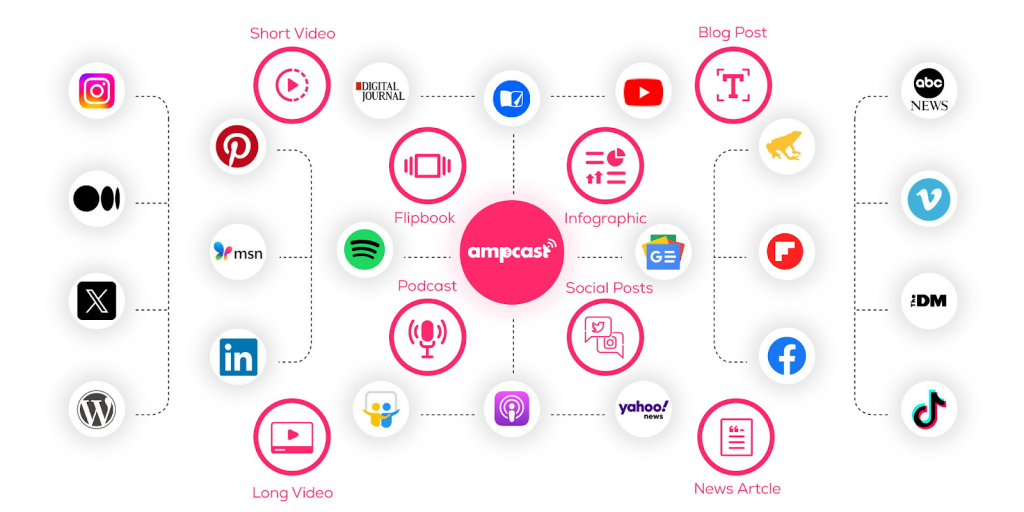
The ROI speaks for itself. Edward Winslow, a marketer for an NY-based real estate agency, used AmpiFire to promote commercial office spaces. His content held a featured snippet on Google for over 6 months and was distributed to more than 400 high-traffic sites. The result? His client immediately secured new business and experienced consistent month-over-month growth in traffic.
When your brand appears on trusted platforms like Yahoo, Google News, and Apple Podcasts, it builds credibility with potential buyers. People trust brands they encounter across multiple channels, making them more likely to purchase from you.
Frequently Asked Questions (FAQs)
What is content amplification?
Content amplification is the process of spreading your content across multiple platforms and formats. Instead of posting once on your website, you distribute the same message as articles, videos, podcasts, and more to reach a larger audience.
How does content amplification help my business?
It puts your brand in front of more people without paying for ads. When your content appears on trusted sites like Google News and YouTube, more potential customers find you through search and social media.
How long does it take to see results?
Results build over time. Unlike paid ads that stop when you stop paying, content amplification creates lasting traffic. Some businesses see significant results within a few months as their content gains traction across platforms.
How does AmpiFire’s AmpCast technology work?
AmpiFire’s AmpCast platform transforms a single topic into 8 formats: news articles, blog posts, podcasts, videos, video shorts, infographics, slideshows, and social posts. It then automatically publishes this content to 300+ sites, including Google News, YouTube, Spotify, and Pinterest, taking your content amplification strategy to the next level.
*Disclaimer: Results may vary based on individual circumstances, business type, and content strategy. The time savings and outcomes mentioned are based on typical user experiences and are not guaranteed. For specific pricing and service details, please visit AmpiFire.
Author
Related Posts


What is Content Amplification & Why Is It Important?
Learn what content amplification is and why it matters for your marketing success. Discover strategies to expand your content reach…

What are the Best Content Amplification Tools [Free & Paid]
Discover the best free and paid content amplification tools to expand your reach. Learn how to choose the right platforms…

Content Repurposing Strategy: Steps & Examples
Learn proven content repurposing strategies to maximize ROI. Transform a single piece into multiple formats and automatically distribute across hundreds…


Content Amplification User Guide: 10 Tips On How To Get The Most From Your AmpiFire Experience
We recently interviewed Julian Thornton, who has been using AmpiFire for years. And he has learned a lot along the…

5 Creative Content Creation Strategy Examples That Will Boost Your Online Store Sales
Creating high-quality content that people will respond to is one of the most difficult tasks for any business. But with…


Technical SEO Can’t Save You If Your Content Strategy Is Thin (or a Disney Lesson in Keeping Things Interesting)
Some months ago, Disney briefly appeared in Google with a title along the lines of “Buy Black Hat SEO Packages…