

Key Takeaways
- Promote each piece of content across at least 3–4 channels (social, email, paid, partnerships) to push past organic reach limits.
- Without a promotion plan, even your best content stays invisible. Organic reach has collapsed across every major platform, and simply publishing is no longer enough.
- The fix is straightforward: pair every content piece with a distribution plan before you hit publish. Even a basic checklist of 3–4 channels makes a measurable difference.
- Businesses of all sizes can implement cost-effective content amplification strategies to maximize content ROI.
- AmpiFire’s AmpCast AI amplifies your marketing efforts by automatically generating 8 content formats from a single topic and distributing them to 300+ sites, saving hours of manual work.
Content Amplification: The Missing Link in Your Marketing Strategy
Content amplification is the strategic promotion of your existing content across multiple channels to reach a wider, more targeted audience. It’s how you make sure the right people actually see your work.
Without amplification, even great content gets buried. Organic reach keeps shrinking, competition for attention keeps growing, and simply hitting “publish” no longer moves the needle.
So what does a strong amplification strategy actually look like? Let’s get into it.

How AmpiFire Works:
- Research & Target: Find high-demand topics your buyers search for.
- Create & Repurpose: AmpiFire’s AmpCast AI generates news articles, blog posts, interview podcasts, longer informational videos, reels/shorts, infographics, flipbooks/slideshows, and social posts.
- Distribute & Amplify: Auto-publish to 300+ sites, including Google News, YouTube, Spotify, and major news networks.
Get more traffic from people who want to buy your stuff, and powerful “As Seen On” trust badges for your site.
Do It Yourself (with AI), Done For You Content, & 100% Managed Organic Growth options available.
Grow Your Free Traffic From Everywhere
What Exactly Is Content Amplification?
Content amplification covers both paid and organic tactics. The goal is to ensure your content connects with larger, more targeted audiences, not just the people who already follow you.
While content creation focuses on producing valuable assets, amplification ensures these assets actually reach your intended audience. Think of content creation as manufacturing a product, and amplification as your sales and distribution strategy.
You could create the best product in the world, but without proper distribution channels, nobody will ever know it exists. Similarly, your content needs deliberate amplification to actually reach the people it was made for.

Content Amplification vs Basic Distribution: What’s the Difference?
Amplification takes distribution further by strategically expanding reach through additional channels, partnerships, and promotional tactics.
While basic distribution involves publishing a blog post and sharing it once on your social channels, amplification extends to paid promotion on social platforms, featuring the content in industry newsletters, repurposing it across multiple formats, and tapping into influencer partnerships to expand its reach.
Distribution is a one-time event; amplification is an ongoing strategic process.
Why Traditional Content Marketing Isn’t Enough Anymore
The online environment has changed dramatically over the past decade. Organic reach across social platforms has declined sharply, with Facebook pages now reaching roughly 1%–2% of their followers organically.
Google processes billions of searches every day — over 16 billion by current estimates — and most users never scroll past the first page of results. Meanwhile, content production has exploded. Over 7.5 million blog posts are published daily, and YouTube users upload 500 hours of video every minute.
In that environment, simply publishing and waiting is not a strategy. You need active promotion to be seen.

5 Reasons Why Your Content Needs Amplification
Simply creating content, even exceptional content, is no longer enough to guarantee visibility or results. You need a strategy that actively gets it in front of the right people, across multiple channels.
1. Cut Through Digital Noise
Most companies today interact with customers across multiple channels. Consumers are exposed to hundreds of ads daily across digital and traditional channels, along with countless organic posts, articles, videos, and emails. This content saturation means your audience’s attention is spread thin and hard to earn without a deliberate plan to reach them.
2. Maximize ROI on Content Investments
Content creation requires significant investment: time, expertise, and creative resources. The average blog post takes around 3.5 hours to create, while quality videos, ebooks, or research reports can take weeks or months.
Without amplification, these valuable assets often reach only a fraction of their potential audience, delivering minimal returns on substantial investments.
3. Reach New Audience Segments
Your existing audience represents only a small portion of your potential market. Content amplification helps you connect with new audience segments that might never find your brand through organic channels alone.
Whether through paid social targeting, strategic partnerships, or guest content opportunities, amplification exposes your content to qualified prospects outside your current reach.
4. Boost Conversion Rates and Sales
Amplified content reaches more of the right people at optimal moments in their buyer journey. By strategically amplifying different content types across channels with precise targeting, you can guide prospects through your funnel more effectively.
Educational content amplified to cold audiences builds awareness, while solution-focused content amplified to engaged prospects drives consideration and conversion.
5. Stay Competitive in Your Industry
While some companies still view content amplification as optional, market leaders across industries have adopted it. If your competitors strategically amplify their content while you rely solely on organic reach, they’ll likely capture more audience attention, engagement, and conversions, even if your content is of higher quality.
In competitive markets, amplification is no longer optional. The real edge comes from how well you do it. The real competitive edge now comes from how strategically and effectively you amplify.

How Do You Build a Content Amplification Strategy?
To get started with your content amplification strategy, follow these steps:
- Start with high-quality content worth amplifying. Before investing in amplification, ensure your content offers genuine value, addresses audience pain points, and differentiates itself from competing content on the same topic. Quality indicators include depth of insight, actionable takeaways, unique research or perspectives, engaging presentation, and relevance to your target audience.
- Identify your target audience segments. Develop detailed audience segments based on interests, challenges, content consumption preferences, and position in the buyer journey. Map specific content assets to these audience segments, then select amplification channels and tactics that best reach each segment. This targeted approach ensures your amplification budget delivers content to the people most likely to find it valuable and take desired actions.
- Set clear amplification goals & KPIs. Successful content amplification requires clear, measurable objectives tied to broader marketing goals. Determine if you’re primarily focused on increasing brand awareness, generating leads, nurturing prospects through the funnel, or driving direct conversions. Establish specific KPIs to track amplification performance, including content reach (impressions, views), engagement (clicks, shares, comments), lead generation (form completions, downloads), and direct conversion metrics (sales, subscriptions).
Turn Your Content Strategy Into Real Results With AmpiFire
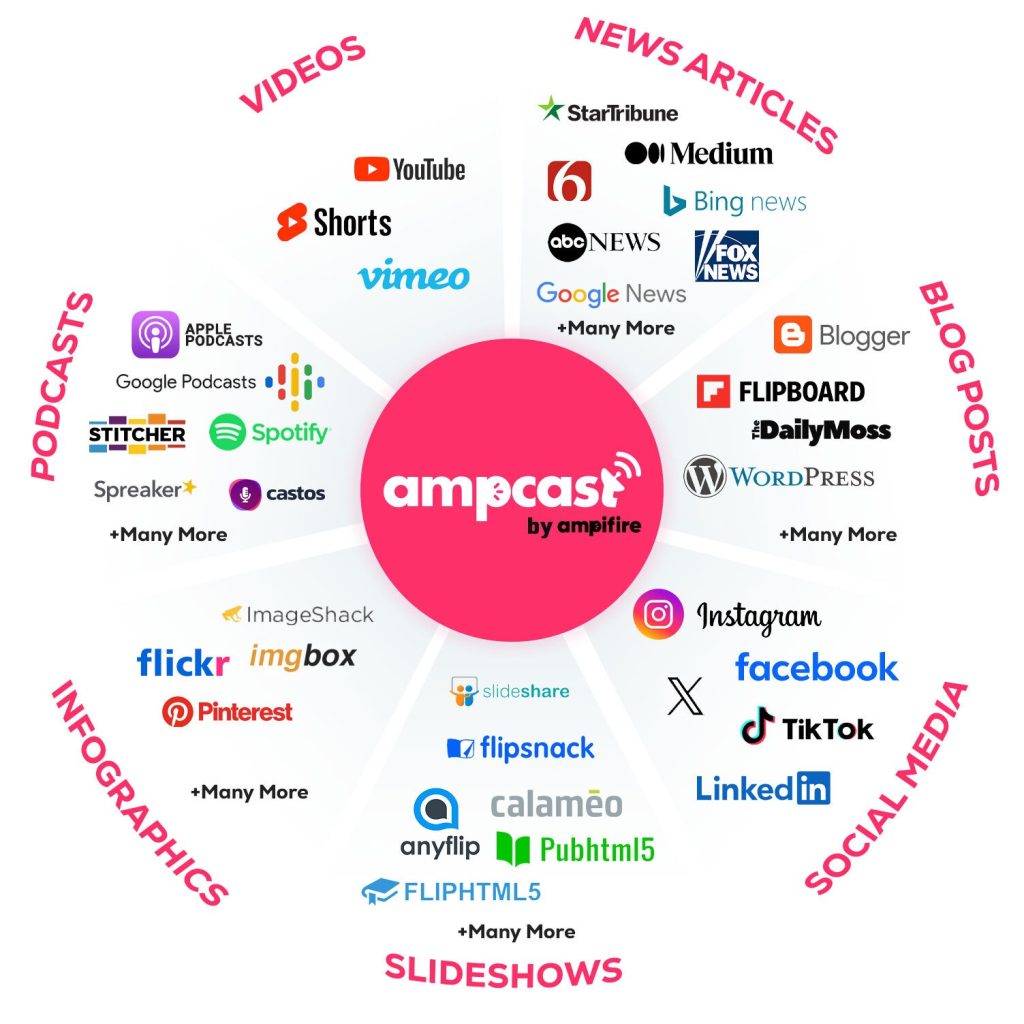
High-quality content requires a dedicated distribution strategy to reach its full potential in a crowded market. Relying on organic reach alone often leaves valuable marketing assets unseen by the target audience. Efficiently scaling your visibility across multiple platforms enables your message to connect with prospective buyers directly where they spend their time.
AmpCast AI automates this process by transforming a single topic into eight distinct formats for immediate distribution. The platform publishes your brand across hundreds of high-authority sites to generate traffic and establish credibility. Start using AmpCast AI to simplify your marketing workflow and secure the reach your business deserves.
Frequently Asked Questions (FAQs)
What is content amplification in simple terms?
Content amplification means actively promoting your content across different channels to reach more people. Instead of just publishing and hoping for views, you strategically share content through paid ads, partnerships, email, and social media to get it in front of your target audience.
Why does organic reach keep declining on social platforms?
Social platforms now show organic posts to a small fraction of your followers, as low as 1%–2% on Facebook and around 3.5% on Instagram. These companies want businesses to pay for visibility. With millions of posts published daily, algorithms prioritize paid content and posts with high engagement over regular business updates.
How much of my marketing budget should go toward amplification?
A common industry guideline is to invest at least as much in promoting content as you spend creating it. Starting with a dedicated amplification budget, even a modest one, is better than relying entirely on organic reach. What matters is matching your investment to each content piece’s potential value rather than spreading money thin across everything you publish.
Can small businesses benefit from content amplification?
Absolutely. Small businesses often see bigger relative gains because they start with limited organic reach. Focus your amplification budget on your best content pieces rather than promoting everything. Strategic targeting helps smaller budgets compete effectively with larger competitors.
How does AmpiFire’s AmpCast technology simplify content amplification?
AmpCast AI takes a single topic and automatically creates eight content formats. It then publishes everything to 300+ sites, including YouTube, Spotify, Google News, and Pinterest. This eliminates hours of manual content creation and distribution work every week.
*Disclaimer: Results may vary based on individual circumstances, business type, and content strategy. The time savings and outcomes mentioned are based on typical user experiences and are not guaranteed. For specific pricing and service details, please visit AmpiFire.
Author
Related Posts


What are the Best Content Amplification Tools [Free & Paid]
Find the best free and paid content amplification tools to expand your reach. Learn how to choose the right platforms…

How to Measure Content Amplification Strategy & Key Metrics to Track
Learn how to measure content amplification across 300+ platforms. Track the key metrics that drive organic traffic, prove business ROI,…


What Exactly Is A Press Inquiry? And Why Are They Important For Your Business?
Are you familiar with using press inquiries for your business? Read about how they work and why they're essential, here.

Content Amplification User Guide: 10 Tips On How To Get The Most From Your AmpiFire Experience
We recently interviewed Julian Thornton, who has been using AmpiFire for years. And he has learned a lot along the…

How Does AI in Content Distribution Work: Strategies & Best Practices
Discover how AI transforms content distribution. Learn strategies that increase reach with AmpiFire's intelligent automation.

Repurpose Video Content Into AI Blog Posts, Social Media & Multiple Formats
Learn how to repurpose long videos across LinkedIn, blogs, Twitter (X), Facebook, TikTok, Reels, and YouTube using AI to maximize…