Quick Summary
Stacey runs an online store selling children’s sensory and educational play products to schools, daycares, and pediatric waiting rooms. She is a dropshipper, 20 years in business, working part-time around a full-time job, a few hours a day.
She cannot outspend LEGO or Fisher-Price. So instead of buying ads, she went after the moment before the sale: the research a buyer does before deciding. The plan was to be the most helpful answer they find, the guide, the comparison, the video they watch before they buy.
She started with one AmpCast post a month. One topic, turned into eight kinds of content, published across 300+ platforms inside a 1,000+ site network. As the results came in, she worked up to two to three posts a week. Still part-time. Still a few hours of writing.
The point of this case study is simple: even on a small budget and a low posting volume, the impact compounds. In ten months she built video, podcast, Pinterest, and AI-search presence from zero, lifted her site traffic, and now gets cited by AI engines beside brands many times her size. Here is what that produced.
On a few posts a week and $0 ad spend, a one-person store followed one of its best years in two decades with a year on track to cross $1M, and now gets cited by AI beside brands many times its size.
Revenue: the headline metric
| Year | Annual revenue |
|---|---|
| 2024 (estimated, pre-AmpCast) | ~$610,000 |
| 2025 (actual) | $730,000 |
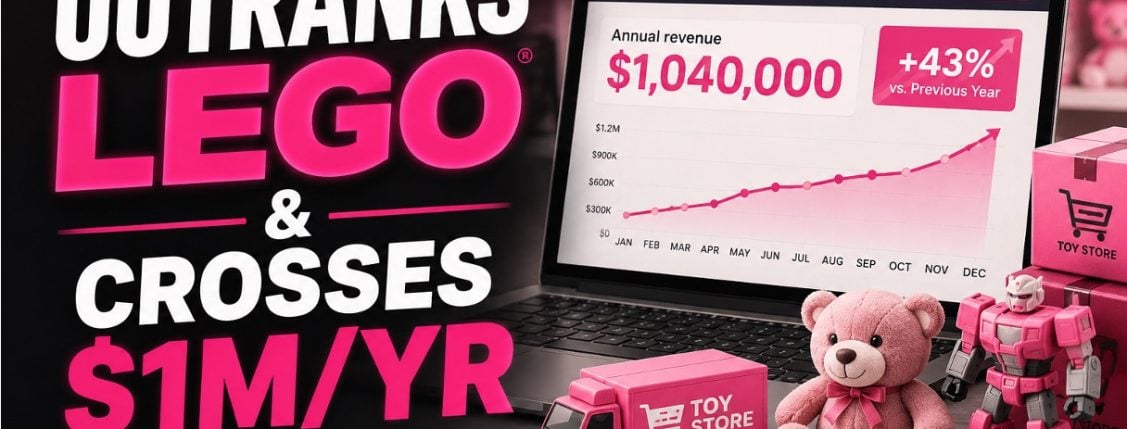
| 2026 (annualized from Q1 and Q2, up 43%) | ~$1,040,000 |
| 2027 (projected) | ~$1,300,000 |
2025 is her reported figure. 2026 is annualized from her Q1 and Q2 results at the time of publishing, which are running 43% ahead of last year. 2024 estimates the pre-AmpCast year, and 2027 projects the same trend forward. The jump began in the second half of 2025, after she started AmpCast.
Channels she already had: before AmpCast, then now
| Channel | Before AmpCast (Aug 2025) | Now |
|---|---|---|
| Monthly website visits | ~14,000 | 18,000 (+28%) |
| Search queries she ranks for | ~15,300 | 19,600 (+28%) |
Channels she built from zero in ten months
| Channel | Before | Now |
|---|---|---|
| AI search citations (across 7 engines) | 0 | ~947 |
| YouTube (total views) | did not exist | 129,342 |
| Pinterest impressions (90 days) | did not exist | 638,000 |
Her starting point in August 2025 against her current readings. The new channels began from zero.
Stacey vs LEGO and Fisher-Price
Her competitors have marketing teams. She has an organized schedule and AmpCast.
She shares the market with brands everyone knows, from LEGO to Fisher-Price. Companies with billions in revenue and big marketing departments that can put a famous athlete in a video ad. Outspending them was never an option.
She runs the store in the after-hours of her day job, so she focused on something budget cannot buy: becoming the most helpful result when buyers research what to buy.
Before a school or a dental office purchases play equipment, they search. They compare options, read guides, watch videos, and increasingly, they ask AI. The brand that keeps showing up with useful answers during that research tends to win the sale, and showing up there is earned with content, not bought with ad spend.
Her bet was that she could become that helpful, ever-present answer on a handful of AmpCast posts a month. The timeline below shows what happened.
AUGUST 2025: THE STARTING LINE
In August she published her first AmpCast post. She started at one a month, which is all her schedule allowed, and built up from there as the results came in.
Each post is called an AMP. She brought the idea, and AmpCast built it out into a full article and eight formats: social posts, Pinterest pins, a podcast episode, Reels, and longer videos. She scheduled them to go out across the month, so her channels stayed active every day without more work from her.
Before this, her blog brought in almost no traffic, her YouTube channel was effectively empty, and she had no podcast at all. Her content channels started from close to zero.
“I am a one person website, doing it part time while working a full time job and other things, so my time is very limited but consistent. I work on the articles on the first of the month, then I schedule staggered posts on social media, Pinterest, etc. for the rest of the month. So there is always something being posted daily.”
EARLY FALL 2025: 6,100 ORGANIC VISITS A MONTH AND HER FIRST AI REFERRALS (TWO MONTHS IN)
Two months in, the early signals showed up. By late August, Google organic traffic was running about 6,100 visits a month and rising (GA4, Google-organic only). Direct and Bing traffic were up. Her new podcast had reached 117 downloads from a standing start, and ChatGPT had started referring visitors to her site, a traffic source she had never had before.
“Thank you, everyone! I am now getting a good number of chatgpt referrals to my site now, thanks to all of Chris’s excellent trainings! New way to look at SEO and I am hoping this keeps me above my competitors. All of these add up to more traffic and sales to my site.”
She paused for two weeks in September for a vacation, then got back to it. Still only about one AMP a month at this stage.
JANUARY 2026: A $730,000 YEAR, ONE OF HER BEST IN TWO DECADES (SIX MONTHS IN)
By the new year, the content was compounding. Her blog had grown from nothing since August. Referring domains had roughly doubled over the year, and backlinks had climbed from around 800 to over 1,700 (Ahrefs), both signals that search engines were treating her site as more credible.
YouTube, non-existent before AmpCast, had reached 3,921 views by the end of 2025 (Aug to Dec, YouTube Studio).
The revenue is what made the year stand out. She reported about $730,000 in gross sales for 2025, one of her top three years in two decades of running the business. She also landed a single $11,000 order from a luxury villa interior design company in Abu Dhabi, buying her products for a project overseas.
“My niche is very small but still seeing traffic grow. My gross sales is around 730k for this year, which is in the top 3 years of starting my business 20 years ago, working only a few hours a day on it. I have a day job too.”
“I finished the year with a 11k order from a luxury villa interior design company in Abu Dhabi! Never thought I would work with companies from other countries. I believe they found me with some of my AMPS! I am a dropshipper, they are handling all the logistics. Maybe a new steady lead for future orders.”
MARCH 2026: 123,000 VIDEO VIEWS IN 90 DAYS (EIGHT MONTHS IN)
Around the eight-month mark, the videos that had been quietly building started to break out. Her YouTube channel pulled 123,091 views in a single 90-day stretch, a level it had never come close to before.
Pinterest told the same story. Her boards drew 638,000 impressions and 21,800 engagements over 90 days, sending around 1,500 clicks back to her site, all from the same AMP content repurposed into pins and infographics.
In Google search, her own pages and her AMP-distributed content (syndicated to outlets like Business Insider, Medium, and PodScripts) were filling multiple positions on page one for her buyer keywords, things like LEGO tables for a dentist office and sensory dividers for a classroom. One topic, published as eight formats, was showing up again and again in the same results.
JUNE 2026: 18,000 VISITS, 19,600 KEYWORDS, CITED BY AI (TEN MONTHS IN)
Ten months in, her own traffic tool reads 18,000 visits a month (SEO Quake, total visits), up from 5,900 on the same tool six months earlier, with 82.9% of it coming from search. (SEO Quake counts total visits, so its 5,900 reading is not the same measure as the 6,100 Google-organic figure from GA4 earlier in the story.) She now ranks for 19,600 organic keywords, more than a thousand of them added in the most recent month.
“AMPs are really working! About 6 months ago, Chris showed us SEO Quake in one of his trainings and I installed it and ran it. I wish I took a screenshot of it then, as it was only at 5.9k. Today, I looked and WOW!”
YouTube tells the same story. The channel did not exist before AmpCast. By June 2026 it had pulled 129,342 total views, with one early video on sensory mirror play alone reaching 68,000.
Now Her Brand Gets Recommended by AI
The most striking shift is in AI search. Her store now picks up 947 citations across 7 AI engines, the answers that Grok, Google AI Mode, Google AI Overviews, ChatGPT, Perplexity, Copilot, and Gemini generate when someone asks a buying question. Every one of those started from zero before she began publishing.
For a one-person store, that is a kind of visibility money cannot easily buy. When a school or a dental office asks an AI what to buy, her brand is in the answer, sitting beside companies many times her size.
On at least one high-intent buyer search, her brand leads the Google AI Overview answer outright, cited several times in a single response and listed beside toy and educational brands many times her size.
Across the major engines, the spread looks like this:
| AI engine | Citations |
|---|---|
| Grok | 363 |
| Google AI Mode | 190 |
| Google AI Overviews | 126 |
| ChatGPT | 111 |
| Perplexity | 87 |
| Copilot | 60 |
| Gemini | 10 |
| Total | 947 |
AI search citations by engine, June 2026. Total 947, from zero before she began publishing.
She is seeing this show up in sales. On June 10, 2026, ten months after her first post, she summed it up:
“AMPing 2 to 3 times a week since August. Revenue is up 43% from last year. Presence in channels I never thought I’d be in, a one-person ecomm store.”
She has been publishing since August 2025. Her 2026 revenue is up 43% over 2025, on a one-person store.
Turn One Topic Into Content That Follows Buyers Everywhere
This is what made the whole thing manageable for one person. Most content tools take one blog post and re-share it across social media, with the same words and slightly different captions. AmpCast takes a single topic and builds it into eight separate content formats, each made for the platform it runs on.
From one article, AmpCast produces a news article, a blog post, an interview-style podcast, a longer informational video, an infographic, a flipbook or slideshow, social posts, and short-form Reels. Those formats then publish out to 300+ platforms, including Google News, YouTube, Spotify, Apple Podcasts, and the major social channels.
A big brand pays a writer, a video editor, a podcast producer, a designer, and a distribution team to cover that much ground. She got the same spread of content from one day of writing a month.
Win the Research Phase Before Buyers Ever Pick a Brand
She could not outspend the big brands, so she went after the moment they overlook: the research a buyer does before they decide. The play came down to three steps.
- Find the real buyer questions. The specific things a school director, a daycare owner, or a pediatric office manager actually types in before they buy. Water tables versus sand tables. What to put in a dental waiting room. Sensory dividers for a classroom.
- Answer them better than anyone else. Each topic became a genuinely useful piece: a comparison, a buying guide, a how-to that helps the buyer decide, and that earns their trust in the store behind it.
- Put that answer everywhere they look. One topic, published as eight formats across 300+ platforms, so the same helpful answer is there whether the buyer searches Google, watches a video, listens to a podcast, or asks an AI.
Publish a Little, Compound a Lot
The reason this works is the shape of the growth. Each month of content keeps bringing in visitors after it is published, so new articles add to the old ones instead of replacing them. Paid ads run the other way: the traffic only lasts as long as the spend.
That is what consistent, distributed publishing can do over time. It starts slow, but for a small business competing against big brands, it builds an advantage that is hard for a larger ad budget to buy past.
“If I didn’t find AMPCAST, I would not be where I am today, growing my brand. Just want to say thank you, and can’t wait to see what 2026 brings. Back to blogging!”
Poach Market Share From Brands That Outspend You
Her story points to one strategy: when a competitor can outspend you many times over, you stop fighting them on ad budget and you intercept the customer earlier, during the research they do before they buy. That is where a small player can win, and it is where she won.
Before a school or a dental office spends on play equipment, they search, compare, read guides, watch videos, and increasingly, they ask AI. The brand that shows up with the most useful answers during that research earns the recommendation. A larger ad budget does not control that stage. Consistent, well-distributed content does.
The Multiplier: One Topic, Working Across Every Channel
AmpCast does not replace advertising. It makes every other channel work harder. One topic becomes eight formats, published across 300+ platforms including Google News, YouTube, Spotify, Apple Podcasts, and the major social networks. That is how her brand ended up present in Google search, in AI answers, on YouTube, and on Pinterest at the same time, all from content she could turn around in a day a month.
When a buyer sees a brand in several places while researching, trust builds. When that buyer later runs into any of her channels, or even a competitor’s ad that sends them searching, her content is already there to answer the question and win the click.
“Competitors can match your ad spend in a day. Building content is more like laying a foundation brick by brick, and they cannot pay to skip the years of work it takes to catch up.”
Why This Advantage Holds Up Over Time
Paid advertising rewards the biggest budget. Content rewards the most consistent publisher. You cannot buy search authority or an established presence across AI, video, and podcasts overnight. It builds slowly, which is exactly what makes it hard for a better-funded competitor to copy.
After a year or more of steady publishing, a rival cannot simply throw money at the gap and close it. The lead compounds. Her own numbers show the shape of it: traffic that climbed for ten straight months and is still climbing, content from last year still bringing in buyers today.
Why the Model Is More Profitable Long Term
Multichannel content gives a business advantages that paid ads alone cannot:
- Traffic stays steadier, while paid traffic stops the moment the budget does.
- Organic traffic typically carries far higher margins than paid, which often runs near break-even in competitive markets.
- Strong content lifts the paid campaigns you do run, because buyers who research and find you convert better.
- Several traffic sources reduce the risk of depending on any single channel.
- Showing up in more places raises both traffic and conversion, through higher trust and visibility.
- Steadier traffic, stronger brand, and better margins make the business itself worth more.
Could Your Business Do the Same?
The approach scales. A solo store, a mid-size company, or a large brand can all run it, because it rewards consistency over budget. It works best when you sell a quality product that buyers research first, you face bigger competitors, and you want visibility that compounds rather than disappearing when you stop paying. It is a slower fit if you need results inside a single month, since organic growth takes time to build before it pays off.
There are two ways to start:
- Run it yourself with AmpCast. Create and distribute the content on your own schedule, the way the owner in this case study did. [Get started with AmpCast →]
- Let us run it for you. Hand it to the AmpiFire Agency as a done-for-you service, with strategy, production, and distribution handled end to end. [Apply for Done-For-You content]
Either way, the lesson from her ten months stays the same: start, stay consistent, and let the content compound.
Author
-
CEO and Co-Founder at AmpiFire. Book a call with the team by clicking the link below.
Related Posts
FavSEO Features & Pricing: Is It The Best Website Optimization App for Ecommerce Store?
Learn how FavSEO helps e-commerce stores rank higher. Pricing, features, and performance insights in one detailed review.

Online Medical Store Generates Millions in Sales From Just 113 Pieces of Content in Less Than 12 Months
Shopify Store in Multi-Billion Dollar Market Had No Search Traffic When Julian Thornton, started working with the client, there were…

17 BigCommerce Apps & Shopping Plugins for Unprecedented Online Store Growth
Boost your BigCommerce store's success with 17 powerful tools for SEO, multi-channel selling, fraud protection, product reviews, personalized recommendations, marketing…

7 Ecwid Facebook Store Examples: Real-Life Implementations to Ignite Your Creativity
Explore real-life examples of successful Ecwid Facebook store implementations and gain valuable insights into creating a seamless shopping experience, leveraging…

Ecom Store CRO Checklist: Proven Techniques & Best Practices
Get more sales with our ecom store CRO checklist: find proven techniques for optimizing your website, product pages & omnichannel…

How to Boost Your eCommerce Brand Exposure: 7 Strategies for Building & Marketing a Successful Online Store [Examples]
When it comes to building a successful eCommerce brand, visibility is key. Whether you sell premium goods or are simply…